

By Jag Mohan Thaken, Senior Journalist, Columnist & Political Analyst
30 April 2026, New Delhi: India and New Zealand signed a Free Trade Agreement (FTA) on April 27, 2026. While the governments of both countries have welcomed the move, Indian farmers' unions have raised concerns.
Why is that so?
Indian Prime Minister Narendra Modi, in a tweet, termed the FTA signing ceremony a landmark moment in the India-New Zealand partnership.
"Today marks a landmark moment in the India-New Zealand partnership!
I am delighted that the India-New Zealand FTA signed today will add unprecedented momentum to our developmental partnership. It reflects the deep trust, shared values, and ambition that bind our two nations.
This agreement will greatly benefit our farmers, youth, women, MSMEs, artisans, startups, students, and innovators. It will open new avenues for growth, create opportunities, and deepen our synergy across sectors.
The investment commitment of $20 billion by New Zealand will further strengthen our cooperation in agriculture, manufacturing, innovation, and technology, paving the way for a more prosperous and dynamic future for both countries."
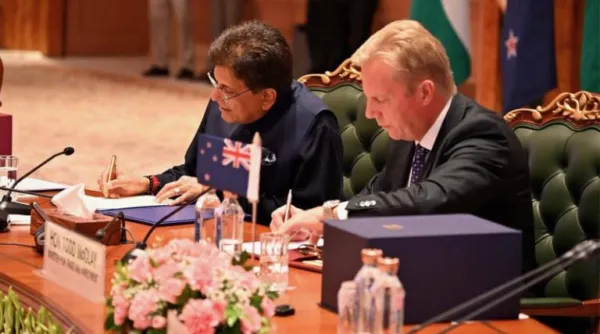
Union Minister of Commerce and Industry Piyush Goyal and New Zealand's Minister for Trade and Investment, Hon. Todd McClay, signed the landmark India-New Zealand Free Trade Agreement.
New Zealand's Minister Todd McClay said that the India-New Zealand FTA opens "once-in-a-generation" opportunities and marks a new chapter in bilateral ties.
The signing of the agreement reflects shared ambition, deepening engagement, and a commitment to mutually beneficial growth, said Mr. McClay.
He described the FTA as a "once-in-a-generation" opportunity that will boost exports, create jobs, and strengthen bilateral economic ties. He highlighted strong participation from New Zealand businesses and noted that the pact will improve market access, reduce trade barriers, and support MSMEs. He also emphasised strong people-to-people connections, including the Indian diaspora's contribution in New Zealand, along with longstanding cultural and sporting ties. Describing India as a key partner in a changing global landscape, he expressed confidence that the agreement will deepen cooperation and deliver shared prosperity.
Indian Minister Piyush Goyal said, "A new-generation trade deal for Viksit Bharat @2047, encompassing tariffs, talent, investment, and farm productivity, empowering youth, farmers, women, artisans, and MSMEs."
He further stated that the agreement was concluded in nine months and marks a key milestone in India's engagement with developed economies, aligned with the vision of Viksit Bharat 2047. He noted that India is signing its seventh FTA in the last three and a half years, with plans for agreements with the European Union and the United States, taking the total to nine FTAs with 38 advanced economies, covering nearly 65-70% of global GDP. He also highlighted expected investment inflows of US$20 billion and said New Zealand has opened access in 118 sectors, with MFN commitments in 139 sectors.
A PIB press release following the signing stated that farms, fisheries, and factories will benefit, with zero-duty market access on 100% of India's exports. India has offered market access in 70% of tariff lines, covering 95% of New Zealand's bilateral trade, along with a commitment of USD 20 billion investment to fuel agriculture, manufacturing, infrastructure, startups, innovation, and emerging technologies.
The release also clarified that to protect farmers, rural economies, and domestic industries, market access excludes dairy and key agricultural products such as coffee, milk, cream, cheese, yoghurt, whey, casein, onions, sugar, spices, edible oils, and rubber.
The FTA, while being projected as farmer-friendly, also highlights agricultural productivity partnerships and Centres of Excellence for apples, kiwifruit, and Manuka honey to improve productivity, farmer incomes, and knowledge transfer.
The FTA eliminates duties on 100% of Indian exports. A USD 20 billion investment commitment over 15 years strengthens long-term economic and strategic cooperation.
Through agricultural productivity partnerships, the FTA aims to collaborate with farmers to boost productivity and integrate them into global value chains.
India has offered market access in 70.03% of tariff lines while keeping 29.97% in exclusion, covering 95% of New Zealand's bilateral trade.
Certain products are excluded, such as dairy (milk, cream, whey, yoghurt, cheese, etc.), animal products (other than sheep meat), vegetable products (onions, chana, peas, corn, almonds, etc.), sugar, artificial honey, fats and oils, arms and ammunition, gems and jewellery, copper and its articles, and aluminium products, among others.
30% of tariff lines will see immediate duty elimination, covering wood, wool, sheep meat, leather, and raw hides. 35.60% of tariffs will be phased out over 3, 5, 7, and 10 years, including petroleum oils, malt extract, vegetable oils, and selected machinery. 4.37% of products will face tariff reductions, including wine, pharmaceuticals, polymers, aluminium, and iron and steel articles. 0.06% fall under tariff rate quotas, including Manuka honey, apples, kiwifruit, and albumins.
The All India Kisan Sabha (AIKS) has criticised the FTA and demanded its scrapping, calling it an onslaught on Indian agriculture. The organisation alleges that by signing the agreement, the government has compromised farmers' interests in favour of global finance.
In a press release dated April 29, AIKS stated that the agreement continues a trend of what it calls "disastrous FTAs." It argued that Indian farmers are already facing an agrarian crisis, worsened by rising fertiliser costs due to global geopolitical tensions.
The statement issued by AIKS President Ashok Dhawale and General Secretary Vijoo Krishnan claims that tariffs on nearly half of New Zealand's exports to India would be eliminated immediately, with nearly 80% becoming tariff-free over time. They argue that despite claims of protecting sensitive sectors, there are loopholes in the agreement.
AIKS also alleges that the FTA significantly reduces customs duty on New Zealand apples, which could make them cheaper and adversely affect the livelihoods of around 1.75 lakh Indian apple-growing families. Since New Zealand farmers receive higher subsidies, Indian farmers may struggle to compete.
Similarly, while the government states that core dairy products are excluded, AIKS points out that certain high-value dairy products, such as bulk infant formula, may see duty reductions. This, they argue, could benefit large New Zealand dairy companies while harming Indian dairy farmers, many of whom are small and marginal producers with limited state support.
The organisation also raised concerns about a fast-track mechanism for duty-free imports for further manufacturing and export, which it believes could favour corporate players.
While the government maintains that the agreement will benefit farmers and has protected sensitive sectors, the farmers' union argues that structural vulnerabilities remain.
Dr. Inderjeet Singh, National Vice-President of AIKS, said, "The dairy sector is very vulnerable, regardless of the government's claims. Indian dairy farmers have very high stakes if FTAs with developed countries come into operation."
The government of India should take farmers into confidence and address their concerns to ensure that their interests are protected without any ambiguity.
Global Agriculture is an independent international media platform covering agri-business, policy, technology, and sustainability. For editorial collaborations, thought leadership, and strategic communications, write to [email protected]
In the first quarter of the year, sales of tractors (+2.7%), combine harvesters (+65%) and telescopic handlers (+46%) rose, whilst
05 May 2026, Brazil: Fertilizer and energy prices have spiked due to the closure of the Strait of Hormuz, putting pressure
29 April 2026, New Delhi: The National Bank for Agriculture and Rural Development (NABARD) has acquired equity stake in 24×7 Moneyworks