
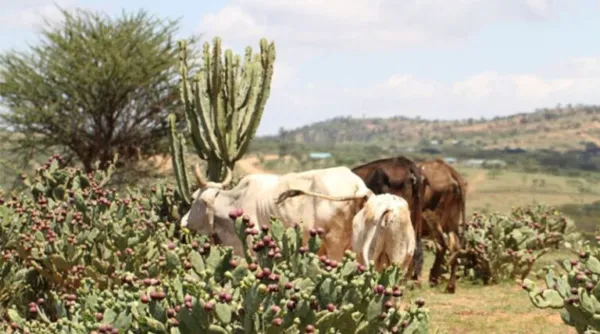

21 March 2026, Africa: CABI-led research published in the journal Biological Invasions suggests that the invasive prickly pear pest Opuntia stricta could cost sub-Saharan Africa USD 307 billion in lost livestock production over the next 50 years.
The authors argue that current costs associated with the "loss" of forage growing under and near O. stricta plants, which is inaccessible to livestock in Laikipia County, Kenya, and eastern Africa, are USD 8.4 million and USD 244.6 million, respectively, and stress that this plant negatively impacts livelihoods and biodiversity. They believe that O. stricta alone could reduce access to forage valued at more than USD 31, USD 18 and USD 26 billion in the absence of control over the next 50 years in Ethiopia, Kenya and Tanzania respectively.
Cacti have been introduced to many parts of the world for food, fodder, and ornamental purposes. But many of these have become invasive, also having a detrimental effect on human and animal health as well as pasture production.
When livestock eat cactus fruits, small spines on the fruits, called glochids, lodge in their mouths, throats, stomachs, and intestines. These spines often cause secondary infections, leading to ill health and death. Large spines on modified stems, called cladodes, can also harm livestock. They often pierce animals' eyes as they try to access grass growing under and around cactus plants.
However, the introduction of the biological control agent Dactylopius opuntiae 'stricta' biotype - a sap-sucking bug also known as 'dudu' in Swahili, has already reduced these potential impacts significantly in South Africa and Kenya.
Dr Arne Witt said, "The widespread use of biological control against O. stricta across Africa would go a long way to preventing the reduction of forage for livestock and wildlife estimated to be valued at a conservative USD 307 billion over the next 50 years.
"The cost of preventing this loss would be minuscule in comparison. Firstly, because an effective biological control agent has already been identified, screened, and found to be safe and effective, and secondly, the agent is likely to spread naturally from release sites in South Africa and Kenya at no real cost to neighbouring countries."
He added that introducing the cochineal to countries or regions with isolated Opuntia stricta invasions may be the only cost, as the agent is unlikely to reach these areas through natural dispersal.
Dr Witt said, "The challenge is that those who will benefit from control often lack the financial resources to introduce, rear, release, and disseminate the cochineal. This situation highlights the need for governments, international development partners, and environmental agencies to fund such projects for significant livelihood and environmental benefits."
India Issues Draft Rules for Amendment to Its Insecticides Rules, 1971
Global Agriculture is an independent international media platform covering agri-business, policy, technology, and sustainability. For editorial collaborations, thought leadership, and strategic communications, write to [email protected]
02 April 2026, Uganda: New Holland is proud to highlight the extraordinary impact that the donation of a TT model tractor
Opinion piece by Dr Himanshu Pathak, Director General of the International Crops Research Institute for the Semi-Arid Tropics 01 April
02 April 2026, Bhubaneswar: Aquapulse has raised INR 25 crore in an ongoing Series A funding round led by NABVENTURES Ltd through the AgriSURE