

Guest Author: Christian Pereira, Agribusiness Strategist at Bizup Strategy, specializing in growth strategies and M&A.
30 March 2026, São Paulo : How many biologicals companies do you know that have genuinely differentiated products and still end up competing on price?
Many of them.
That is the most honest diagnosis of the sector today. And nowhere is it more visible than in Brazil, which happens to be the world's most advanced real-world laboratory for agricultural biologicals at scale.
Brazil is not a niche market. It is the proving ground.
The country represents over 11% of global bioinputs consumption, according to data from Brazil's National Association for the Promotion and Innovation of the Biologicals Industry (ANPII Bio), and has been growing biologicals adoption in row crops like soy, corn, cotton for over a decade, at a pace four times faster than the global average as per CropLife Brasil's latest market figures. What is happening there now tends to play out in other emerging agricultural markets five to seven years later.
So when a recent market study showed that treated area in Brazil is projected to grow 78% by 2030 while industry revenue grows only 46% - more applications, less revenue per dose - it was not a local anomaly.
It was a structural warning for the entire sector. More acres, More competition, Less margin. And the problem is not in the laboratory.
It is tempting to imagine the biologicals sector as a level playing field where always innovation wins. The reality is more uncomfortable.
A handful of companies have built genuine differentiation: proprietary technology, proven multi-season efficacy, real barriers to replication. But they compete on a market crowded with near-identical products - different labels, same active ingredients, interchangeable positioning, all claiming equivalent performance.
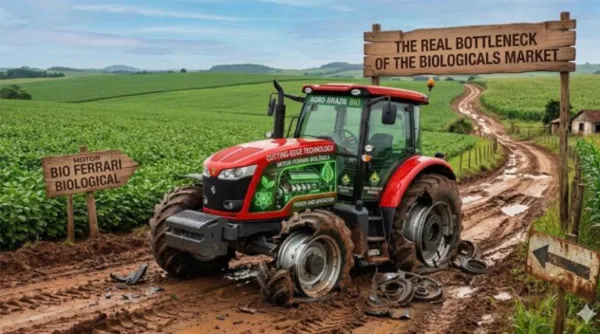
When the grower cannot clearly tell a Ferrari from a garage build, the decision defaults to the only variable that is always legible: price. And in a price war, the Ferrari loses because it carries R&D costs the generic competitor will never have.
Differentiation and value-based selling have become the defining strategic challenge for serious biologicals players globally.
But here is what most miss: differentiation does not live only in the product. It has to be built, communicated, and delivered by a commercial organization capable of sustaining it - season after season, at the farm gate, in the language the grower actually speaks. Most companies are nowhere near that.
The gap I see most consistently across markets, company sizes, and ownership structures is not in R&D. It is in commercial execution.
Specifically, four recurring failures:
The result is predictable. Companies with genuinely superior products compete in terrain that is not theirs - the terrain of the lowest price.
There is one investment the sector systematically undervalues: the field technical professional who creates demand rather than just supporting it.
Not the agronomist who presents PowerPoints in the farm office.
The professional who can design the right application protocol for a specific crop system and then translate that protocol into an economic outcome the grower can see clearly: yield gain per hectare, input cost offset, risk reduction over the season. This person does not wait for demand to appear. They build it.
A biological product that arrives without credible technical support generates uncertainty. Uncertainty kills premium pricing before the conversation even starts.
The last mile between the lab and the field is not covered with a technical argument. It is covered with trust built across seasons - by someone with boots on the ground and results to show.
This is where channel battles are actually decided. Not in the product specification. In the recommendation of someone the grower trusts, when pest pressure is rising and the application window is closing.
Many biologicals companies, particularly those with chemical heritage, or those recently acquired by chemical multinationals run the same commercial model they have always used: territory reps, product visits, volume discounts, transactional close.
It does not work for biologicals.
Selling a biological product is far closer to selling premium seed than to selling a fungicide. It requires a long sales cycle, a consultative approach, expectation management, post-application follow-up, and confidence built across multiple seasons - not a single visit.
The grower is not buying a liter of biological product. They are buying a probability of outcome.
Those who learn to sell that narrative capture premium. Those who don't become a line on a procurement spreadsheet, competing entirely on price against products that cost a fraction of what theirs costs to develop.
Underneath all of this is something rarely discussed in industry conferences: sales culture.
Not sales training. Not incentive programs. The invisible operating system that defines how the entire organization - R&D, Marketing, Sales - relates to the moment a grower makes a buying decision.
Where this culture exists, the three functions work as an integrated system:
- R&D translates agronomic efficacy into the ROI language the salesperson needs in the field
- Marketing validates positioning with the people who actually buy - not with those who approve the internal brief
- Sales brings field intelligence that feeds back into product development and communication
Where this culture is absent, each function optimizes its own metrics in isolation and the company with the best product routinely loses to the competitor with the better commercial execution.
Commercial culture without process is chaos. Process without commercial culture is bureaucracy. The biologicals sector needs both and leadership with the courage to build them together.
The biologicals market will continue to grow. The fundamentals are real.
But growth in a market does not guarantee profitability for every participant. As the Brazilian data illustrates with unusual clarity: area grows 78%, revenue grows 46%. That spread is not a rounding error. It is the structural cost of scaling volume without scaling commercial differentiation at the same pace.
Consolidation is already underway in Brazil and it will follow in every market where biologicals have scaled fast and barriers to entry have remained low.
When the major chemical multinationals eventually enter this space with full commercial force using distribution networks already in place and grower relationships already built, the companies that survive will not be those with the most innovative pipeline.
They will be the ones that learned, earlier than their competitors, that the battle is won in the last mile.
Do you have a field technical team that builds demand and not just delivers information? A commercial process that scales beyond your best individual contributor? A culture where R&D, Marketing, and Sales operate as a system?
If the answer is not immediate and clear, the engine may be ready. The wheels may not be.
MIT-WPU Researchers Develop AI Models to Boost Oil Recovery Amid Global Energy Volatility
Global Agriculture is an independent international media platform covering agri-business, policy, technology, and sustainability. For editorial collaborations, thought leadership, and strategic communications, write to [email protected]
09 April 2026, Mumbai: Leading tractor manufacturers, including Mahindra Tractors and Swaraj Tractors, have announced price increases across their domestic tractor ranges in April
10 April 2026, UK : Joe Howe and Will Brundle have gained well-deserved promotions this year, taking on area sales manager
10 April 2026, Belgium: The Gates Foundation has awarded a $7 million grant to Rainbow Crops to support the development of crop varieties that can