

28 March 2026, AU: Sorghum research is being strengthened under a new 7-year alliance that combines practical farming systems work with longer-term genetics.
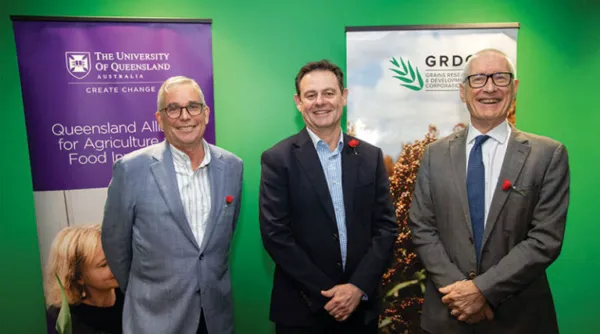
Announced in November 2025, the Sorghum Strategic Alliance is a partnership between GRDC and the University of Queensland (UQ). It represents GRDC's largest collaborative commitment to sorghum research to date and is intended to lift productivity and profitability for northern growers.
An initial $13 million GRDC investment underpins the alliance, alongside co-investment from UQ's Queensland Alliance for Agriculture and Food Innovation (QAAFI).
GRDC General Manager Applied Research, Development and Extension Craig Baillie says the alliance marks a step change in how sorghum research is to be delivered.
GRDC has invested in sorghum research for quite some time, but the Sorghum Strategic Alliance is an opportunity to bring a number of threads into a larger program of work, with the idea of making that more impactful.
Mr Baillie says the long-term nature of the program is key.
"Building out a longer program of work gives a bit of a runway to achieve some of the outcomes that we would be challenged by if it was a shorter program."
The alliance will include research into 4 initial foundational areas, including:
- boosting yield potential through advanced genetics and breeding
- optimising grain filling duration to deliver larger, more consistent sorghum grain in variable climates
- developing larger grain with increased and more digestible protein
- improving sorghum yields through targeted agronomic research.
"We have identified key areas where we know there is really good value for growers, which allows us to build on that foundation in a more collaborative way and co-design future work, rather than GRDC going to market to stand up individual investments," Mr Baillie says.
With research and development being a centrepiece of the alliance, he says there will also be a firm focus on extension.
"A key part of all our investments is to build extension and adoption. We're keen to make good investments around ideas that we extract from industry, but then also be able to translate that and focus on the impact."
The alliance is evenly split between upstream and downstream research.
Upstream work focuses on fundamental genetic technologies that will drive longer-term improvements in sorghum varieties, while downstream research targets agronomy and farming systems to help growers capture more value from current genetics and management practices.
Together, the program is designed to balance longer-term genetic advancement with practical on-farm gains, spanning the full research pathway from laboratory and glasshouse through to field trials and commercial-scale application.
"It's a balanced program between upstream research and downstream farming systems agronomic work to realise the potential that's already out there," Mr Baillie says.
He says there will be opportunities at for grower input on the direction of the project at GRDC National Grower Network (NGN) Forums.
"Where farmers have ideas, issues and problems they'd like to provide to GRDC, that's an opportunity to bring these into the fray, some of which could be explored through the alliance as well."
This upstream and downstream work will be underpinned by UQ's decades of expertise in sorghum breeding. More than 90% of commercial grain sorghum hybrids grown in the country contain genetics developed by UQ and the Department of Primary Industries (DPI).
The alliance will draw on UQ's expertise in genetics, predictive breeding and gene editing to develop the next generation of sorghum varieties. The focus is on improving resilience, productivity and quality, targeting traits such as heat, drought and cold tolerance, protein content and quality, biomass production and digestibility.
UQ Professor Matthew Morell says the partnership will allow the university to continue delivering practical, on-farm solutions for Australian agriculture.
The biggest provider of sorghum research in Australia by far is UQ, so a strategic alliance building on UQ's partnership with DPI is an excellent outcome.
"We have some of the world's most outstanding quantitative plant breeders and the Sorghum Strategic Alliance will allow us to bring on some early or mid-career researchers in crop genomics, agronomy and farming systems to further strengthen our international standing in plant breeding."
The alliance is in its startup phase to ground the work and kick off the research. A mid-term review will follow to ensure projects are delivering as expected and concluding with a benefit realisation phase.
Mr Baillie says multiple check-ins along the way will allow researchers and project managers to fine-tune projects.
"The alliance is a thought leadership piece around seeing where the industry can transition to and how we can extract value over the long term.
"We're trying to set up something that has long-term value to the industry, but in a way where the industry doesn't have to wait a long time to receive the benefits. The idea is to distribute benefits along the way, so there is a mix of early, middle and long-term delivery as a result of the program design."
MIT-WPU Researchers Develop AI Models to Boost Oil Recovery Amid Global Energy Volatility
Global Agriculture is an independent international media platform covering agri-business, policy, technology, and sustainability. For editorial collaborations, thought leadership, and strategic communications, write to [email protected]
30 March 2026, Basildon: CNH Industrial (NYSE: CNH) announced today that it has published its notice of the 2026 Annual General
30 March 2026, Nigeria: On a recent morning in Zamfara State in northwestern Nigeria, children lined up patiently at Danturai Primary
18 December 2025, Abidjan: The Board of Directors of the African Development Bank Group (https://AfDB.org) meeting in Abidjan today approved a €102.12