

12 March 2026, Illinois: Nitrogen fertilizers remain the backbone of global agricultural productivity, and among them urea is the most widely used nitrogen fertilizer in the world.
With a nitrogen content of about 46 percent, urea provides one of the most efficient ways to supply nitrogen to crops such as wheat, rice, maize, and many horticultural crops.
However, behind every tonne of urea lies a highly energy-intensive industrial process. The production of urea depends heavily on natural gas, which acts both as a chemical feedstock and as an energy source. In countries where domestic gas production is limited, Liquefied Natural Gas (LNG) becomes essential to sustain fertilizer manufacturing. This connection between natural gas and fertilizers means that global energy markets directly influence fertilizer availability, production costs, and ultimately food security.
Understanding why LNG is so important requires looking at how urea is produced and how natural gas is used at multiple stages of the process.
Urea production begins with the manufacture of ammonia, which is the fundamental building block of all nitrogen fertilizers. Ammonia is produced using hydrogen and nitrogen. While nitrogen is readily available from the air, hydrogen must be produced using an industrial process.
In modern fertilizer plants, hydrogen is primarily extracted from natural gas, which consists mainly of methane (CH₄).
The first stage of production involves steam methane reforming, where natural gas reacts with steam at very high temperatures, typically around 800-900°C.
This reaction produces hydrogen and carbon monoxide. The carbon monoxide is then converted into carbon dioxide through another reaction known as the water-gas shift reaction, which also generates additional hydrogen.
By the end of this stage, the plant has produced two critical components:
- Hydrogen, which will be used to produce ammonia
- Carbon dioxide, which will later be used to produce urea
This step demonstrates the unique role of natural gas. Unlike many other industrial fuels, natural gas does not simply provide heat; it also becomes part of the chemical structure of the fertilizer itself.
Once hydrogen is produced, it is combined with nitrogen extracted from air in the Haber-Bosch process, one of the most important industrial chemical processes ever developed.
In this stage, nitrogen and hydrogen react under extremely high pressure and temperature to form ammonia.
The reaction requires:
- Temperatures of around 450-500°C
- Pressures of 150-250 bar
The output is ammonia (NH₃), which serves as the base material for urea and several other nitrogen fertilizers.
Ammonia itself can be used as a fertilizer, but it is difficult to store and transport safely. Therefore, most ammonia is converted into urea, which is easier to handle and distribute globally.
The final stage of the process converts ammonia into urea using the carbon dioxide generated earlier in the plant.
First, ammonia and carbon dioxide react to form ammonium carbamate. This intermediate compound then decomposes into urea and water.
After purification and processing, the urea is converted into granules or prills, which are the solid forms commonly sold to farmers.
Because the plant generates both ammonia and carbon dioxide internally, modern urea plants operate as integrated chemical systems, where every component of the process is interconnected.
Natural gas has become the dominant feedstock for ammonia and urea production worldwide because it offers several advantages compared to other alternatives.
First, methane contains a high hydrogen content, making it efficient for hydrogen extraction. Second, natural gas burns relatively cleanly and allows for more efficient heat management inside fertilizer plants. Third, it enables integrated production systems that can recycle carbon dioxide within the plant.
As a result, natural gas now accounts for nearly 70 percent of global ammonia production feedstock.
In a typical ammonia plant, natural gas serves two main functions.
Approximately 70-80 percent of the gas is used as feedstock, meaning it becomes part of the chemical reaction that produces hydrogen. The remaining 20-30 percent is used as fuel to power the high-temperature reactions required for ammonia synthesis.
This dual role makes natural gas indispensable in fertilizer manufacturing.
Ammonia and urea production are among the most energy-intensive processes in the chemical industry.
On average, producing one tonne of ammonia requires roughly 28-33 million British thermal units (MMBtu) of natural gas. Since urea production depends on ammonia, the availability and price of natural gas directly determine fertilizer production costs.
For this reason, natural gas often accounts for 60-80 percent of the total cost of producing ammonia and urea.
This is why fertilizer plants are typically located in regions with abundant and inexpensive natural gas, such as the Middle East, the United States, and parts of Russia.
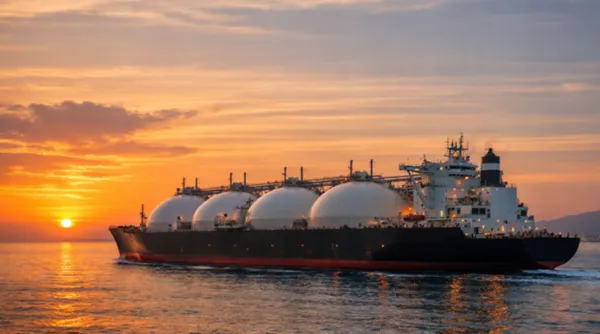
Many fertilizer-producing countries do not have sufficient domestic natural gas supplies. In such cases, Liquefied Natural Gas (LNG) plays a critical role.
LNG is natural gas that has been cooled to -162°C, converting it into a liquid form. This reduces its volume by about 600 times, allowing it to be transported by specialized ships across oceans.
Once the LNG arrives at import terminals, it is regasified and transported through pipelines to industrial users, including fertilizer plants.
Countries such as India, Japan, South Korea, and several European nations depend heavily on LNG imports to support fertilizer production and industrial energy needs.
Because natural gas represents the largest cost component in fertilizer manufacturing, fluctuations in LNG prices can significantly influence fertilizer markets.
When natural gas prices are low, fertilizer plants can operate at lower production costs. This typically leads to:
- Lower global fertilizer prices
- Higher operating rates at fertilizer plants
- Increased fertilizer availability
However, when LNG prices rise sharply, fertilizer production becomes more expensive. In extreme cases, plants may reduce output or shut down temporarily.
This dynamic was clearly visible during the energy crisis of 2021-2022, when natural gas prices in Europe surged dramatically. Several fertilizer plants across the region were forced to suspend operations because production costs exceeded market fertilizer prices.
The cost of producing urea varies significantly depending on natural gas availability.
In regions with abundant domestic gas, such as the Middle East, production costs are relatively low. In contrast, countries that rely heavily on imported LNG face higher costs due to transportation, liquefaction, and regasification expenses.
Broadly speaking:
- Low-cost producers: Middle East, Russia, United States (due to cheap natural gas)
- Moderate-cost producers: China and Southeast Asia
- Higher-cost producers: Europe and LNG-dependent countries
These cost differences explain why international trade in urea is significant, with large volumes exported from gas-rich regions to countries where production costs are higher.
The strong link between natural gas and fertilizer production means that fertilizer markets are highly sensitive to developments in global energy supply.
Geopolitical tensions, shipping disruptions, or supply constraints in major gas-exporting regions can affect LNG availability. Since LNG cargoes move through critical maritime routes such as the Strait of Hormuz and the Suez Canal, disruptions in these areas can quickly influence fertilizer markets.
In practical terms, fertilizer supply stability is closely tied to energy security.
Looking ahead, researchers and policymakers are exploring alternatives to natural gas-based fertilizer production. One promising option is green ammonia, produced using hydrogen derived from renewable electricity through water electrolysis.
While the technology is advancing, large-scale commercial adoption remains limited due to high production costs.
For the foreseeable future, natural gas and increasingly LNG will remain the primary energy source supporting global nitrogen fertilizer production.
Urea fertilizers are essential for feeding the world's growing population, but their production is deeply dependent on natural gas. From hydrogen extraction to ammonia synthesis and urea formation, natural gas drives every stage of the manufacturing process.
In regions where domestic gas supply is limited, LNG serves as the critical bridge between global energy markets and fertilizer production.
This means that the stability of fertilizer supply and ultimately global food production remains closely linked to the availability and affordability of natural gas.
From Rust Threat to Wheat Expansion in Ethiopia
Global Agriculture is an independent international media platform covering agri-business, policy, technology, and sustainability. For editorial collaborations, thought leadership, and strategic communications, write to [email protected]
20 March 2026, Italy: 2025 marks a return to growth for tractor sales, which have risen by around 22 percentage points
25 March 2026, Vietnam: To strengthen the future of the rice sector in Vietnam, the International Rice Research Institute (IRRI) Vietnam
18 December 2025, Abidjan: The Board of Directors of the African Development Bank Group (https://AfDB.org) meeting in Abidjan today approved a €102.12