




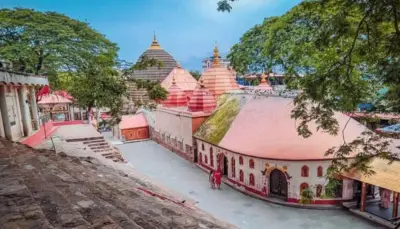

Nestled atop the sacred Nilachal Hill in Guwahati, the capital city of Assam, the Kamakhya Temple is one of India's most revered pilgrimage destinations.
Dedicated to Goddess Kamakhya, also known as Mahamaya, the temple holds immense religious and spiritual significance in Hinduism, particularly within the Shaktism tradition. The goddess is worshipped as a powerful manifestation of divine feminine energy, or Shakti, and is associated with fertility, creation and transformation.
Surrounded by ancient legends, distinctive rituals and remarkable architecture, Kamakhya Temple attracts devotees and visitors from across the country. Its unique traditions, especially those celebrating the natural cycle of menstruation, distinguish it from many other Hindu temples. Here are five fascinating facts about Kamakhya Temple that reveal its rich history, mythology and spiritual significance.
5 Interesting Facts About Kamakhya Temple That You May Not Know
1. It Is One of the Most Important Shakti Peethas in India
Kamakhya Temple is among the most prominent Shakti Peethas, sacred sites associated with Goddess Sati and the divine feminine energy. The temple's origins are rooted in ancient religious traditions, although its present structure reflects several periods of construction and restoration.
The temple is believed to have been rebuilt in the 16th century under the patronage of Koch King Nara Narayana after earlier structures were damaged. Subsequent rulers and religious figures contributed to its restoration and maintenance, helping preserve its importance as a major centre of Shakta worship.
Today, Kamakhya Temple remains a significant pilgrimage destination for devotees of Goddess Shakti and is particularly renowned for its Tantric traditions.
2. The Temple Is Closely Connected to the Legend of Goddess Sati
One of the most well-known stories associated with Kamakhya Temple comes from the legend of Goddess Sati and Lord Shiva. According to Hindu mythology, Sati's father, King Daksha, disapproved of her marriage to Shiva. When Daksha organised a grand yajna, he deliberately excluded the couple from the invitation list.
Despite this, Sati attended the ceremony, where Daksha insulted Shiva. Deeply hurt by her father's disrespect towards her husband, Sati sacrificed herself in the sacred fire.
Overwhelmed by grief and anger upon learning of her death, Shiva carried her body and performed the destructive cosmic dance known as the Tandava. To restore balance to the universe, Lord Vishnu used his Sudarshan Chakra to separate Sati's body into multiple parts. According to widely known traditions, the places where these parts fell became sacred Shakti Peethas.
Kamakhya is particularly associated with the belief that Sati's yoni, representing the female reproductive organ and the source of creation, fell on Nilachal Hill. This association makes the temple especially significant in Shaktism.
3. The Temple Celebrates the Natural Cycle of Menstruation
One of the most distinctive aspects of Kamakhya Temple is its association with menstruation and fertility. According to local belief, Goddess Kamakhya undergoes her annual menstrual cycle during the Hindu month of Ashadha, generally falling in June.
During this period, the temple closes its doors for several days as devotees believe the goddess is menstruating. The annual observance is known as the Ambubachi Mela, which attracts large numbers of pilgrims, sadhus and spiritual seekers.
The Brahmaputra River is sometimes described in popular accounts as turning red around this time, and this phenomenon is associated in local tradition with the goddess's menstrual cycle. However, the claim that the river changes colour because of the goddess's menstruation is a religious belief rather than an established scientific explanation.
Unlike traditions that treat menstruation as something to be concealed, the Kamakhya tradition places fertility, the female reproductive cycle and the power of creation at the centre of its religious symbolism.
4. It Represents the Power of the Divine Feminine
Kamakhya Temple is an important centre of Shaktism, a Hindu tradition that recognises the goddess as the supreme divine power. The goddess is revered as a manifestation of Shakti, the creative energy believed to sustain the universe.
The temple's spiritual significance is closely connected with ancient texts such as the Kalika Purana and the Yogini Tantra, which are associated with the religious traditions of the Kamakhya region.
A particularly distinctive feature of the shrine is that the principal deity is not represented by a conventional idol. Instead, devotees worship a natural rock formation symbolising the yoni, which is kept within the inner sanctum and associated with a natural spring.
This symbolism connects the temple with fertility, regeneration and the continuous cycle of life. For devotees, it represents the belief that divine feminine energy exists throughout creation and is fundamental to the universe.
5. Its Distinctive Architecture Reflects a Rich Religious Heritage
Kamakhya Temple is renowned for its distinctive architectural style, which combines elements of traditional Assamese design with influences from other Indian temple-building traditions. Its beehive-shaped dome and sculpted exterior give it a striking appearance that distinguishes it from many other Hindu shrines.
The main temple forms part of a larger sacred complex associated with the ten Mahavidyas, or manifestations of the Divine Mother in Shakta traditions. These are Kali, Tara, Tripura Sundari (Shodashi), Bhuvaneshwari, Bhairavi, Chhinnamasta, Dhumavati, Bagalamukhi, Matangi and Kamala.
Several other shrines dedicated to different forms of the goddess are located within the temple complex, making it an important centre of worship for devotees following various Shakta traditions.
The temple's elaborate carvings, sacred spaces and distinctive dome reflect centuries of religious devotion and architectural development. Together, these features make Kamakhya Temple not only a major pilgrimage destination but also an important part of Assam's cultural and historical heritage.