


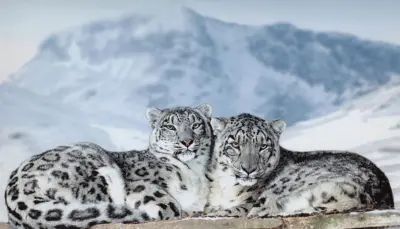

Ethereal, solitary and incredibly elusive, snow leopards have earned their nickname, the "Ghost of the Mountains," for good reason.
These magnificent big cats inhabit the towering mountain ranges of Central and South Asia, spanning twelve countries. Living at elevations few humans ever reach, they navigate steep cliffs and rugged slopes with remarkable agility, hunting mainly during the soft light of dawn and dusk.
Spotting a snow leopard is notoriously difficult, even during winter when they move to lower elevations in search of prey. Although their grey coats, marked with distinctive black spots, stand out against the snow, their exceptional camouflage makes them masters of disappearing into the landscape.
However, catching a glimpse of one isn't entirely out of reach. Advances in scientific research have helped experts understand their movements better, while specialist tour operators are increasingly collaborating with conservationists to organise responsible, snow leopard-focused wildlife expeditions.
There are no universally accepted scientific statistics ranking the best destinations for snow leopard sightings. However, by bringing together tour operator records, wildlife tracker reports and field research, we've ranked the world's leading snow leopard hotspots according to the estimated likelihood of encountering one on a dedicated wildlife-tracking expedition during the most favourable season.
1. Hemis National Park and Ulley Valley, Ladakh, India
Estimated sighting probability: 80-95%
Best time to visit: January-March
Ladakh is widely regarded as one of the best places in the world to spot snow leopards in their natural habitat. Hemis National Park, in particular, is renowned for its exceptionally high snow leopard density, with estimates suggesting around two cats per 100 square kilometres.
During winter, prey species such as blue sheep and Himalayan ibex move down into lower valleys in search of food. Snow leopards follow them, making this season particularly favourable for wildlife enthusiasts hoping to catch a glimpse of these elusive predators.
The region's well-developed local tracking network further improves the chances of a sighting. Village spotters, radio communication systems and experienced wildlife trackers work together to locate and monitor the cats. Visitors can also stay in traditional Ladakhi homestays in villages such as Rumbak and Ulley, placing them right in the heart of prime snow leopard territory.
The landscape itself is another advantage. Its relatively open, exposed terrain makes it easier to spot snow leopards moving across ridgelines from considerable distances with the help of high-powered spotting scopes.
2. Kibber Wildlife Sanctuary, Spiti Valley, Himachal Pradesh, India
Estimated sighting probability: 60-75%
Best time to visit: January-March
Nestled high in Himachal Pradesh, the rugged Trans-Himalayan landscape surrounding Spiti Valley is increasingly emerging as a strong contender to Ladakh for snow leopard sightings.
The region's snow leopard population has reportedly increased from 51 to 83 individuals in recent years, supported by an abundance of blue sheep, one of the big cats' preferred prey species.
Like Ladakh, Spiti has developed a strong community-led wildlife tourism network, bringing together local trackers, conservationists and homestay operators. However, reaching this remote destination requires considerably more effort. The journey from Chandigarh can take around two days by road, while heavy snowfall and landslides frequently disrupt road connectivity during winter.
For those willing to undertake the journey, the experience can be extraordinary. The dramatic mountain scenery around Kibber offers spectacular photography opportunities, and visitors occasionally enjoy relatively close encounters with snow leopards in their natural surroundings.
3. Altai Mountains, Tavan Bogd and Gobi-Altai, Mongolia
Estimated sighting probability: 50-70%
Best time to visit: November-March
Mongolia is home to the world's second-largest snow leopard population, with estimates suggesting around 1,000 individuals. Its vast, open wilderness, particularly across the Altai Mountains, provides an incredible setting for wildlife enthusiasts.
With very low human population density and relatively little forest cover, the region offers expansive views of the mountainous landscape. This makes spotting wildlife particularly rewarding, while the dramatic surroundings create excellent opportunities for photography.
However, sightings are generally less predictable than in Ladakh. Mongolia's snow leopards occupy extensive territories, and its wildlife-tracking infrastructure is not as developed. The Gobi-Altai region is also gaining attention as an emerging hotspot, with an increasing number of recorded sightings.
Responsible tourism is particularly important here. Some operators have faced concerns over unethical wildlife-viewing practices, including reports of baiting animals to attract them. Before booking an expedition, check whether the company works directly with local conservation organisations and community-based trackers.
4. Tien Shan Mountains and Sarychat-Ertash Reserve, Kyrgyzstan
Estimated sighting probability: 35-55%
Best time to visit: June-September and November-March
Kyrgyzstan offers a more adventurous and relatively untouched snow leopard experience. Its vast Tien Shan mountain range supports a smaller but significant population of these elusive cats.
Sightings are less predictable than in Ladakh or Mongolia, largely because of lower leopard densities and less-developed tracking networks. Nevertheless, the country makes up for this with spectacular wilderness, horseback journeys to remote mountain camps and opportunities to experience traditional Kyrgyz nomadic culture.
The Sarychat-Ertash State Nature Reserve is emerging as one of the country's important snow leopard conservation areas. Wildlife tourism and conservation-based expeditions are still developing here, giving visitors opportunities to participate in community-led conservation activities.
Depending on the programme, volunteers may help install camera traps, monitor wildlife movements and collect valuable data that supports ongoing research and protection efforts.
5. Dolpo, Manang and Kangchenjunga Regions, Nepal
Estimated sighting probability: 25-45%
Best time to visit: January-March
Nepal has enormous potential to become one of the world's leading destinations for snow leopard encounters. The country supports a remarkable concentration of these big cats, with estimates suggesting that around 10% of the global population lives within just 2% of their suitable global habitat.
However, several challenges currently limit its potential for wildlife tourism.
The upper Dolpo region and remote Manang Valley offer some of the most promising opportunities for tracking snow leopards. However, forested landscapes and difficult terrain can make sightings more challenging than in the relatively open mountains of Ladakh and Mongolia.
Dedicated snow leopard tourism infrastructure is also still in its early stages. Despite these limitations, Nepal offers much more than wildlife spotting. Visitors can combine tracking expeditions with breathtaking Himalayan scenery, visits to ancient Buddhist monasteries and encounters with other fascinating mountain wildlife.
With further investment in conservation and responsible tourism, Nepal could become an increasingly important destination for snow leopard enthusiasts.
6. Chitral Gol, Gilgit-Baltistan and the Karakoram, Pakistan
Estimated sighting probability: 20-35%
Best time to visit: November-March
Pakistan is another promising destination for snow leopard enthusiasts, with important populations inhabiting the Karakoram and Hindu Kush mountain ranges, particularly across Gilgit-Baltistan.
Several communities along the Karakoram Highway have established local snow leopard monitoring initiatives, while conservation-focused tourism is gradually gaining momentum.
Although sighting opportunities are improving as local tracking networks expand, wildlife tourism infrastructure remains less developed than in destinations such as Ladakh and Mongolia.
The region's breathtaking mountain scenery makes it an attractive destination for adventurous travellers. However, security conditions can vary, so visitors should carefully review official government travel advisories and local travel restrictions before planning an expedition.
7. Jigme Dorji National Park and High Himalayan Regions, Bhutan
Estimated sighting probability: 10-20%
Best time to visit: November-March
Bhutan is celebrated for its extraordinary commitment to environmental protection and biodiversity conservation. The country also supports a small but protected snow leopard population, making it an interesting destination for those hoping to explore pristine Himalayan wilderness.
However, the likelihood of spotting a snow leopard here remains relatively low. Dense vegetation, challenging mountain terrain and limited dedicated wildlife-tracking infrastructure make encounters particularly difficult.
A snow leopard expedition in Bhutan is therefore best approached as an opportunity to explore untouched natural landscapes rather than a trip with an expected wildlife sighting.
That said, the experience offers plenty of other rewards. Bhutan's remarkable biodiversity, rich cultural heritage, traditional monasteries and spectacular mountain scenery make it an unforgettable destination, even if the elusive snow leopard remains out of sight.