
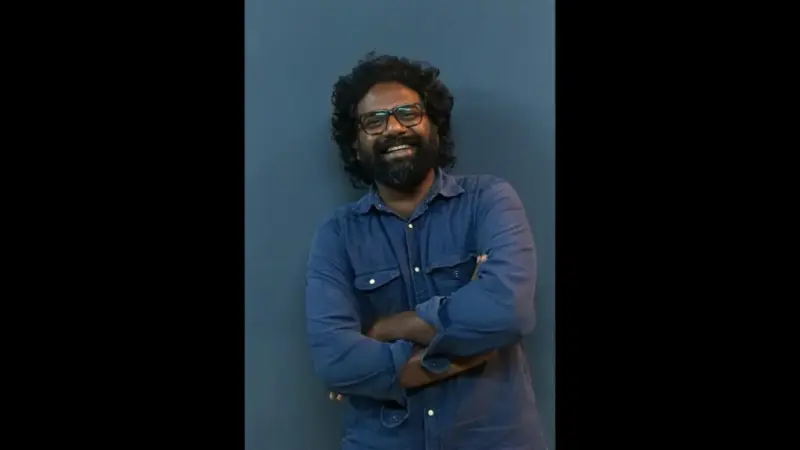

Members of the Problematic Family, a debut Tamil feature by R. Gowtham marked a significant moment with its selection in the Forum section of the 76th Berlin International Film Festival, held in February 2026. The film's entry into one of the world's most discerning cinematic spaces signals the arrival of a voice willing to work outside familiar narrative comforts.
In conversation, R. Gowtham speaks with an ease that feels generous yet thoughtful. He does not withhold and reflects openly, often circling back to his ideas and refining them as he speaks. Yet this openness in speech stands in quiet contrast to the film which resists offering the same kind of clarity. If his words move toward explanation, his cinema seems to move away from it, lingering instead in ambiguity, in fragments, in spaces where meaning is not fixed but gently unfolding.His debut feature, Members of the Problematic Family, begins with a rupture. As described in the official synopsis of the Berlin International Film Festival website, the character Prabha, a troubled and troubling young man, has died under uncertain circumstances. Around him gathers a family that is neither unified nor entirely broken, but suspended in a strange emotional stillness. His mother Santhi, his uncle Sellam, his cousins Dinesh and Mugil, and a wider circle of relatives move through the rituals of death: a 16-day funeral that unfolds less as a solemn passage and more as a restless, unfolding process. In this space, a question quietly persists: who was Prabha, and what does his absence mean to those who remain?With an almost anthropological attentiveness, Gowtham observes these moments without imposing judgment. There is no single register of grief here. Instead, there are accumulations of gestures, misplaced anger, silences and irritations. The film embraces its characters in all their contradictions and vulnerabilities.
It is perhaps from within this world that the film's title takes on its quiet force. When asked how he arrived at it,Gowtham recalls that the project once carried a very different name: Meetchi, or redemption. For a long time, the title seemed right, even inevitable. But as the film slowly took shape, something about that certainty began to feel misplaced. Redemption, with all its promise of closure, no longer seemed to belong. What emerged instead was a film that does not resolve, but observes, one that allows things to remain incomplete. That instinct to observe rather than resolve can be traced back to Gowtham's earlier life, when he found himself documenting street plays as part of a little magazine movement. When asked how those experiences shaped his filmmaking, he does not speak of technique as much as attention. It taught him, he suggests, to look carefully, to notice the small gestures that flicker and disappear in everyday life. Not the grand performances, but the quiet, almost invisible movements through which people reveal themselves. It is this sensibility that lingers in his cinema, where characters are not constructed as dramatic figures but encountered as if in passing.
Take, for instance, the character of Prabha. When questioned about how such a disruptive, alcoholic presence came into being, Gowtham does not answer directly. Instead, he returns with another question : is this a problematic man within a family, or is this a man produced by a problematic family? The film does not resolve this tension, and that refusal becomes its strength. It allows the character to exist not as a fixed identity but as a shifting possibility.
This refusal extends into the emotional register of the film as well. In a cinematic landscape where family dramas often lean heavily on sentiment, one cannot help but ask whether Gowtham was consciously resisting this tradition.This refusal extends into the emotional register of the film as well. Gowtham is clear that he does not want to impose a fixed emotional position on the audience. He resists the idea of guiding viewers toward a particular response, suggesting instead that each person should be able to take from the film what they want. For him, clarity, especially when it dictates feeling, can become limiting. In choosing to strip away emotional cues and no insistence on sympathy, the film asks its audience to sit with discomfort. At the heart of all this lies a question that perhaps defines Gowtham's entire approach: should a film guide its audience, or should it let them find their own way? To guide too clearly, he believes, is to limit. Films that declare their positions too strongly risk becoming tied to their moment, losing their resonance over time. Instead, he chooses to leave space for uncertainty, for disagreement, for personal interpretation. Once the film is made, he says, it no longer belongs to him
Nowhere is this more evident than in the film's engagement with death. What happens, one wonders, when a film refuses to centre grief as its emotional anchor? Gowtham's response is almost gentle in its clarity: grief is not always what we think it is. Cinema has trained us to expect it, to recognise it instantly. But in life, he suggests, death can arrive with other, more complicated emotions: relief, lightness, even a quiet release. He recalls a moment with a friend who pointed out how a once-gloomy house had become unexpectedly bright after the passing of an elderly man. It is a small story, almost incidental, yet it holds within it the unsettling truth that death does not always deepen sorrow; sometimes, it alters the air itself.
And yet, when asked which part of the film was most difficult to bring to life, Gowtham shares that the writing came with ease. It was the act of gathering others, of aligning expectations, of navigating doubt and misunderstanding, that proved challenging. Even within these difficulties, however, there is a sense of quiet gratitude. The film, he insists, was never his alone. It was shaped in conversation, in disagreement, in the back-and-forth of a collective trying to make sense of something together. Entire sections were cut, rethought, and reshaped through this process.
This spirit of fragmentation, of assembling meaning through parts rather than wholes, naturally leads to questions about the film's structure. Did this fragmented form emerge gradually, or was it always present? Gowtham answers without hesitation: it was always there. More than a stylistic choice, it reflects the way he remembers the world.Memories remain while the order of events dissolves. But if a film unfolds in fragments, how does it hold together emotionally? Here, Gowtham gently pushes back against the very idea of "holding together." Continuity, whether technical or emotional, is not something he actively pursues. What matters is whether a moment feels alive. If it does, it stays. If it does not, it goes. In retrospect, he concedes, something like emotional continuity may emerge, but only as a by-product, never as an intention.
The world of the film, too, reflects this delicate balance between specificity and openness. When asked about the importance of its setting, a neighbourhood that feels both part of and apart from Chennai, Gowtham speaks of familiarity. It was a place he knew, a place that allowed him to work without the added uncertainty of the unfamiliar. And yet, he is careful not to claim it as unique. The story, he believes, could exist anywhere. What matters is not the geography, but the texture of life it holds.
This attention to texture becomes particularly striking in the depiction of funeral rituals. One might ask whether these are meant to be ethnographic in their detail. Gowtham resists that framing. What interested him, he says, was not accuracy but atmosphere, the confusion, the negotiations, the small frictions that arise when people try to do what they believe is right. Funerals, in his view, are less about spiritual transcendence and more about collective performance. People gather, argue, decide, and proceed, not always with conviction, but often out of obligation. Within this process lies a range of emotions rarely acknowledged: boredom, irritation, relief, alongside grief.
That such a film found its way to the Berlin International Film Festival is, in itself, telling. One might expect a work so rooted in a specific cultural context to face barriers abroad. Instead, Gowtham describes audiences who listened closely, who asked thoughtful questions, who noticed even the silences. One question that was asked to him in the film's screening, in particular, lingered with him: 'why do so many characters seem alone?' It was a question that revealed something the film does not state outright, yet carries within it - a quiet loneliness.
Behind the film lies a story of collective effort. When asked about the production process, Gowtham speaks not of budgets or schedules but of people, friends, collaborators, family members who came together to make the film possible. Resources were borrowed, shared, improvised. Groups like Potato Eaters Collective embody this spirit, offering a space where filmmakers support one another in the absence of institutional backing. And yet, the question remains: can such films survive within the broader Tamil industry? Gowtham's answer is cautious. There is a growing sense of community, he acknowledges, but the structures needed to sustain independent cinema, funding, distribution, global networks, are still fragile. In response, he and his peers are beginning to imagine alternative pathways, building audiences slowly, one city at a time, rather than seeking immediate, large-scale release.
When the conversation turns to influence, Gowtham again resists easy answers. He speaks with admiration of works like The Death of Ivan Ilyich, Ikiru, and Kattradhu Thamizh, yet he draws a quiet boundary. These are works to return to, to feel with, to think about, but not to replicate. His own path, it seems, lies elsewhere. About his future projects, Gowtham says he feels he can make two or three films in this phase. He describes himself as being in a "fertile" period, with scripts already in place for his next projects, and a strong desire to return to shooting. At the same time, he acknowledges the practical delays that come with independent filmmaking: the festival run, sales, and the absence of strong financial backing beyond his immediate circle. While he is clear that he does not want to repeat himself formally, he notes that certain questions and emotions remain unresolved, and these will continue to shape his upcoming work.