

A day before a planned nationwide protest in the national capital, the Safai Karamchari Andolan (SKA) has raised urgent concerns over continuing deaths of sanitation workers in sewers and septic tanks, calling for immediate government intervention.
Speaking to Maktoob, SKA's National Convener and veteran activist, Bezwada Wilson, described the situation as a "national shame," alleging that despite repeated promises, manual scavenging and hazardous sewer cleaning persist across India.
"We are losing lives every few days. These are not accidents, they are preventable deaths," Wilson said, pointing to what he called a "systemic failure" to enforce safety measures and accountability.
Wilson said over 120 deaths were recorded in 2025 alone, significantly higher than official figures.
"There is a glaring mismatch between what the government reports and what we document on the ground," Wilson added. "Why are these numbers being underreported?"
The organisation held a protest demonstration and dharna at Jantar Mantar in New Delhi today, March 25.
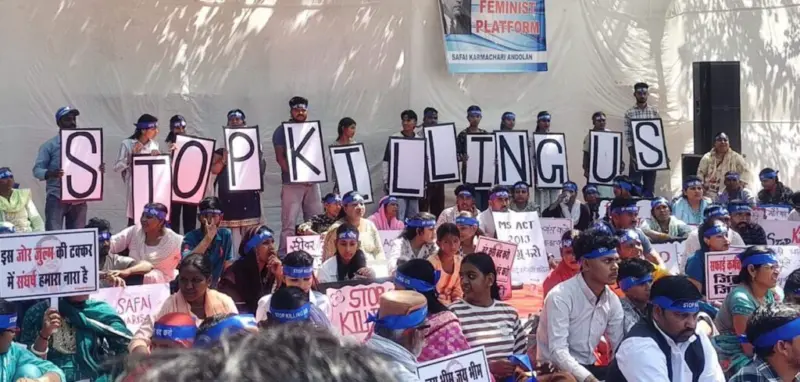
Dozens of sanitation workers, activists, and families of victims gathered at Jantar Mantar on Tuesday for a protest led by the Safai Karamchari Andolan (SKA), demanding urgent action to stop deaths in sewers and septic tanks.
The demonstration, held under the banner #StopKillingUs, brought together participants from multiple states, including workers who have survived hazardous sewer cleaning and relatives of those who lost their lives in such conditions.
Protesters raised slogans, held placards, and called on the government to enforce laws banning manual scavenging and ensure safer alternatives through mechanisation.
Wilson said the continued deaths reflect a failure of governance. "Despite clear legal prohibitions, people are still being forced into sewers without safety gear. These deaths are entirely preventable," he said.
He highlighted that dozens of deaths have already been reported in the first few months of 2026 alone, urging authorities to act swiftly.
He also pointed to discrepancies between official data and independent documentation, alleging that the true scale of the crisis remains underreported.
A key demand of the protest was accountability. Activists called for strict punishment of officials and contractors responsible for unsafe working conditions, as well as compensation and rehabilitation for affected families.
They also reiterated the need for complete mechanisation of sewer cleaning work to eliminate human entry into hazardous spaces.
Wilson said, "This is not a one-day protest; we will continue until every sanitation worker in this country is guaranteed safety and dignity."
Wilson emphasised that the issue goes beyond statistics. "Behind every number is a family devastated, often from the most marginalised communities. Dalits are still being forced into this degrading work despite legal prohibitions," he said.
He also criticised what he termed "false claims" by authorities that manual scavenging has been eradicated. "This is not just misinformation, it is a denial of lived reality," he said, adding that SKA has been fighting the issue for over four decades.
"We are not asking for sympathy," he said. "We are demanding dignity, safety, and justice."
A memorandum addressed to the Prime Minister was submitted by the SKA, outlining these demands and urging immediate intervention.
Participants described the protest as part of a long-standing struggle against caste-based and unsafe labour practices, stressing that manual scavenging continues to disproportionately affect Dalit communities, despite repeated government claims of its eradication.
The protest concluded with a call for sustained nationwide mobilisation until concrete steps are taken.