
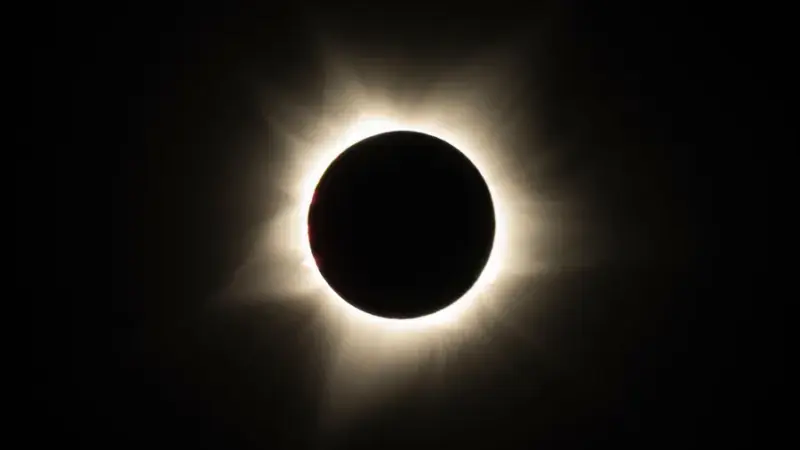

The sky is gearing up for one final spectacle in 2025 as the year's last solar eclipse is set to unfold on Sunday night (Indian time).
Although it will not be visible from India, observers in parts of Australia, Antarctica, and across the Pacific and Atlantic Oceans will have the opportunity to witness the Moon partially covering the Sun, capping off a year that already featured two total lunar eclipses and another partial solar eclipse.
What exactly happens during a solar eclipse?
A solar eclipse occurs when the Moon passes directly between the Sun and Earth, casting a shadow on Earth and blocking sunlight completely. In the case of a partial eclipse, only a portion of the Sun is obscured. In some places on Sunday, up to 85 per cent of the Sun will be covered by the Moon.
During such an eclipse, Earth's shadow looks very dark on the side of the Moon facing us. What observers on Earth see depends on how the Sun, Earth, and Moon align at that moment.
When will the eclipse take place?
The event will begin at 10:59 pm (IST) on Sunday night, reach its maximum at 1:11 am early on Monday, and end at 3:23 am.
How many eclipses have there been in 2025?
The year 2025 has already been an exciting one for astronomy, with four eclipses in total with two partial solar eclipses and two total lunar eclipses. The partial eclipse on Sunday night will mark the second and final eclipse of the year.
Why is this timing significant?
Interestingly, this celestial event comes just a day before the autumnal equinox, or the official start of autumn in the northern hemisphere, on 22 September.
Astronomically, this is the moment when the Sun is positioned directly above the equator. On this day, Earth is not tilted toward or away from the Sun, resulting in day and night being almost equal in length, at roughly 12 hours each (with only small variations).
When is the next solar eclipse?
For those who miss Sunday's spectacle, there is no need to worry. The next solar eclipses are scheduled for 17 February and 12 August 2026, though once again, they will not be visible from India. The country, however, will finally get the chance to witness a solar eclipse in August 2027.