
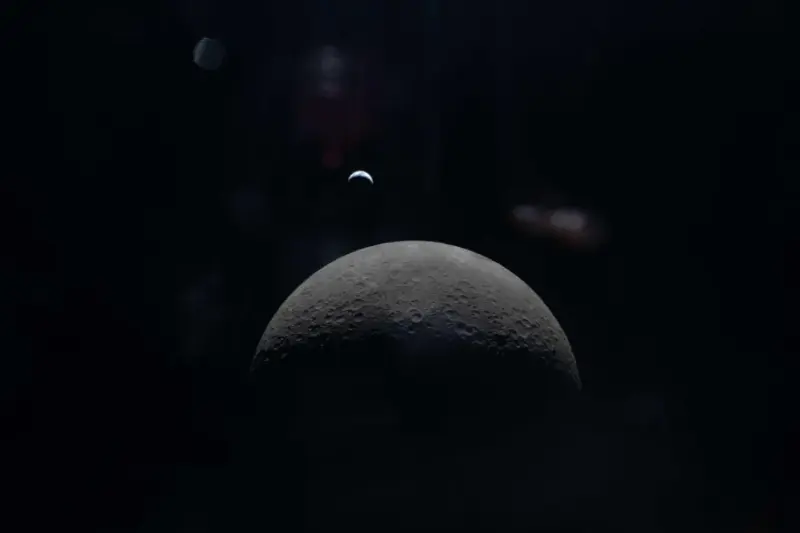

After a record-breaking journey around the moon and back, the Artemis II mission is now returning to Earth, and full preparations are underway for its final descent.
NASA is aiming for splashdown-the moment the crew capsule will land in the Pacific Ocean-on Friday at 8:07 P.M. EDT (5:37 A.M. IST on Saturday). But the hours and minutes before this moment are extremely critical.
The four Artemis II astronauts-Reid Wiseman, Victor Glover, Christina Koch and Jeremy Hansen-will start their day at 11:35 A.M. EDT (9:05 P.M. IST). Soon after that, around 1:50 P.M. EDT (11:20 P.M. IST), they will prepare the small capsule for re-entry, packing away items and making sure everything needed for their return through Earth's atmosphere is ready.
Next, NASA has planned a final course correction burn at 2:53 P.M. EDT (12:23 A.M. IST), if required, to keep the Orion capsule-named Integrity by the crew-on the right path toward Earth.
The astronauts will also go through their re-entry checklist, making sure each of them is properly wearing their space suit, which will protect them during the rough journey down, and that they clearly understand their roles during the descent.
NASA will live stream the entire event, with its official broadcast starting at around 6:30 P.M. EDT (4:00 A.M. IST), a little more than an hour before the capsule is expected to re-enter Earth's atmosphere.
Just before re-entry, the capsule will separate from its large service module about 42 minutes before splashdown. Then, at around 7:37 P.M. EDT (5:07 A.M. IST), the Orion capsule will fire its engines briefly to move into the correct position and direction for re-entry and landing.
After that, at around 7:53 P.M. EDT (5:23 A.M. IST), Orion will enter the upper part of Earth's atmosphere at about 400,000 feet (around 122 km) above the ground, starting a 13-minute descent. At this point, the capsule will be moving at about 24,000 miles per hour (around 38,600 km per hour).
ALSO READ | Artemis II crew clicks rare 'Earthset' photo from Moon's dark side
In the first two minutes of descent, the spacecraft will drop about 200,000 feet (around 61 km), and during this time it will face extreme heat of around 5,000°F (2,760°C). This happens because the air in front of it gets highly compressed due to its very high speed, as explained by NASA. As the capsule continues to fall, it will go through very high pressure and intense heat stress.
As the capsule comes down, it will face very high pressure and extreme heat. NASA has designed Orion with a special protective layer called a heat shield, which is made to burn, melt and slowly break away so that the heat does not enter inside the spacecraft.
It will also go through a six-minute communication blackout, during which the extreme heat will block the crew from talking to mission control.
As the spacecraft falls toward Earth, it needs to slow down before landing. It does two things:
● First, it fires small rocket engines to brake, like pressing the brakes on a car.
● Second, it tilts and rolls its body sideways so the air pushes back against it harder - the same way you slow down when you stick your hand out of a car window at an angle. The more it tilts, the more the air pushes back, and the slower it gets.
ALSO READ | Nutella goes viral in space during Artemis II Moon mission; NASA responds
Around nine minutes after it starts coming down, the spacecraft will be moving just below the speed of sound (around 1,200 km per hour), at an altitude of around 35,000 feet (about 10.7 km) above Earth's surface.
At that time, the capsule will start opening parachutes step by step to slow down. First, small parachutes open, then slightly bigger ones, and finally the main large parachutes open to bring it safely down.
The drogue parachutes (small parachutes used to slow down and stabilise the capsule) will open at around 10 minutes, helping the capsule come down from 24,000 feet (about 7.3 km) to 6,800 feet (about 2.1 km). After that, the pilot parachutes (small parachutes that help pull out the main parachutes) will open, followed by the main large parachutes, which will slowly and safely bring the capsule down for the last 5,000 feet (about 1.5 km) at a speed of around 17 mph (about 27 km per hour).
Splashdown is planned for 8:07 P.M. Eastern Time (5:37 A.M. IST on Saturday) in the Pacific Ocean near San Diego, California. During this 13-minute descent, the crew will travel about 1,701 nautical miles (around 3,150 km).
There, the USS John P. Murtha (a large US Navy ship used for recovery operations) will be waiting for them. Within two hours after splashdown, divers will take the astronauts out of the capsule and place them into helicopters to carry them to the ship. They will then undergo basic medical checks onboard before they return to land (Earth's surface).
(Girish Linganna is an award-winning science communicator and a Defence, Aerospace & Geopolitical Analyst.)