




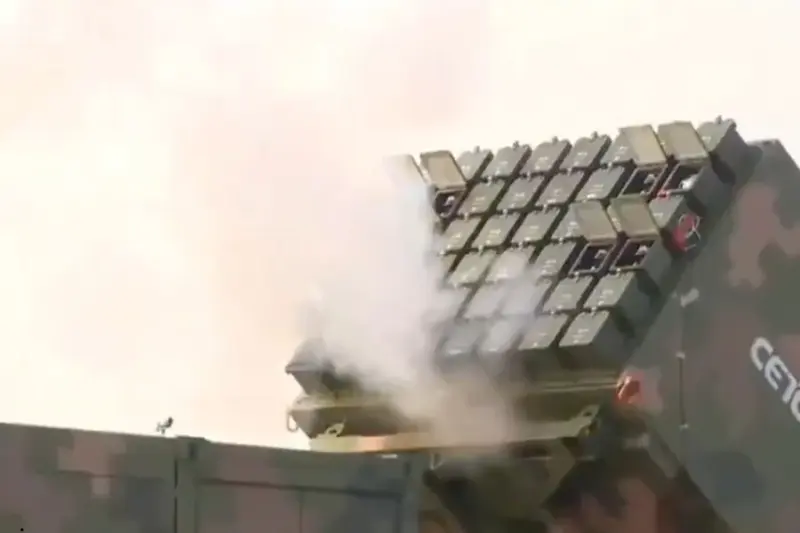

In late March, China's People's Liberation Army revealed something that has shaken military experts across the world. It is called the Atlas drone swarm system, or Atelasi.
This is not just another fancy drone. It is a full flying army packed into a truck. One single operator, sitting far away, can launch and control nearly 96 drones at the same time. Think of it like one person playing a video game, but instead of a screen, real drones are flying in the sky, finding targets, and attacking together. For India, which already shares a tense border with China, this new weapon is a serious wake-up call.
Let us first understand what makes Atlas so dangerous. The system has three main parts. The first is a Swarm-2 combat vehicle that can carry and launch 48 fixed-wing drones. The second is a command vehicle from where one operator controls all the drones. The third is a support vehicle that handles reloading, maintenance, power supply, and communication. The most shocking part is the speed. Atlas can launch one drone every three seconds, which means all 96 drones can be in the sky within just 300 seconds, that is only 5 minutes. Once up, they can spy, jam enemy radars, confuse air defence systems, or directly attack targets.
Also read | EXPLAINED: Why India opening door to 'green jet fuel' makes sense
To understand the real power of drone swarms, just look at what happened recently in West Asia. A US E-3 Sentry AWACS aircraft, which is basically a flying radar that guides fighter jets, was destroyed at Prince Sultan Airbase in Saudi Arabia by a swarm of just 29 drones with a few missiles. Now imagine 96 drones attacking together. The damage can be massive.
Many people will ask, does the US or other countries not have such drones? They do. The US has "Perdix" with 103 micro-drones and "Offset" with 250 unmanned systems. China itself has the "Jiu Tian" mothership that carries 100 to 150 drones. But Atlas is different because of its brain, not just its body. The drones can talk to each other, change routes mid-flight, recheck targets, and attack in teams, all with one human controlling them. In today's war, it is not about how many drones you have. It is about how smart they are.
Atlas has been built by China Electronics Technology Group Corporation (CETC), a government-owned company closely tied to the Chinese military. CETC has a dark history too. It has helped build surveillance systems used against Uyghur Muslims in Xinjiang, and one of its linked firms, Zhenhua Data, reportedly tracks the digital activities of over 2.5 million important people around the world, including politicians, journalists, and military officers. So this is not just a defence company. It is a full spying and warfare machine.
Now comes the biggest worry for India. If China deploys Atlas in its Western Theatre Command, Tibet, and Xinjiang, our Himalayan borders become extremely vulnerable. Tibet already has strong Chinese roads and railways, which means these drone swarms can be moved quickly to the border. Once launched, they can overload Indian air defence systems, force our forces to waste expensive missiles on small drones, and attack supply roads leading to our forward posts in Ladakh, Arunachal Pradesh, and Sikkim. If supply lines get cut, our soldiers at high-altitude posts can get isolated. Even worse, jamming these drones is very hard because they share information among themselves and keep changing formations on their own.
Also read | HAL's golden ticket: Forging Russia's Sukhoi-57 Felon stealth fighter at home
So how should India prepare? First, India must urgently invest in anti-drone systems, especially laser-based weapons and microwave guns that can destroy many drones at once instead of one by one. The DRDO's anti-drone system and Smash-2000 rifles are a good start, but we need much more, and fast. Second, India needs its own smart drone swarm. The indigenous projects like "Air Launched Flexible Asset Swarm" by DRDO must be speeded up. Third, our border roads, airbases, and radar stations must be hardened and camouflaged to reduce easy targets. Fourth, strong electronic warfare units must be placed along the Line of Actual Control to jam, confuse, or hack these swarms. Fifth, training is key. Our soldiers must practise in real drone-war conditions, not just traditional battles. Sixth, India should deepen defence partnerships with the US, Israel, and France, who are far ahead in counter-drone technology.
Atlas is still in testing, and China has not confirmed exports yet. But its public display at the 2024 Zhuhai Airshow and the English name it carries hint that it may be sold to Pakistan or other rivals of India soon. The message is simple - the next war will not be fought by soldiers alone. It will be fought by swarms of flying machines. India must not wait. The sky of tomorrow belongs to those who prepare today.
( Girish Linganna is an award-winning science communicator and a Defence, Aerospace & Geopolitical Analyst. He is the Managing Director of ADD Engineering Components India Pvt. Ltd., a subsidiary of ADD Engineering GmbH, Germany. )