
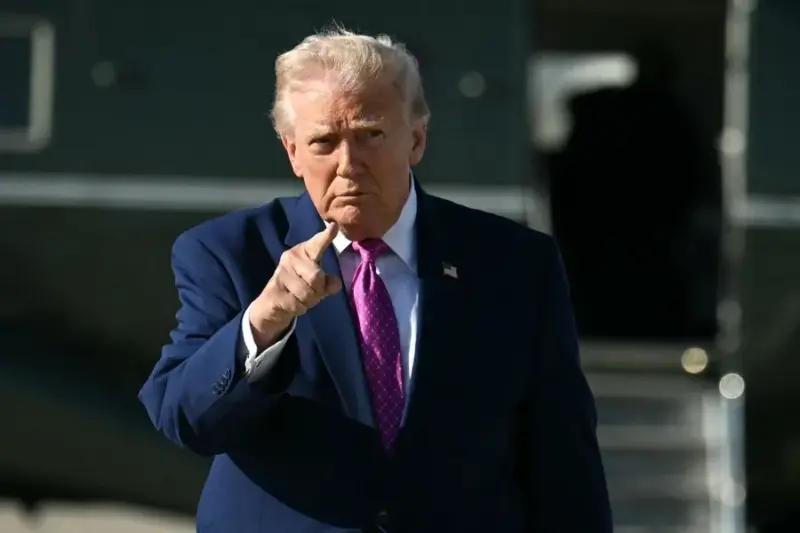

Donald Trump is once again doing what he does best. He is trying to market confusion as statesmanship, improvisation as strategy, and a pause in violence as proof of peace.
The ceasefire he has been touting as a great personal triumph already looks less like a diplomatic achievement and more like a clumsily assembled political prop.
It was built to dominate a news cycle, not to survive contact with the region it claims to pacify. That is the first thing one must understand about this latest farce.
A real ceasefire is not just an announcement or a boast, and it is certainly not a social media performance. It is a negotiated structure with clear terms, obligations, enforcement, and consequences for violation. What Trump appears to have pushed through was something altogether flimsier, a public relations moment dressed up as a diplomatic breakthrough!
Also Read: How Donald Trump turns war into spectacle
The moment the dust began to settle, the contradictions were already visible. Iran and others seemed to operate on the understanding that Lebanon was part of the de-escalation framework, and Donald Trump himself had signalled that the Iranian proposal looked workable.
Yet, the moment Israel resumed pounding Lebanon and the arrangement came under strain, Washington retreated into semantic evasions. US Vice President J D Vance now says the ceasefire was really only between the United States and Iran, and if others thought Lebanon was covered, that was their misunderstanding and their problem.
In other words, the United States now wants to claim the prestige of brokering calm without accepting responsibility for the very theatre where that calm is being shredded. This is not a misunderstanding, but the oldest American trick in the book. Promise the language of restraint, preserve the architecture of impunity, and then act surprised when the region notices the fraud.
What has happened in Lebanon since then should strip away whatever little credibility this arrangement had. Israel has carried out devastating strikes while continuing to invoke the vocabulary of security and counterterrorism. That vocabulary has long been used as a moral laundering service for their excesses.
Also Read: War ends, but real danger stays
Say Hezbollah, command centres, or military necessity. But when heavily populated areas are hit, hospitals damaged, ambulances struck, and civilians buried under rubble, the world is not obliged to suspend its eyesight merely because the right incantations have been uttered from Tel Aviv and echoed in Washington.
The obscenity here lies not merely in the violence itself, but in the diplomatic dishonesty surrounding it. If you know that strikes on Lebanon are likely to provoke Iran, unsettle the region, imperil maritime traffic, and threaten the very truce you are publicly celebrating, then treating Lebanon as some separate compartment is not realism, but bad faith and a refusal to acknowledge the obvious.
In West Asia, wars do not remain tidily confined within the boxes drawn for them by American briefers and television surrogates. They spill, they mutate, and they drag in allies, proxies, shipping lanes, energy markets, and fragile governments. Anyone pretending otherwise is either a rank moron or a propagandist.
Trump, as ever, behaves like a man who thinks foreign policy is some branding exercise. He wants the applause line and the image of the strongman who forced peace on a turbulent region through sheer personal will. He wants the story before he has secured the substance. That is why his diplomacy so often resembles stagecraft. He confuses declaration with outcome, and thinks saying something loudly is the same as making it true.
The deeper problem, of course, is that Trump's approach is not merely vain but structurally reckless. It rests on the assumption that the United States can indulge Israel's maximalism, dismiss the concerns of every regional actor not named Israel, threaten Iran into compliance, and still be taken seriously as a guarantor of stability. That fantasy has been repeatedly disproved, yet Washington clings to it with the stubbornness of an empire in decline. It still believes it can reserve the right to define peace in terms that only benefit its clients, and then denounce everyone else as unreasonable when those terms collapse.
Also Read: When is a war lost?
Iran's response over the Strait of Hormuz is a reminder that the region has ways of making American delusions very expensive. Whether one calls it closure, restriction, coercive control, or calibrated disruption, the point remains the same. Iran has signalled that if Lebanon burns while Washington lectures everyone about technicalities, there will be a price, and that price will not be paid only in rhetoric. It will be paid in energy markets, insurance costs, shipping anxiety, and the wider sense that the region is once again sliding toward a larger conflagration because the United States wanted a victory lap before it had secured peace.
And that is what makes Vance's remarks especially revealing. They are not merely crude, but diagnostic. They show an administration that thinks in narrow legalistic slices while presiding over a profoundly interconnected crisis. They show a vice president more interested in disclaiming liability than in preserving a truce. They show a White House that wants all the prestige of peace-making with none of the burden of coherence.
There is also something morally rotten in this posture. Lebanon is not a footnote, and its civilians are not collateral to the grand narrative of Trumpian success. A ceasefire that leaves room for one party to pulverise Lebanon while the broker shrugs and says that was never really part of the deal is not peace. It is just a hierarchy of human worth masquerading as diplomacy.
One need not romanticise Iran or Hezbollah to say this plainly. One only needs a functioning conscience and the bare minimum respect for reason. If you claim to be de-escalating a regional war, then the burning of Beirut matters, the bombings of civilian areas matter, the destruction of infrastructure matters, and the reaction in Hormuz matters.
Everything is connected, except perhaps in the minds of men whose chief political talent lies in mistaking swagger for strategy.
So no, this is not some glorious Trump triumph now endangered by unfortunate complications. It is exactly what it looked like from the start. A tenuous, boastful, badly constructed arrangement held together by bluster, ambiguity, and the usual American willingness to call something peace so long as the right side gets to keep bombing.
The tragedy is not that this ceasefire is fraying. The tragedy is that it was designed to fray. It was conceived not as a durable settlement but as a performance of control. And in West Asia, performances of control have a habit of ending in smoke, rubble, and sanctimonious lies from the men who scripted them.
The author is a National Award winner for Best Narration and an independent political analyst. Views expressed are personal.