




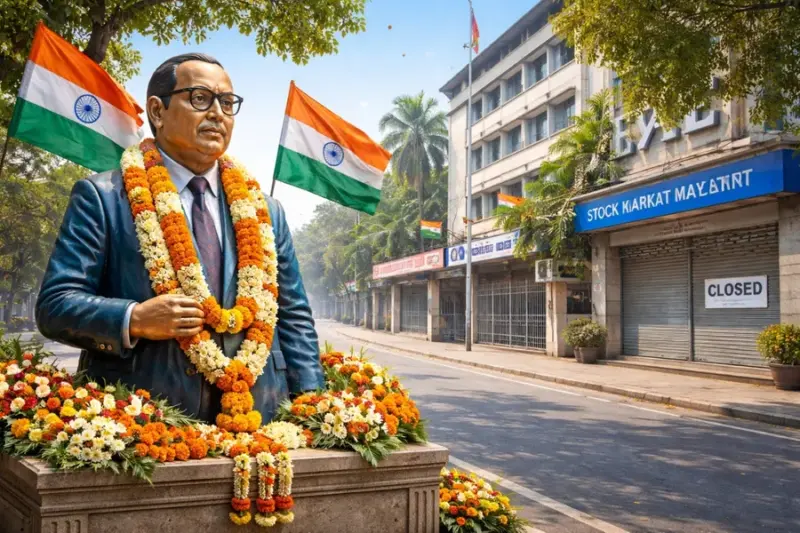

Ambedkar Jayanti, observed annually on April 14, commemorates the birth anniversary of Dr B.R. Ambedkar, the principal architect of the Indian Constitution.
In 2026, the day falls on a Tuesday and has been declared a nationwide gazetted holiday, affecting a wide range of public and financial services.
April 14, 2026, is being observed as a gazetted national holiday across India to mark the birth anniversary of Dr B.R. Ambedkar, the chief architect of the Indian Constitution. The central government has declared the day a public holiday, resulting in widespread closure of public institutions and services.
Schools, colleges and government offices closed
All government schools, colleges and universities will remain closed on the occasion. Central government offices across the country will also not function. In most states, state government offices are expected to follow the same schedule, leading to a near-complete shutdown of administrative services for the day.
Banks shut under RBI holiday calendar
Banks across India will remain closed as the day is listed as a holiday under the Negotiable Instruments Act by the Reserve Bank of India. This means branch services such as cash deposits, withdrawals, cheque clearance and in-person banking will not be available. However, digital banking services, including internet banking, mobile apps, UPI and ATM access, will continue to operate normally.
Also read | Total solar eclipse 2026: Date, visibility and countries where the sky will turn dark
Stock markets BSE and NSE closed for trading
Trading activity on both the Bombay Stock Exchange and the National Stock Exchange will remain suspended throughout the day. There will be no activity in equity, equity derivatives, currency derivatives or securities lending and borrowing segments. Trading will resume on April 15. The Multi Commodity Exchange (MCX) will remain closed during the morning session but is scheduled to reopen for the evening session.
Private offices and businesses may remain open
Private sector offices, including corporate firms and IT companies, are generally not required to observe the holiday. Many organisations may remain open or offer optional leave depending on internal policies. Retail shops, commercial establishments and small businesses are also expected to function normally in most areas.
Essential services to function without disruption
Essential services such as hospitals, pharmacies, emergency services and public transport will continue to operate. This ensures that daily life is not significantly disrupted despite closures in government and financial sectors.
Digital services ensure continuity
Although physical banking and official services are paused, digital platforms will remain fully functional. Online transactions, mobile banking, card payments and other digital financial services will continue without interruption, allowing individuals to carry out necessary transactions.
Multiple regional festivals on the same day
April 14 also coincides with several regional festivals, including Tamil New Year, Bohag Bihu, Maha Vishuva Sankranti and Biju/Buisu festival. These celebrations are observed in various parts of the country, including cities such as Chennai, Bengaluru, Guwahati and Kolkata, adding cultural significance to the day.
The holiday will primarily affect government-related work, in-person banking and stock market trading. Citizens are advised to plan any urgent financial or administrative tasks in advance. However, with essential and digital services remaining operational, overall disruption is expected to be limited.