
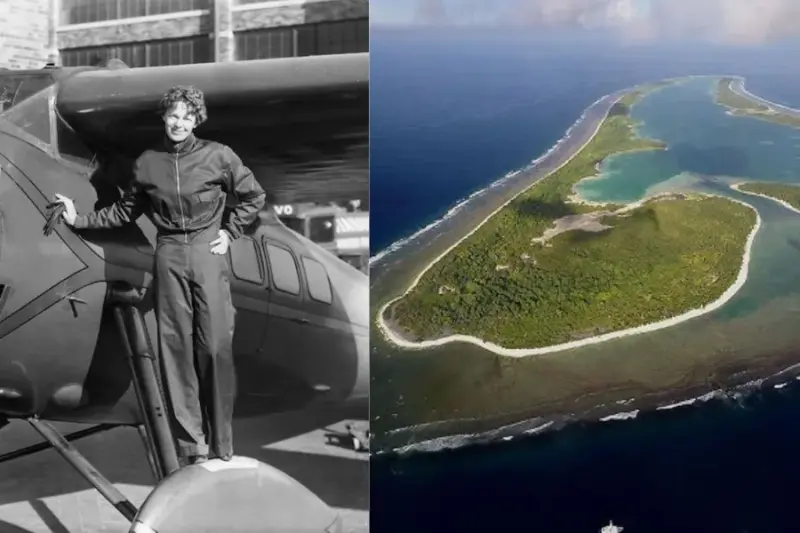

A veteran aviator believes he may have cracked one of the world's most enduring mysteries, the fate of pioneering flyer Amelia Earhart.
Justin Myers, a pilot with nearly 25 years' experience, says satellite images led him to what appears to be the wreckage of Earhart's Lockheed Model 10 Electra on Nikumaroro, a remote atoll long suspected to be her final landing site.
Myers' claim stems from hours spent studying Google Earth after watching a documentary about Earhart and her navigator Fred Noonan and their fatal 1937 round-the-world attempt. What he saw, he argues, resembles the remains of a small twin-engine aircraft, one almost exactly the same length as Earhart's Electra.
But despite the detail of his findings, Myers says authorities and academics have largely ignored him.
Images reveal object matching Electra dimensions
Myers says he began by analysing potential emergency landing areas on the atoll, part of Kiribati, placing himself "in Amelia and Fred's shoes".
While scanning a flat stretch of reef, he noticed a dark, straight object in the surf zone. Using built-in measurement tools, he found it to be 39 feet long, the same length as the Electra.
He described the process in his blog, "I picked an area which would probably have been what I thought to be best considering the circumstances. I zoomed in and there was a long sandy-looking shape. [...]I measured the sandy section, which was over 50ft long, looked up the specifications of the Electra, and that measured 39ft. I laughed and thought 'What do you think you are doing?'
However, to the left of the sandy section that had been eroded by the weather over many years was a dark-coloured, perfectly straight object. I used the measuring tool on Google Earth and to my surprise and mild little shiver it measured approximately 39 ft."
Myers continued examining the imagery and says he identified what looked like additional debris, including a radial engine. Measurements, he insists, aligned with the Electra's known components.
Myers told Popular Mechanics that the object "looked like a section of aircraft fuselage," adding, "It looked man-made… that was remarkable by itself, let alone the possibility it was Electra 10E NR16020, even though the measurements looked the same."
He believes natural forces may have alternately exposed and concealed the debris over time:
"Myers suggests… 'there was an element of luck in spotting that aircraft debris, as Mother Nature had revealed what had been buried on the reef for a long time.'"
Authorities show little interest
Uncertain where to report his discovery, Myers approached the National Transportation Safety Board, which told him the matter fell under the Australian Transport Safety Bureau. He then filed an official report in Brisbane.
Since then, he says, responses have dried up. An expedition group in California and researchers at Purdue University, the institution that holds Earhart's personal archives, did not follow up on his outreach.
Competing claims cloud the search
Myers' struggle for attention may partly stem from the sheer number of competing theories.
The International Group for Historic Aircraft Recovery has long argued that Earhart likely ended up on Nikumaroro and has mounted more than a dozen expeditions there.
Purdue University researchers are separately investigating the Taraia Object, an underwater anomaly seen in a 1938 aerial photograph that some believe could also be the Electra.
Meanwhile, former US intelligence officer Tony Romeo, CEO of Deep Sea Vision, once claimed underwater sonar images near Howland Island showed an aircraft with "unique dual tails". A subsequent expedition proved the object was nothing more than a rock formation.
The high failure rate, Myers acknowledges, makes people hesitant to invest in another hunt.
Myers is careful not to overstate his case. He told Popular Mechanics, "The bottom line… is from my interests from a child in vintage aircraft and air crash investigation, I can say that is what was once a 12-metre, 2-engine vintage aircraft. What I can't say is that is definitely Amelia's Electra."
Even if the aircraft he spotted is not Earhart's, he says it could still resolve a different aviation mystery, "If this is not Amelia's Electra 10E, then it's the answer to another mystery that has never been answered."
Last year, in September, President Donald Trump had ordered the declassification and release of all government records related to aviation pioneer Amelia Earhart.
What happened to Amelia Earhart?
Amelia Earhart, 39, and navigator Fred Noonan set off on their round-the-world attempt on 1 June 1937 aboard a twin-engine Lockheed Electra, departing from Miami and heading east. After a series of refuelling stops, the duo reached Lae, in what is now Papua New Guinea, on 29 June, having already covered more than 22,000 miles of their 29,000-mile route.
They resumed their journey on 2 July, bound for remote Howland Island, a difficult speck in the Pacific that lay roughly 2,600 miles away and was intended as their next refuelling point. To aid navigation, the U.S. Coast Guard positioned the cutter USCGC Itasca near the island, maintaining radio contact as Earhart reported deteriorating weather and dwindling fuel. Communications soon became erratic, and her final transmission indicated they were "running north and south" while searching for the island.
When the aircraft failed to appear, the US Navy and Coast Guard launched what was then the largest search in American history. After nearly two weeks with no trace, the operation was suspended on 19 July. Earhart and Noonan were declared lost at sea, and later pronounced dead in absentia on 5 January 1939.
A federal inquiry concluded the aircraft likely exhausted its fuel and crashed into the Pacific, a view still widely accepted, though the plane has never been located. Tom Crouch of the National Air and Space Museum has suggested the wreckage may lie on the ocean floor, potentially preserving personal items such as Earhart's leather jacket, shoes or even teeth, similar to artefacts recovered from deep-sea sites like the Titanic.
The absence of definitive evidence has fuelled enduring speculation. Some theories claim Earhart and Noonan may have been captured by Japanese forces; another posits they crash-landed on Nikumaroro Island, formerly Gardner Island. In 2018, researcher Richard Jantz re-evaluated bone measurements taken in 1940 and argued they were highly consistent with Earhart's physiology, though no conclusive link, including aircraft debris or viable DNA, has ever been found.
A mystery waiting for funding
A planned 2025 research trip to Nikumaroro was postponed until 2026, leaving Myers' supposed Electra-like debris unverified for now.
Whether his discovery proves to be a breakthrough or another dead end will depend on whether any organisation with the means to mount an expedition is willing to take a fresh look at the reef.
Until then, the mystery of Amelia Earhart's disappearance, and the true nature of the object on Nikumaroro, remains unresolved.