
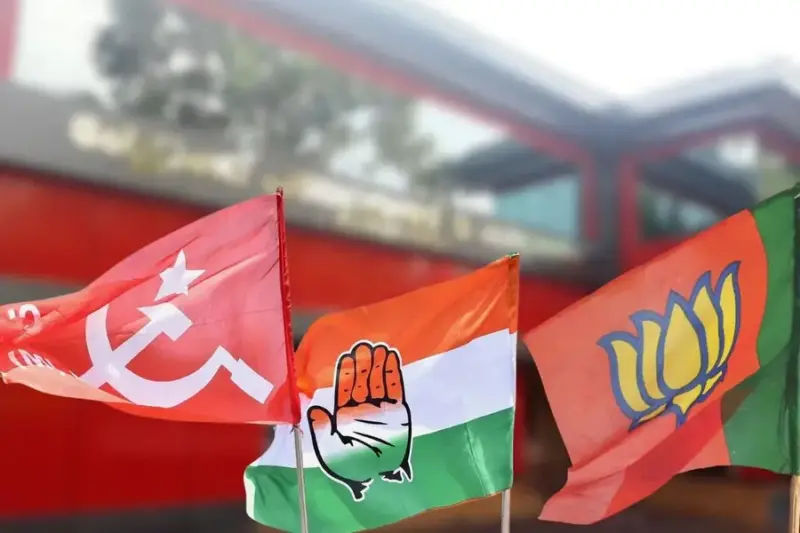

Kerala's all-important Assembly election is barely days away. The stakes are high for all three political fronts, though to varying degrees.
For the LDF, a victory is crucial to retain what is now its last major bastion in the country. The UDF faces an existential moment: a third consecutive defeat could rupture its nearly half-century-old coalition. The NDA, though still a marginal force in terms of seats, has reputational stakes-especially after its symbolic and prestigious breakthrough in the Thiruvananthapuram Corporation.
Yet the most striking feature of this election is not a visible surge for any front-but the absence of one. Kerala, for many decades, followed a predictable electoral pattern - alternation of power between the LDF and the UDF. This "revolving-door" system functioned as an embedded democratic corrective which ensured accountability among parties and prevented them from taking voters for granted. Rare deviations from this were driven by exceptional circumstances-such as the post-Emergency churn of 1977 or the extraordinary context of the COVID-19 pandemic in 2021. These freak outcomes first enabled the UDF and then the LDF to break the cycle and secure a second consecutive term.
Logically, a government seeking a third term after ten uninterrupted years should face a formidable anti-incumbency wave-particularly in a state like Kerala known for its choosy voters. It was clearly evident in the 2024 Lok Sabha and Local bodies polls last year. Interestingly, such sentiments have been openly expressed not only by the LDF's critics or the non-partisan public but even by staunch Left supporters, including prominent cultural leaders. Their argument, though, sounds a tad romantic for an electoral warfare, but it is not entirely without logic. According to these "critical insiders", the Left should be defeated this time for the sake of its own survival, as the long innings in power have led to deep internal decay. They believe a stint in the Opposition could cleanse the LDF of complacency, cut the flab, and help it rebound slim and trim. They back the argument by pointing to West Bengal, where, despite its long political, cultural and social hegemony, the Left is yet to reappear after a single woman threw them into the Bay of Bengal over a decade ago.
And yet, as the campaign draws to a close, a perceptible wave remains elusive.
Pre-poll surveys across the spectrum, conducted by national or regional agencies, including those by media houses not sympathetic to the Left, though give the UDF an edge, do not indicate any sweeping surge against the incumbent. Except in districts where Muslim and Christian communities dominate, the LDF appears capable of holding ground in the rest of the state-albeit with reduced margins. Outside a few traditional UDF strongholds, like Malappuram or Ernakulam, the contest appears remarkably balanced, indicating a sharp tripolar contest. Though a few predict the return of the LDF, most surveys say that the UDF will be ahead albeit, marginally. They also foresee that the NDA may reopen its account, which was closed in 2021. Certain surveys point to the possibility of even a hung assembly.
That the Left base remains largely intact is no small deal after ten years in power and being opposed by forces ranging from one end to the other end of the ideological spectrum, besides being targeted by a belligerent media, almost in unison. If anything, the more compelling headline for the surveys might well have been the absence of a decisive anti-incumbency wave.
The LDF has historically demonstrated an uncanny ability to rebound in Assembly elections, even after setbacks in immediately preceding parliamentary contests, as seen in 2019 and 2021. Though its lacklustre performance in the Local Self-Government polls is challenging, the LDF's vote share has improved since the Lok Sabha elections. Moreover, its campaign has foregrounded enhanced infrastructure development and welfare systems despite having endured unprecedented natural disasters and financial suffocation from a less-than-friendly central government. These themes continue to resonate with large sections of the electorate. A decade relatively free of corruption at high places and communal violence, too, has been highlighted repeatedly.
At the centre of this narrative stands Chief Minister Pinarayi Vijayan. His image as an efficient, decisive administrator-though often rightly criticised as authoritarian-retains a cross-sectional appeal. This appears to align with the contemporary global phenomenon of fascination with strong leaders, even in well-entrenched democracies. A recent Gallup World Poll pointed to the sustained appeal of leaders associated with economic performance and stability across countries. Similarly, a Pew Research Centre survey in 2023 found significant support worldwide for strong, decisive leadership, with India registering particularly high approval at 85%.
By contrast, the UDF appears to suffer from a leadership vacuum. The era of towering figures like K. Karunakaran, A. K. Antony, and Oommen Chandy-leaders who commanded authority across regions and communities despite the factional games they played-has passed. Though KC Venugopal, Ramesh Chennithala and VD Satheesan aspire to rise to the level of their predecessors, their appeal appears much more restricted, at least for now. While the absence of a centralised strongman may be normatively healthier for democracy, the lack of a unifying figure capable of managing internal contradictions, vaulting ambitions, and projecting administrative coherence can be electorally costly. Persistent jockeying for the next Chief Ministership within the Congress only deepens voter uncertainty.
That said, the UDF's principal strength lies in the apparent consolidation of minority communities, particularly Muslims, behind it. Rahul Gandhi and Priyanka Gandhi's embrace of Kerala as their electoral turf has helped revive minority confidence in the Congress as a viable national counterweight to the BJP.
Conversely, the CPM's recent political positioning has complicated its outreach to minorities. Consolidation of minorities behind the UDF and the erosion of traditional pro-Left Hindu votes towards the saffron side appear to have prompted the CPM to do some desperate social engineering exercises. Its tactical engagement with "anti-Muslim" leaders like the Ezhava supremo Vellappally Natesan and its strident criticism of organisations such as the Muslim League and the Jamaat-e-Islami Hind-particularly after the latter supported the UDF-have been perceived by sections of the Muslim community as antagonistic. Neither did the CPM correct the impression through intelligent political messaging. Panicked by the changed social equations and the sensational eruption of the gold theft at Sabarimala, CPM softened its positions on issues like women's entry into the shrine, engaged with Hindu groups, and held a global Ayyappa Conference. These contributed to the perception of a "soft-Hindu" shift, resulting in both the minorities and large sections of the majority community distancing themselves from the LDF.
Yet, minority consolidation within the UDF is not without fault lines. Tensions between Muslim and Christian communities persist, with sections of the Church expressing concern over what they perceive as disproportionate influence of the Indian Union Muslim League within the alliance. Islamophobic narratives by prominent Church leaders, such as "love jihad" and "narcotic jihad"-however contested-have found resonance in certain quarters, reflecting a growing undercurrent of mistrust. The Kerala Congress (M) 's shift to the LDF underscored these anxieties. Whether these internal contradictions will blunt the impact of minority consolidation remains an open question.
The BJP's evolving role further complicates the electoral landscape. From a marginal presence, it has expanded its vote share significantly over the past two decades, disrupting Kerala's traditional bipolarity. Its strategy now appears more targeted, focusing on a limited number of constituencies where it has demonstrated competitiveness. This strategy has fuelled mutual allegations between the LDF and UDF of tacit understandings with the BJP in select seats-charges that, while difficult to substantiate, contribute to the overall climate of suspicion.
At the same time, though there may be no official deals between the parties, one often meets sections of pro-Hindutva voters who think differently. According to one such section, though the NDA may win a few seats, since it is unlikely to come to power, UDF should be backed to keep the "God-less" Left in bay. Conversely, there is also a section within that side which considers the LDF a better option than a Muslim League-dominated UDF in power. In an increasingly hazy political atmosphere where there are no perceptible waves, all such mutually warring thinking processes may play out in quite unpredictable manners.
However, the NDA's prospects may be constrained by multiple factors: a possible erosion of Christian support accentuated by the new Foreign Contribution Regulation Amendment (FCRA) bill which has triggered a massive protest from the Christian Churches, dissatisfaction over perceived neglect by the Union government in matters such as financial allocations and disaster relief, and the absence of major project announcements even during high-profile visits by Prime Minister Narendra Modi to thank the voters for helping his party capture the Thiruvananthapuram Corporation.
Taken together, these dynamics produce an electoral landscape marked less by sweeping currents than by cross-cutting undercurrents. The visible signs of a decisive wave are absent. Instead, what emerges is a finely balanced contest in which marginal shifts across regions and communities could determine the outcome.
This election also marks Kerala's definite entry into the post-ideology era. Defections of parties across UDF and LDF were not uncommon in Kerala, though the "Aaya Ram Gaya Ram" phenomenon has never been as common as in North India. Even CPM's top leaders like KR Gouri or MV Raghavan or Congress veterans like K Karunakaran had shifted between the two fronts. But few had dared to cross over to the other end of the ideological spectrum, held by the BJP. Perhaps the saffron party's insignificant role in Kerala those days might also have been a reason. But all such secular inhibitions now appear to have vanished. In the beginning, the migration was from the rank and file of the two fronts, but now it looks like the turn of the leaders. Padmaja Venugopal and Anil Antony, the daughter and son of Kerala's tallest Congress leaders, recently crossed over to the saffron camp. This election saw two senior Left leaders -former MLAs of the CPM and the CPI- joining the BJP, for the first time.
The real question in the final run-up to this election may not be whether there is a wave-but whether a silent one is gathering beneath the surface, waiting to reveal itself only when the ballots are counted.