

Kolkata/Chennai: Polling has begun in two politically significant states, West Bengal and Tamil Nadu, both of which the Bharatiya Janata Party (BJP) has struggled to capture historically.
In West Bengal, nearly 3.6 crore voters are eligible to cast their ballots in the first phase, covering 152 of the state's 294 constituencies across 16 districts.
Key battlegrounds in this phase include Nandigram and major north Bengal regions such as Darjeeling, Siliguri, Jalpaiguri and Cooch Behar. The second phase of polling is scheduled for April 29.
Tamil Nadu will vote across all 234 constituencies in a single day, setting up a high-intensity political contest across two very different electoral landscapes.
Bengal phase 1: Bipolar battle under heavy security
In West Bengal, polling is being conducted in 152 constituencies spread across 16 districts, covering regions from the northern hills to central and industrial belts.
The contest has largely consolidated into a direct face-off between the ruling Trinamool Congress (TMC) and the BJP, turning this phase into a high-stakes political showdown.
The campaign leading up to polling day saw a sharp escalation in rhetoric, with leaders from both camps trading allegations over governance, identity politics, and law and order.
Union Home Minister Amit Shah led the BJP's final push with a series of rallies, outlining welfare promises and attacking the state government, while Chief Minister Mamata Banerjee countered with accusations of external interference and attempts to influence voters.
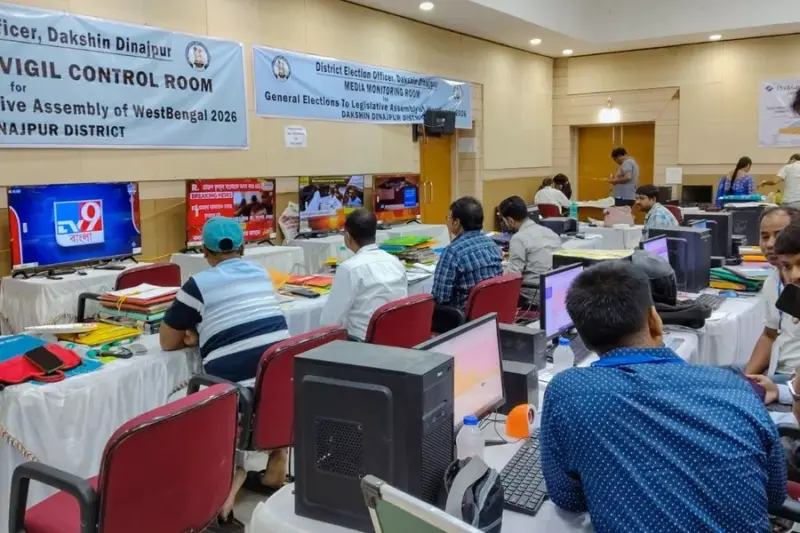
Security arrangements reflect the intensity of the contest. Thousands of surveillance teams and flying squads have been deployed to monitor violations and ensure swift action.
Unprecedented security cover
Polling in Bengal's first phase across 152 Assembly constituencies will be conducted with an extensive security grid in place.
A total of 2,407 companies of central forces have been deployed across these seats, with Murshidabad alone accounting for 316 companies, the highest deployment in any district.
At the booth level, security presence has been calibrated based on the number of polling stations within a centre.
Each booth will have at least four central personnel. If a polling station has three to four booths, eight personnel will be deployed; centres with five to six booths will have 16 personnel, while those with seven to eight booths will be guarded by 24 central force personnel.
Central forces will also secure a 100-metre perimeter outside every polling station. Inside, at least one baton-carrying police officer or home guard will be stationed at each booth, while additional personnel will be assigned to manage voter queues.
In total, around 41,000 state police personnel have been deployed for the first phase, forming a layered security arrangement aimed at ensuring orderly and peaceful polling.
Several constituencies in this phase are drawing significant attention due to closely fought contests and high-profile candidates.
Suvendu Adhikari remains one of the central figures, with his contest being closely watched given its political significance.
Other seats across regions are witnessing repeat battles from the previous election, where narrow margins had made outcomes highly unpredictable.
Adding another layer of complexity is the controversy surrounding the Special Intensive Revision (SIR) of electoral rolls.
The exercise, conducted under judicial supervision, has led to major changes in voter lists and sparked a political divide. While the ruling party has alleged voter suppression, the opposition has defended the process as a necessary clean-up.
Tamil Nadu votes in single phase, triangular contest emerges
In contrast, Tamil Nadu is holding elections across all 234 constituencies in a single phase, with an electorate exceeding 5.7 crore voters. The state's politics, traditionally dominated by a bipolar structure, has taken on a more complex character this time.
The ruling Dravida Munnetra Kazhagam (DMK), led by Chief Minister MK Stalin, is seeking a renewed mandate based on its governance record and welfare initiatives.
The opposition All India Anna Dravida Munnetra Kazhagam (AIADMK), headed by Edappadi K Palaniswami, has attempted to mount a strong challenge through alliances, including with the BJP.
However, the entry of actor-turned-politician Vijay and his party Tamilaga Vettri Kazhagam (TVK) has added a third dimension to the electoral contest.
By fielding candidates across constituencies, the new entrant has the potential to alter traditional vote shares and make several races more competitive.
Key constituencies across the state are witnessing multi-cornered fights, with senior leaders and emerging challengers going head-to-head.
The election is as much about narrative as it is about numbers, whether the ruling alliance's governance pitch holds ground, or the opposition and new entrants succeed in reshaping voter sentiment.
Security, scale, and stakes across two states
The scale of the elections in both states has necessitated extensive security and monitoring measures.
In Tamil Nadu, coordinated deployment of state police, central forces, and election monitoring teams has been put in place to ensure smooth voting.
Authorities have emphasised strict vigilance against inducements, cash distribution, and other electoral malpractices.
As polling progresses, the outcomes in both states are expected to carry significant political implications. In West Bengal, the results will test the strength of a sharply polarised contest, while in Tamil Nadu, they will reveal whether the traditional two-front system can withstand a new political challenger.