
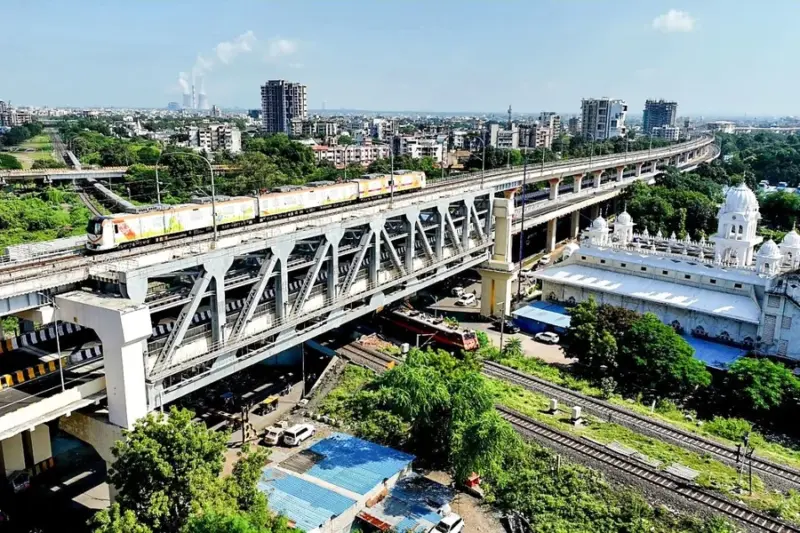

Bengaluru has marked a major milestone in urban infrastructure with the full operationalisation of its first double-decker metro flyover at the Central Silk Board junction.
The project, a first-of-its-kind road-cum-rail structure in South India, is expected to ease congestion for thousands of daily commuters.
All five flyovers now open
With the opening of the final two stretches, all five flyovers - A, B, C, D and E - are now functional. Built by Afcons Infrastructure Ltd, the combined structure spans 3.2 km and forms part of the elevated section of the Bengaluru Metro's Blue Line (Phase 2A).
The double-decker flyover is integrated into the 9.8 km elevated corridor connecting Silk Board to KR Puram under the Namma Metro expansion. The project aims to reduce bottlenecks at key traffic junctions along the Outer Ring Road.
Also read | 'Don't cross the yellow line': How Kochi Metro's alarm system works and why it matters
Engineering complexity and execution
Officials highlighted the complexity of constructing a five-level structure at one of the city's busiest intersections. Due to heavy traffic and space constraints, construction work was limited to a narrow overnight window between midnight and early morning hours.
Authorities estimate that commuters can now save up to 30 minutes of travel time. The newly opened flyovers allow smoother movement between HSR Layout, BTM Layout, Ragigudda, and Electronic City, reducing dependence on traffic signals at Silk Board.
Key structural highlights
- Flyover D is the tallest at 28 metres, forming the fifth level of the structure
- The system allows signal-free movement across multiple directions
- The junction, previously one of the most congested after Hebbal, is expected to see sustained decongestion
Earlier phases opened in 2024 enabled traffic from Ragigudda and BTM towards HSR Layout and Electronic City to bypass the Silk Board signal. With the final links now operational, additional routes - especially HSR to BTM - can avoid the junction entirely.
Afcons Infrastructure Ltd, part of the Shapoorji Pallonji Group, executed the project. The company has decades of experience in complex engineering projects and is ranked among leading global contractors in infrastructure development.