

A year ago, in a small town near Cuddalore in Tamil Nadu, a newborn became the centre of fear. Why?
The child's body did not fit the expectations of "male" or "female".
Panic spread quickly through the family. Relatives whispered that something was wrong, that the baby was a "sin", that something must be "fixed".
Someone found *Vino Dhan.
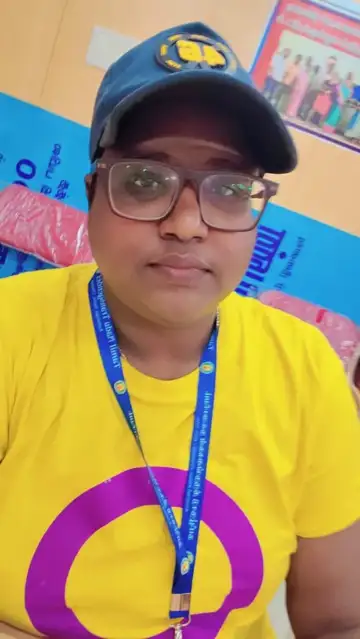
"They called me because they were scared," says Vino Dhan, a 33-year-old intersex person from Coimbatore, Tamil Nadu. "I went there and told them, there is nothing wrong with your child… Let the child grow."
The parents listened. They chose to raise the baby without forcing a label. But the pressure did not stop. Neighbours and relatives continued to intervene, urging them to "correct" the child.
Then came the Transgender Amendment Bill, 2026.
"After March 30, the father called me again," they recall. "He was panicking. He asked me - 'Is everything that people are saying true? Is this bad?'"
For Vino Dhan, that moment captures what is at stake.
"My question is, what was the need for this bill to be cleared in a hurry," they ask. "Without awareness, without consulting us, you are creating fear among innocent people."
"Many people don't even know what an intersex person means," Vino Dhan says.
Intersex people are born with sex characteristics - genitals, chromosomes, or reproductive organs that do not fit typical binary definitions of male or female bodies. It is a natural biological variation, affecting an estimated 1.7% of the population. It is not the same as being transgender, which relates to gender identity rather than biology.
Yet, in public discourse and policy, the two are often merged.
"For easiness, the government is putting intersex people into the transgender category," they say. "But intersex is biology. Transgender is identity. They are not the same."
"In Tamil Nadu, I personally know, maybe, 20 people. Many are hidden. Many live a fake life and merge into other identities because society does not accept them."
Growing up without language
Vino Dhan was 13 when they realised they were different.
"I was born as female, but I had male genital organs," they say. "At school, people would ask questions. I didn't understand my own body."
Their parents, without formal education, were unprepared.
"My family didn't know anything. My father was a painter, a daily wage labourer. My mother is an agricultural worker. When my body started changing, it was shocking for them," they recall. "They took me from temple to temple. That is all they knew."
It was only during a diploma in radiology that things began to make sense.
"That is when I got awareness," they say. "That is also when I learnt about my genetic condition."
MORE IN THIS COVERAGE | A trans woman's question as India rewrites identity law
They were born with 46 XY chromosomes, typically associated with male biological development, but their body did not function in conventionally male ways.
"Physically, I look female. There is breast development. No beard, no body hair. The male organs were present, but they did not function."
Medical decisions, one after the other
Fear has shaped many of Vino Dhan's medical choices.
"People told me my male organs could become cancerous," they say. "After my father's death, my family got scared. They didn't want to lose me too. So they forced me into surgery."
In 2022, they underwent a procedure to remove their testicles.
"Everyone approached it as - 'she is a girl, she is removing unwanted organs'," they say. "But my identity is fluid. I cannot fully differentiate."
The aftermath was difficult.
"After the surgery, I developed complications - diabetes, thyroid issues," they say. "Doctors told me it was a by-birth condition, not necessarily because of the surgery. My hormone system is slow."
Their health challenges extend beyond this. Vino Dhan also lives with Retinitis Pigmentosa, a genetic condition that progressively reduces vision.
"I was told I cannot practise radiology because of my eyesight," they say.
Education without employment
Despite these setbacks, Vino Dhan continued studying.
They hold a diploma in radiology and a Master's degree in psychology.
Yet, employment remains out of reach.
"I am a postgraduate. I still don't have a job," they say. "Now I am preparing for government exams."
Their household survives on a modest ₹1,000 monthly allowance from the Tamil Nadu government and their mother's irregular income.
"My mother is diabetic. She cannot work regularly," they add. "My vision is also getting worse."
"Don't decide for children"
If there is one issue Vino Dhan speaks about with urgency, it is surgeries on intersex children.
"Sex-normalising surgery for minors should be stopped," they say. "Let children grow. Let them decide for themselves. Don't force them into what society wants."
Their stance comes not just from personal experience, but from witnessing others.
"They don't even understand what is being done to their bodies," they say. "Later, they have to live with the consequences."
Systems that humiliate
Even accessing official recognition has been difficult.
Tamil Nadu has introduced a separate intersex identity card, but the process, Vino Dhan says, is exhausting.
"To get the card, I had to go back and forth to hospitals for six to eight months," they say. "Even doctors didn't have awareness. They told me - 'just convert and be female'."
Medical boards, they say, are often dehumanising.
"When we go there, doctors call students and show our bodies as examples," they say. "It is humiliating. Are we objects?"
And now, the Trans bill has become law.
They question the requirement to prove identity before authorities.
"Why should I go to a District Magistrate to show my gender?" they ask. "Are we asking others to prove who they are?"
A widening gap
For Vino Dhan, the current legislative approach risks deepening marginalisation.
"Many intersex people already have disabilities," they say. "With this bill, you are pushing us further down."
They believe the lack of consultation is a fundamental flaw.
"The government is doing things without asking us," they say. "If you don't speak to the community, how will you know what we need?"
"Even if I lose my vision…"
Despite everything, Vino Dhan continues their advocacy, working with networks such as Intersex India to raise awareness.
They recall their college years as a time of intense mental health struggles.
"Only after college did I realise this is not just my issue," they say. "There is a whole community."
"Even if my vision completely goes, I am ready to come to the streets and shout for our rights," they say.
They pause, then return to the child in Cuddalore, the one whose life briefly shifted because someone took the time to explain.
"That is all we need," they say quietly. "Awareness. Not fear. We are normal, after all."
* Vino Dhan is an intersex person from Coimbatore, Tamil Nadu, who uses they/them pronouns.
MORE IN THIS COVERAGE | 'Transgender amendment redefines who gets to say THIS IS WHO I AM'