
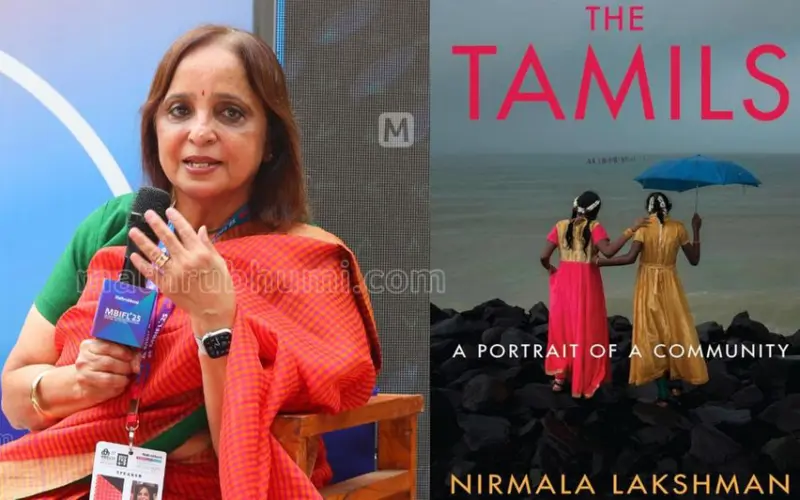

The Tamils- A Portrait Of A Community, penned by Nirmala Lakshman, provides a panoramic and comprehensive history of the Tamil people, who have a unique place in India's cultural landscape.
Nirmala is currently Publisher and Chairperson of The Hindu Group of Publications. She founded and edited The Hindu Literary Review, formulated Young World, India's only children's newspaper supplement, and conceptualised several other feature sections of The Hindu. She launched The Hindu's annual literature festival and continues to curate it. Nirmala has a PhD in postmodern fiction, and has to her credit a book on Chennai, 'Degree Coffee by the Yard : A Short Biography Of Madras'. She spoke to Mathrubhumi after her book launching session at the MBIFL. Excerpts from the interview.
Your introduction to the book is titled Jasmine. It reminds one of Annadurai's famous remark that even the jasmine flowering in the enemy's garden also smells sweet. What a lovely way of putting across the concept of tolerance! While writing 'The Tamils' you must have felt deeply the prevalence of tolerance as part and parcel of Tamil culture?
Jasmine has been very dear to the Tamil people. It symbolises the love and affection of the Tamils as a community. There have been waves of migration into Tamil Nadu from across the world. The Arabs, the Portuguese, the Dutch and the British and the North Indians were welcomed without any reservations. Amalgamation of different cultures is core to the identity of the Tamils. We have learnt to co-live. Most of the migrants came peacefully. They came as traders not as invaders.
Dissent is the soul of democracy. Being the chairperson of one of the most influential media houses down South, you must have been experiencing the reality that the space for tolerance is getting shrunk day by day. The authorities tend to criminalise dissent. How do you look at this development?
In agreement absolutely. The media is bound to speak truth to power. These days we do witness a rise in confrontations. The resistance should come from the communities themselves. We should stand up against the intolerant forces. We should promote humanity across the borders. The Indian constitution upholds secularism and tolerance. Plurality is its cornerstone. people's voices, however, excluded should be heard. Religion and caste have been used to suppress people. Democracy demands dialogue. There should be constant interaction among the various stakeholders.
This brings us to the relevance of diversity which was emphasised by Dr B R Ambedkar. The Indian republic and the constitution have turned 75. But we are still far behind in terms of achieving representative democracy. Due representation of the marginalised sections in the corridors of power is still lagging behind. What are your reflections?
Diversity means every voice is of equal importance. This should be the foundation of our education. Discrimination on the basis of caste has been the curse of our society. People shouldn't be judged by the clan of their birth or the colour of their skin. The mass media has a huge responsibility to address this issue. Though we have the policy of reservation to create a level playing field, I think the target is missed quite often. We should take up affirmative action in this regard.
Prof Mohan Gopal, the former director of National Judicial Academy has pointed out in a conversation with Varghese George that the constitution has been a site of struggle. What is your take?
What a beautiful expression! Our constitution has evolved out of a series of struggles which have broadened the horizons of democracy. The commitment to social justice is a basic feature of the constitution. But many of the goals have not yet been achieved. We have a long way to go. We have to ensure that the most excluded member of our society is able to taste the fruits of democracy. It is amazing to hear about the constitution being referred to as a site of struggle. It captures the very essence of the evolution of our journey.
The fight against injustice has been prevalent among the various communities in Tamil Nadu. Your observations?
Silappathikaram, the ancient text is a standing testimony to this. The way Kannagi fights for justice is highly remarkable. Remember King Paari who offered his royal chariot as a support for the jasmine creeper. You could come across various such examples that vividly illustrate the sense of fairness and justice in the Tamil communities.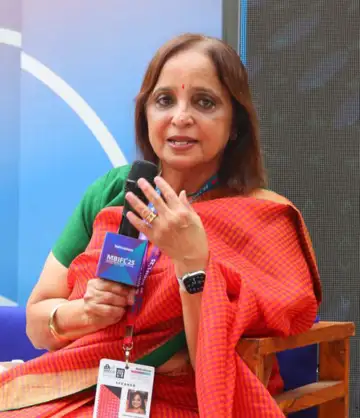
Your book traces the remarkable journey of the people of Tamil Nadu, starting from the Stone Age (1.7 million years ago) all the way to the epic Sangam era (300 BCE to 300 CE), whose literature highlights the influential role of dynasties like the Pallavas, Pandyas, Cholas and Cheras, and the thriving Jain community of that time. The subtitle of your book is ' A Portrait of A Community.' Can the Tamils be viewed as a homogenous community?
There are many distinct features that stand apart when we examine the cultural strands of the Tamils. I travelled across Tamil Nadu many times to get material for my book. A Portrait of a community denotes the universality of Tamil culture. It doesn't negate the polyphonic nature of the Tamils. For example the Tamil Muslims are different from their counterparts in the North. There are multiple narratives, multiple cultures and multiple slangs that add to the beauty of the cultural landscape. You simply can't place Tamil identity under one umbrella.
In one of your interviews you speak of your love of reading books. Reading is one thing and writing is an entirely different act altogether. How has your experience been?
David Davidar, the publisher of Aleph, put forth the suggestion in 2019. It took four and half years to complete the book. I talked to various people who helped me with their insights into the subject. Sometimes the ordinary people gave me the much needed perspective and understanding about the deep layers of Tamil culture. A Muslim girl with a hijab who used to put vibhuti on her forehead was a revelation into the amalgamation of different cultural strains. It was a whole lot inspiring and motivating. One of the greatest lessons that I learnt is the deep respect for the Tamil people and the language. I was profoundly moved by the integrity of the ordinary people. They shared their knowledge very generously. It taught me that nothing should be taken for granted. I came to realise that we shouldn't be judgemental about people. There are many stories that are waiting to be told.
The voice of independent journalism has been under constant threat from various quarters. How do you manage to sustain independent and fair journalism these days?
We have to fight many cases . The centres of power don't like independent spirited journalism. We don't interfere with the editorial work. Our editorial team is competent enough to pursue the path of independent journalism. The Publisher's duty is to extend support and we do that with total dedication. It is our firm belief that we should stand by the truth.
Justice SK Kaul has famously remarked in his verdict on the case related to writer Perumal Murugan, that there should be freedom after speech. He made it crystal clear that one should have the freedom to exist after the speech. Many journalists have been targeted by the state for speaking truth to power. How do you find the media landscape now?
I think it is up to the civil society to take this forward. The people should come forward to regain the spirit of democracy. I really love the expression 'freedom after speech.' We owe much to judges like Justice S K Kaul who have strived much to help us repose our faith in democracy. I have great faith in the Indian people. Remember how the ordinary Indian people fought against the authoritarian regime during the emergency. It was the poor people of North India , who regained democracy in 1977. Independent journalism cannot survive without the support of the people.
The online media is on the rise. One concern is that the availability of free content weakens the very survival of the media. Do you think going behind a paywall is the way out?
The question is how we can deliver justice to the concept of an informed citizenry amidst the struggles to survive. If we put everything behind a paywall that will be detrimental to democracy. So, we have taken a decision to deliver free content as far as possible. We can not keep every story exclusive. If the people don't get to read them our effort will be in vain.
What makes you optimistic in these difficult times?
I have huge trust in the people. Please look at the election results. The last Lok Sabha elections showed the ability of the Indian people to deliver surprises. They can see through the various layers. They know how to uphold the spirit of democracy. They know their rights and entitlements. They know how to teach those who violate the fundamental principles of democracy some valuable lessons. Journalism will never die as long as there are people who would hold the powerful to account.