




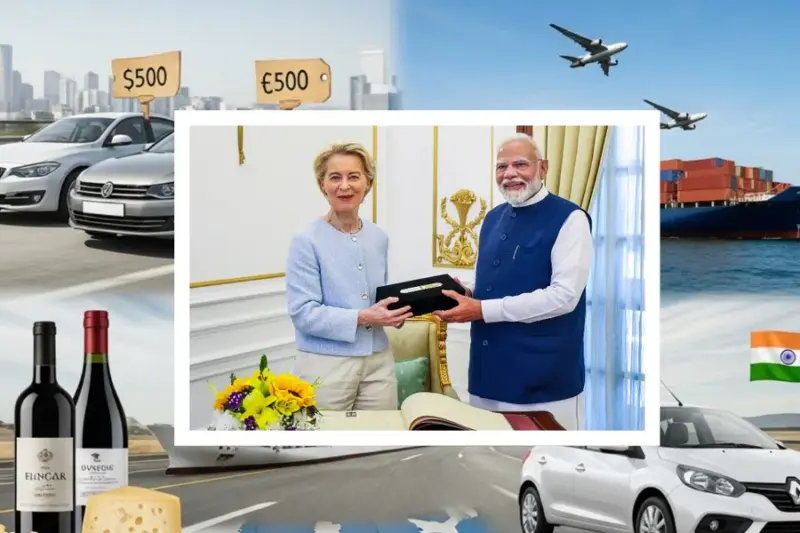

Mumbai: India and the European Union are expected to announce a major free trade agreement (FTA) during the India-EU summit scheduled between January 25 and 28, with a possible declaration on January 27 following Prime Minister Narendra Modi's meetings with senior EU leaders.
Government sources from both sides confirmed to Reuters that negotiations are nearing completion after years of delays.
What is the EU trade deal?
India and the European Union are close to finalising a long-pending free trade agreement (FTA) after years of stalled negotiations. Government sources have indicated that the deal could be announced during the India-EU summit scheduled between January 25 and 28, following meetings between Prime Minister Narendra Modi and top EU leaders, including European Commission President Ursula von der Leyen.
Negotiations were restarted in 2022 after a nine-year pause and have gained urgency amid shifting global trade dynamics and rising protectionism.
What does a free trade agreement mean?
A free trade agreement is a pact between two economies to reduce or eliminate import tariffs and simplify regulatory barriers. The aim is to encourage trade, investment and economic cooperation by making goods and services cheaper and easier to exchange across borders.
For consumers, FTAs often translate into lower prices and wider choices. For businesses, they open access to larger markets and more competitive supply chains.
What could get cheaper for consumers?
One of the most visible impacts of the deal could be lower import duties on European cars and wine. At present, India imposes steep tariffs on imported vehicles, making brands such as BMW, Volkswagen and Renault significantly more expensive.
If tariffs are reduced under the agreement, European cars could become more affordable, particularly in the premium segment. Similarly, lower duties on wine could reduce prices of European labels, especially from France, Italy and Spain.
What does the EU gain?
The European Union sees India as a fast-growing consumer market and the world's third-largest automobile market. Reduced tariffs would help European manufacturers expand their footprint and compete more effectively.
The EU is also seeking greater market access for sectors such as renewable energy, machinery, services and digital trade, while strengthening supply chains outside China.
How Indian exporters could benefit
Indian exporters stand to gain wider access to European markets, particularly in labour-intensive and manufacturing sectors. Officials say the deal could boost exports of:
- Textiles and garments
- Jewellery and gems
- Leather goods
- Electronics
- Chemicals and pharmaceuticals
The EU currently imports nearly $125 billion worth of textiles annually, but India's share remains relatively small compared to competitors such as China, Bangladesh and Vietnam.
Why the timing matters
The talks have accelerated amid rising global trade tensions. In August 2025, the United States sharply increased tariffs on Indian goods, pushing India to diversify export destinations.
At the same time, the EU has withdrawn certain tariff benefits previously extended to India under a special trade scheme, affecting exports worth nearly $2 billion. An FTA could help offset those losses.
Beyond trade: defence and mobility
Alongside the trade pact, India and the EU are expected to sign agreements covering security cooperation and mobility. These could include provisions to ease movement for skilled professionals and students, potentially expanding education and employment opportunities in Europe.
What are the remaining hurdles?
Despite progress, key differences remain. India has been cautious about sharply reducing auto tariffs to protect domestic manufacturers. New EU regulations, including a carbon border tax on imports such as steel and cement, are also a concern for Indian exporters.
Trade experts note that last-mile negotiations are often the most complex, and final approval will require ratification by the European Parliament, a process that could take at least a year.