




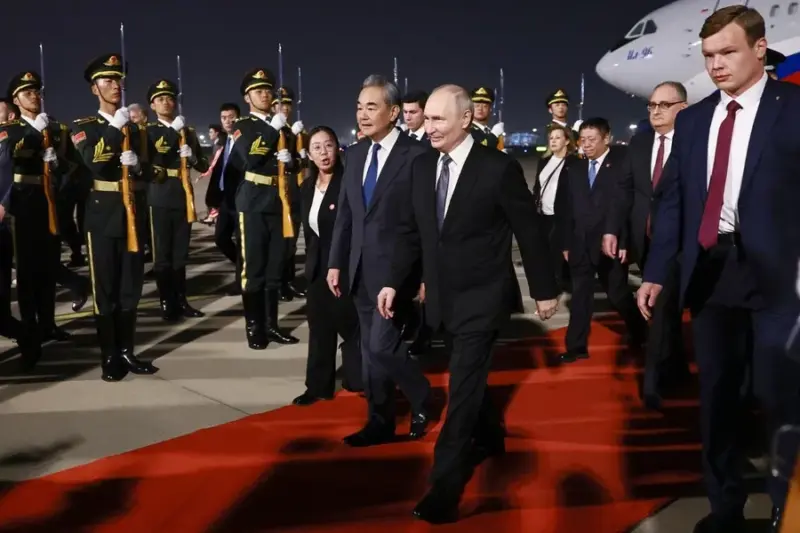

Beijing: Russian President Vladimir Putin arrived in China on Tuesday night for a two-day visit that is expected to focus on economic cooperation, global security issues and the evolving geopolitical landscape.
The visit comes less than a week after US President Donald Trump concluded his own trip to Beijing, placing renewed attention on China's diplomatic balancing act between Washington and Moscow.
Ceremonial welcome in Beijing
Putin's aircraft landed in Beijing late Tuesday, where he was received by Chinese Foreign Minister Wang Yi, alongside an honour guard and groups of young people waving Chinese and Russian flags.
The welcoming crowd, dressed in light blue shirts, chanted greetings as the Russian leader arrived for his latest round of talks with Chinese President Xi Jinping.
Focus on economic and strategic cooperation
According to the Kremlin, discussions between Putin and Xi are expected to cover trade ties, economic cooperation and major international and regional developments.
The trip also coincides with the 25th anniversary of the Sino-Russian Treaty of Friendship signed in 2001, a landmark agreement that laid the foundation for deeper ties between the two countries.
China remains one of Russia's most important economic partners, particularly after Moscow launched its full-scale invasion of Ukraine in 2022. Although Beijing has repeatedly maintained that it is neutral in the conflict, it has continued commercial engagement with Russia despite sanctions imposed by the United States and European nations.
Ahead of his arrival, Putin described relations between Moscow and Beijing as being at "a truly unprecedented level", according to China's state-run Xinhua News Agency.
He said the partnership carried major importance for global stability and international affairs.
Kremlin denies link with Trump visit
Russian presidential aide Yuri Ushakov said there was "no connection" between Trump's recent visit to China and Putin's trip, stressing that arrangements for the Russian president's visit had already been finalised following a videoconference between Putin and Xi on February 4.
Analysts in Beijing suggested the two diplomatic engagements reflected China's attempt to maintain strategic flexibility.
Wang Zichen, deputy secretary-general of the Beijing-based think tank Center for China & Globalization, said Trump's visit was aimed at stabilising relations between China and the United States, while Putin's visit focused on reassuring a long-term strategic partner.
"For China, these two tracks are not mutually exclusive," he said.
Longstanding personal diplomacy between Xi and Putin
Putin last travelled to China in September 2025 for the Shanghai Cooperation Organisation summit in Tianjin, where he also attended a military parade marking the 80th anniversary of the end of the Second World War.
During that visit, Xi referred to Putin as an "old friend", a term considered highly significant in Chinese diplomatic language and rarely used for foreign leaders.
Putin, in turn, addressed Xi as "dear friend"
Earlier this year, Russian Foreign Minister Sergey Lavrov visited Beijing and met Xi, who described ties between the two countries as "precious" under current global conditions.
Xi reportedly said both nations should work together to defend shared interests.
Russia seeks closer coordination with China
Kremlin spokesman Dmitry Peskov said Putin's visit would also provide an opportunity for Russia and China to exchange views regarding Moscow's discussions with the United States.
During Trump's recent visit, Xi had described China-US ties as the world's most important bilateral relationship and said the two countries should treat each other as partners rather than rivals.
At the end of the summit, both governments announced plans to work towards a new framework aimed at maintaining "a constructive China-US relationship of strategic stability".
Wang Zichen said Beijing was attempting to preserve stable relations with Western countries while also maintaining strategic trust with Moscow.
He added that China was seeking enough diplomatic space to position itself as a major power capable of engaging with all sides.
Energy trade remains central to talks
Energy cooperation is expected to feature prominently during the discussions.
China has emerged as Russia's largest trading partner since the war in Ukraine began and remains a major buyer of Russian oil and gas.
Moscow is also anticipating increased energy demand linked to the conflict involving Iran.
Western governments have repeatedly criticised Beijing for continuing exports of high-tech components that support Russia's defence industry, though China has rejected such accusations.
According to Ushakov, Russian oil exports to China rose by 35 per cent during the first quarter of 2026, while Russia has become one of China's leading natural gas suppliers.
Referring to the crisis in the Middle East, Ushakov said Russia continued to be a dependable energy supplier and China a "responsible consumer".
Putin signals progress on oil and gas cooperation
Earlier this month, Putin said Moscow and Beijing had made "a very substantial step forward" in energy cooperation, particularly in the oil and gas sector.
"Practically all the key issues have been agreed upon," he said, adding that he hoped remaining details could be finalised during the current visit.
The Russian president also described cooperation between Russia and China as an important stabilising force in global affairs.
"Interaction between such nations as China and Russia undoubtedly serves as a factor of deterrence and stability," Putin said.
He further added that Moscow viewed improving dialogue between China and the United States positively, saying stronger engagement between the two powers would contribute to global economic stability.
"We stand only to benefit from this, from the stability and constructive engagement between the US and China," Putin said.
Agency inputs