




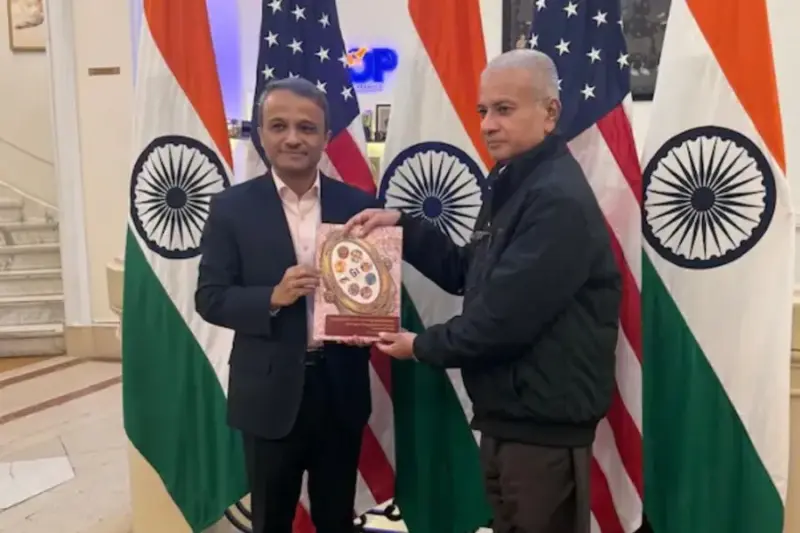

Raju Narayana Swamy, senior IAS officer and noted author, has come out with a new book exploring the global legal framework of Geographical Indications (GI), drawing attention from academics, legal scholars and policy experts.
Titled 'Towards Robust Laws and Strong Jurisprudence: The Saga of Geographical Indication Across the Globe', the book examines how stronger GI protection mechanisms can contribute to sustainable development and the creation of social capital. The publication argues for a transition from a state-driven and trader-centric GI system to a more grassroots, producer-oriented model.
The book, which marks the 36th publication authored by Dr Swamy, was released in New York by Binaya Srikanta Pradhan during a special event.
The work provides a detailed analysis of the international GI regime, legal frameworks governing geographical indications, trans-border GI disputes and case studies from across the world.
Apart from his administrative career, Dr Swamy is also known for his literary contributions. His travelogue Shantimanthram Muzhangunna Thazhvarayil won the Sahitya Akademi Award, while Neelakkurinji: Oru Vyazhavattathile Vasantham earned the Kerala State Award for Children's Literature.
He was recently in the spotlight for serving a record 38 times as a Central Observer for the Election Commission of India, including an assignment as an International Observer during Zimbabwe's 2018 elections.
In 2021, Dr Swamy received the prestigious Leonardo da Vinci Fellowship instituted by George Mason University for his contributions to intellectual property law scholarship. Earlier, in 2018, he was honoured with the Satyendra K Dubey Memorial Award by the Indian Institute of Technology Kanpur for his efforts in combating corruption.
A recipient of the Homi Bhabha Fellowship in cyber law, Dr Swamy has also played an active role in implementing programmes related to rural development, education and healthcare. He is widely recognised for promoting transparency, citizen participation and technology-driven governance.
Dr Swamy graduated in Computer Science and Engineering from Indian Institute of Technology Madras and later earned a PhD in Law from Gujarat National Law University. He secured first rank in the 1991 IAS batch and also completed a postgraduate diploma from the National Law School of India University and an LLM from National Law University Delhi, winning gold medals in both programmes.