




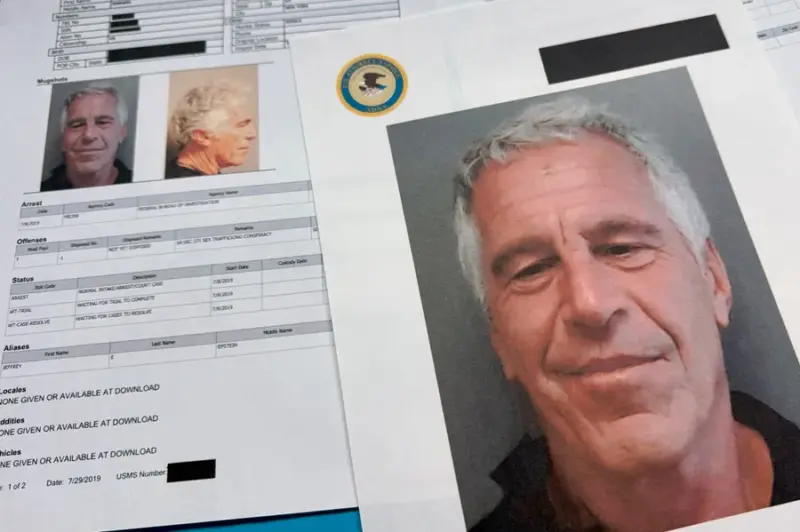

The long-running battle over the release of the Epstein files has reignited a fundamental debate in American democracy: how to balance the public's right to know with the legal and ethical limits on what can be disclosed.
As the latest batch of material surfaces-much of it obscured with heavy black redactions-questions are growing over who decides what remains hidden and why.
For years, the documents linked to Jeffrey Epstein have been weaponised across the political divide, with Democrats and Republicans each using them to accuse the other side of shielding influential figures. Meanwhile, speculation has flourished online, and the release of partially redacted files has done little to settle the matter.
A complex mix of files, not a single archive
A key point often missed in the public conversation is that the "Epstein files" do not represent one cohesive dossier. Instead, they consist of multiple sets of records: FBI investigative material, court filings and grand jury documents. Legally, these categories are treated very differently, and the authority to release or redact them varies accordingly.
The Trump administration now finds itself at the centre of the disclosure debate, with mounting public frustration over years of secrecy. The political pressure played a significant role in Congress voting in November 2025 to release the files, but the legal mechanics of doing so remain complicated.
Why so many redactions?
The documents released so far include sweeping redactions, blotting out names, email addresses, photographs and locations. In some cases-where the identities of victims or witnesses are shielded-the reasoning is clear. In others, the lack of explanation has fuelled further suspicion, with members of the public filling the gaps themselves.
A patchwork of laws governs when information can be released or withheld. The United States' broad freedom-of-information framework includes the Freedom of Information Act (FOIA) of 1966, its 1996 electronic amendments, and the FOIA Improvement Act of 2016. These govern what federal agencies-such as the FBI and the Department of Justice-may disclose.
But other legislation imposes limits. Chief among them is the Privacy Act of 1974, intended to prevent innocent individuals from having their identities revealed unnecessarily. This means redactions can apply to people who appear only incidentally-such as recipients of copied emails, individuals in background photographs or uninvolved third parties.
Inconsistent redactions across agencies
With multiple departments handling different sets of documents, the redaction process has been uneven. One agency may remove certain details while another leaves the same details visible in a separate file. In some instances, information has been blacked out despite already being publicly available elsewhere.
Much of the work falls to career civil servants, who are tasked with navigating the legal, security and privacy requirements. However, some materials-including court records and grand jury proceedings-are outside the remit of FOIA altogether. Only judges can decide whether such documents may be released, placing them beyond the reach of Congress and federal agencies.
Legal grounds for withholding information
FOIA outlines several justifications for withholding material, though without transparency, it is often unclear which one applies. National security concerns represent the most sweeping exemption, allowing agencies to restrict information that could harm US interests-even if the danger is indirect, such as exposing operational practices.
Financial data, proprietary information and sensitive investigative details may also be redacted. But the most significant grounds in the Epstein case stem from privacy protections for victims, witnesses and unrelated individuals.
While many of the blackouts are legally justified, reports suggest that some victims' names, addresses and photographs have appeared in certain documents, raising concerns about inconsistent standards.
The challenge of striking the right balance
Critics say the public deserves a clearer explanation of how decisions are being made-particularly whether a concealed name belongs to someone accused of wrongdoing, a key witness or an uninvolved party. Without that context, the redaction process itself risks undermining public confidence.
The stakes are heightened by the fact that some of the information may lead to ongoing or future prosecutions. Releasing details too early could jeopardise investigations or trial proceedings, making the choices even more delicate.
Epstein's extensive network of high-profile contacts adds another layer of complexity. Some information may be withheld for legitimate legal reasons; other omissions risk being perceived as protection of the wealthy or politically powerful.
Assuming officials across all agencies act in good faith-a difficult assumption in today's polarised political climate-the challenge lies in safeguarding individual privacy while ensuring accountability for anyone implicated in wrongdoing.
(The Conversation)