
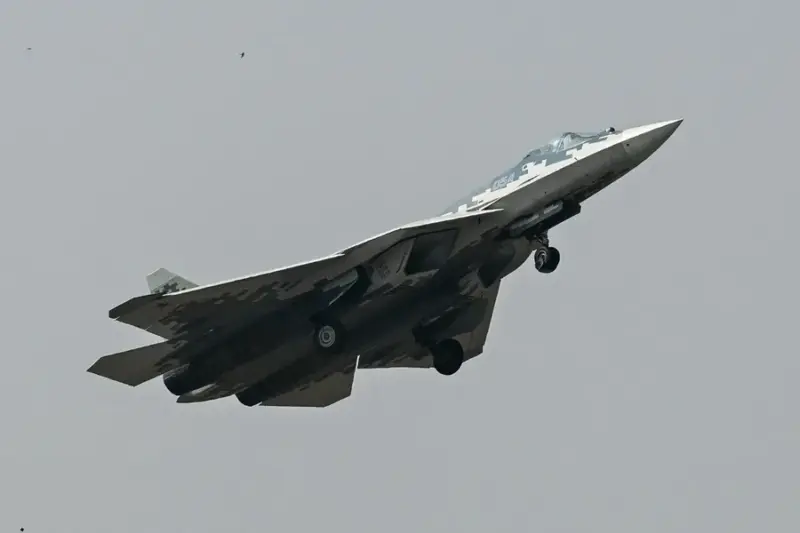

India is moving one big step closer to getting its own fifth-generation stealth fighter jet. That's the conclusion one can draw basis the updates shared by Dr DK Sunil, chairman and managing director of Hindustan Aeronautics Limited ( HAL), on the country's plan to build the Russian Su-57 fighter jet under licence in India.
This is important news because talks on this deal started nearly 14 months ago, and now things are finally moving forward on the ground.
According to Dr Sunil, a Russian team has visited India and explained the full capabilities of the Su-57 to the Indian Air Force (IAF). They have also carefully studied HAL's factories to check if our production lines are ready to build this advanced Russian aircraft.
After the inspection, the Russian committee found that nearly 50% of HAL's existing facilities can be directly used for Su-57 production. However, some fresh investment will still be needed to upgrade the rest.
In simple words, India already has half the setup ready -- the other half needs new machines and tools.
Dr Sunil also confirmed that the Su-57 has already been delivered to Algeria, which became its first foreign customer in late 2025, and the jet is now in active service there. This proves the aircraft is combat-ready and not just a prototype on paper.
Now, the HAL is waiting for Russia to share the exact cost details. Once those numbers arrive, HAL will present a full cost and timeline report to the Indian Air Force.
Russian defence agencies are also working to reduce the overall cost by using HAL's old Su-30MKI production lines -- the same ones used to build over 220 Su-30MKI '4+ generation' jets in India over the years.
What makes the Su-57 so special?
For the uninitiated, the Su-57 'Felon' is Russia's most advanced fifth-generation stealth fighter. It is a twin-engine jet that can fly at a top speed of nearly Mach 2 (around 2,470 km/h) -- which is twice the speed of sound.
The fighter aircraft has a combat range of about 3,500 km and can climb up to 20,000 metres high in the sky. Its radar cross-section (RCS) -- which basically means how easily enemy radars can spot it -- is estimated to be as low as 0.1 to 1 square metre, making it very hard to detect.
For comparison, a normal fighter jet like the Su-30MKI has an RCS of around 15 square metres. So the Su-57 is almost invisible to radar in comparison.
The aircraft also carries weapons hidden inside internal bays (to keep its stealth shape), has advanced sensors, and uses 'super-cruise' technology -- meaning it can fly at supersonic speed without burning extra fuel using afterburners.
India's smart step-by-step plan
Reports from February said the Indian Defence Ministry may first buy around 40 Su-57 jets directly from Russia to quickly boost the Air Force's frontline strength, and later start building them inside India. This is the same clever strategy used earlier with the Su-30MKI -- first import 50 jets, then manufacture locally.
In January 2026, the Defence Ministry confirmed that talks had reached an advanced technical stage. Even more exciting, in June 2025, Russia made a rare offer to share the full source code of the Su-57 with India. This is huge, because it means India can freely customise the jet with its own Indian-made technologies -- something France has refused to do for the Rafale, which is actually an older and lighter '4+ generation' aircraft. This single reason has been blocking any Rafale licence production deal.
In December 2025, a senior Russian official even suggested that India and Russia could jointly develop a brand-new version of the Su-57, giving India ownership rights over key technologies.
An IAF officer later said that if Russian airframe and engines are combined with Indian avionics and software, the resulting jet could be even better than the American F-35. There are also reports that a smaller version of India's own Virupaksha AESA radar may be fitted into the Indian Su-57.
If this deal does goes through, India will not just buy a stealth fighter - it will truly own one.