
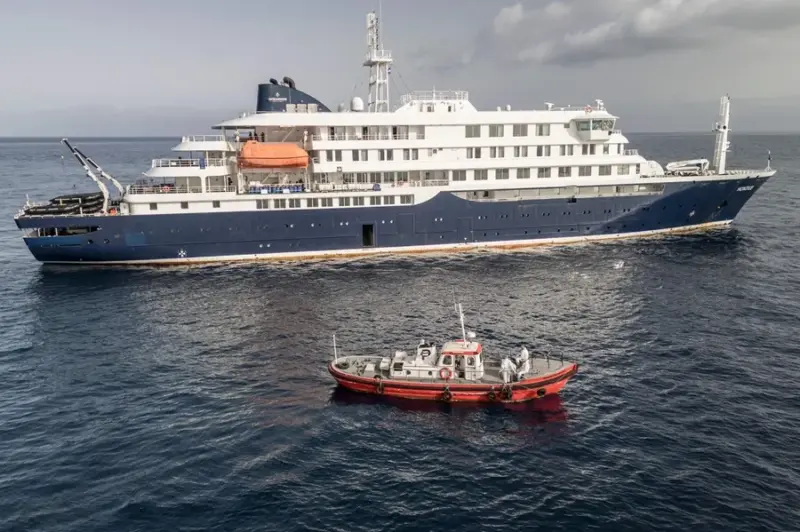

A Dutch-operated cruise ship caught in a deadly hantavirus outbreak is expected to reach Spain's Canary Islands within days, as global health authorities investigate whether the rare rodent-borne virus may have spread between people on board.
The vessel, MV Hondius, has been anchored off Cape Verde since the weekend after three passengers died and several others fell ill.
Spain's health ministry said the ship would arrive in "three to four days," though it did not specify which port in the Canaries. "Once there, the crew and passengers will be duly examined, cared for, and transferred to their respective countries," the ministry said, noting that the World Health Organization (WHO) had identified the islands as the closest destination with sufficient medical capacity.
Medical evacuations under way as ship is cleared to sail
Two seriously ill crew members, one British and one Dutch, will be flown to the Netherlands for "urgent medical care," the ship's operator Oceanwide Expeditions confirmed. A third person linked to a German passenger who died on Saturday is also being evacuated.
The WHO said evacuation plans were being finalised. After the transfers, the MV Hondius will be permitted to continue its journey north. Ann Lindstrand, the organisation's representative in Cape Verde, said that the vessel "can continue its route" once the operations are completed.
Oceanwide Expeditions said the ship would then proceed to Gran Canaria or Tenerife, a journey expected to take around three days.
Cape Verdean authorities have kept the ship offshore near the capital Praia since Saturday, preventing it from docking. Medical teams, supported by WHO personnel, boarded the vessel to assist with testing, isolation protocols and care for symptomatic passengers.
Seven cases identified; three fatalities
The outbreak emerged after the WHO was notified that a rare hantavirus was suspected in the deaths of three passengers. Two cases have been confirmed: a Dutch woman who died after disembarking at Saint Helena, and a 69-year-old British passenger now in intensive care in Johannesburg. Five more suspected cases are under investigation.
In total, three people have died. A Dutch man died on 11 April, followed days later by his wife, who disembarked in Saint Helena and later collapsed during a flight to Johannesburg. A German passenger died on 2 May, though he is not a confirmed hantavirus case.
The MV Hondius began its voyage in Ushuaia, Argentina, on 1 April, carrying 88 passengers and 59 crew members from 23 countries. About 149 people remain on board under "strict precautionary measures," the operator said. Twenty-two British nationals are among them.
WHO: Possible human-to-human transmission
WHO officials say early evidence suggests the virus may have spread between people on board, a rare occurrence with hantaviruses, which are primarily transmitted through rodent urine, droppings and saliva.
"We do believe that there may be some human-to-human transmission that is happening among the really close contacts," said Dr Maria Van Kerkhove, WHO's epidemic and pandemic preparedness and prevention chief. She added that the virus type had not yet been confirmed, but "our working assumption is that it is the Andes virus".
Human-to-human spread has only previously been documented with the Andes strain, found in South America, the region where the Hondius began its route.
WHO said it had been assured "there are no rats on board," and that disinfection measures were ongoing. Those caring for sick passengers are using full protective equipment.
The long incubation period, one to six weeks, has complicated tracing efforts, and investigators believe the Dutch couple who died were "infected off the ship," having travelled in South America before boarding.
Contact tracing extends to flight passengers
South African authorities are tracking passengers who shared a flight with the Dutch woman who died on 26 April. The airline involved, Airlink, said it had been asked to notify all 82 passengers and six crew to contact the health department.
The family of the Dutch couple issued a statement saying: "The beautiful journey they experienced together was abruptly and permanently cut short. We are still unable to comprehend that we have lost them."
What is hantavirus and how dangerous is it?
Hantaviruses are a family of viruses typically carried by rodents. While infections in humans are rare, they can be severe and difficult to diagnose early due to flu-like initial symptoms.
There are two major groups:
- Old World hantaviruses (Europe/Asia): Cause haemorrhagic fever with renal syndrome (HFRS).
- New World hantaviruses (Americas): Cause hantavirus pulmonary syndrome (HPS), which has a fatality rate of around 40%.
The Andes strain, the type suspected in this outbreak, is known to be capable of person-to-person transmission in close-contact settings.
Researchers say incubations can last up to eight weeks, and infections are usually linked to environmental exposure to rodent-contaminated areas. Experts caution that while person-to-person spread is possible, it is still considered uncommon.
There is no specific antiviral treatment, and patients typically require supportive care, including oxygen therapy and ventilation.
How the outbreak may have occurred
WHO officials say investigations are focused on three possibilities:
- Rodent contamination on board: Although the operator reported no rodents, contaminated materials cannot yet be ruled out.
- Exposure during land excursions: The ship visited several islands where rodents are present, making off-ship exposure plausible.
- Person-to-person transmission: The least common route globally, but possible with the Andes virus, especially among close contacts.
Mortality rate and severity
Old World hantaviruses carry an estimated fatality rate of 1% to 15%, depending on the strain.
New World hantaviruses, including the Andes strain suspected in this outbreak, are far deadlier. Hantavirus pulmonary syndrome has a mortality rate of around 40% in the Americas, according to virologists.
There is no dedicated antiviral treatment. Care is supportive, typically involving oxygen therapy, ventilation, fluid management and blood-pressure support.
(With AFP inputs)