




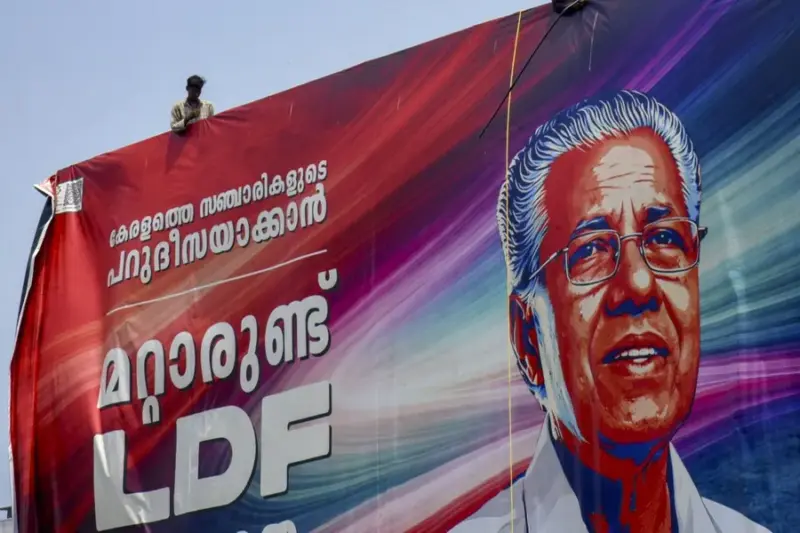

Kerala's 2026 assembly election is being interpreted through a familiar lens -- high turnout must mean anti-incumbency. At 79.63%, the state has recorded one of its highest participation rates in recent cycles, and the instinctive reading is that such mobilisation signals a desire for change.
Little surprise then that there have been anticipatory celebrations in the UDF camp and lately even debates as to who will be CM in the new Government. A closer examination of constituency-level turnout data, absolute vote increases and regional patterns, however suggests that the outcome on May 4th may not conform to that narrative.
The turnout surge is real. Constituency-level comparisons show that votes cast have increased across almost every seat when compared to 2021. In aggregate terms, this translates into a significant rise in total votes polled, even as the electorate itself has marginally contracted following roll revisions. So, more people have voted despite a slightly smaller voter base. The higher percentage is not a denominator led statistical artefact -- it is indeed a genuine expansion in participation.
Almost 10 lakh more votes were cast in 2026 compared to 2021. A number large enough to tempt inferences about anti incumbency.
Yet multi-seat elections are not decided by aggregate turnout, but by how that turnout is distributed. And there in lies the twist in the 2026 Kerala Assembly polls data. As they say, the devil is in the detail.
North Kerala, particularly Central Malabar, has seen the sharpest increases in participation. Central Kerala shows moderate gains, while South Kerala has recorded relatively lower growth. This asymmetry is critical. If this were a classical anti-incumbency election, one would expect the strongest surge in regions where the opposition is structurally competitive, especially in Central and South Kerala. That pattern is not evident.
To understand the likely outcome, it is also important to examine the underlying vote share dynamics. Historically, the Left Democratic Front (LDF) has maintained a remarkably stable vote share base, rarely falling below the 43% mark in Assembly elections. This structural floor has been one of the defining features of Kerala's bipolar politics.
In the run-up to the 2026 election, however, there were indications of softening. Internal primary research conducted in mid-2025 suggested that the LDF's vote share had dipped, raising the possibility of a more competitive contest. What has changed since then is the trajectory.
Subsequent surveys and trend indicators point to a recovery in LDF vote share, bringing it closer to its historical range. This matters because Kerala's electoral outcomes are highly sensitive to small shifts in vote share, but within a constrained band. Unlike states with fragmented opposition spaces, Kerala operates within a tight bipolar framework, with a third player-the NDA-now consistently accounting for an estimated 15-16% of the vote. This has a direct implication for seat conversion.
For the United Democratic Front (UDF) to secure a clear majority, it typically requires not just a lead over the LDF, but a substantial vote share gap. In past elections, decisive UDF victories have been associated with clear and pronounced swings.
In the current context, with the NDA retaining a meaningful and relatively stable vote share, the space for such a large differential is structurally limited. Even if the UDF improves its vote share, the presence of a third pole compresses the margin required for a sweeping seat conversion.
The Malabar turnout surge is being explained by some as evidence of minority consolidation in favour of the UDF. While this remains a plausible hypothesis, the data suggests a more complex reality. Turnout increases are visible not only in minority-heavy constituencies but also in mixed and LDF-leaning seats.
Moreover, even under stress-tested scenarios where additional turnout is disproportionately assumed to favour the UDF, the electoral impact appears bounded.
A moderate skew could shift a handful of seats; a stronger skew may tighten the contest but not flip the final outcome in terms of Seats. Only an extreme and near-uniform consolidation across multiple constituencies would significantly alter the statewide balance, and there is limited empirical evidence to support such a scenario.
Another notable feature of this election is the shift in gender participation. Data from Election Commission turnout records shows that female participation has exceeded male participation by a significant margin in several constituencies. This represents a structural shift from earlier elections, where the gap was minimal.
In Kerala, higher female turnout has often been associated with welfare sensitivity and local governance considerations rather than purely ideological swings, suggesting that this factor may not translate into a uniform anti-incumbent vote. If anything, it could actually be pro-incumbent.
South Kerala, which would typically anchor any opposition surge, does not exhibit a decisive turnout spike. While the region remains competitive and may still deliver gains to the UDF, the absence of a sharp participation increase limits the possibility of a sweeping shift.
Central Kerala continues to be the primary battleground, where marginal swings could determine a cluster of closely contested seats.
When these elements are brought together -- statewide participation increase, regional asymmetry, recovery in LDF vote share, structural constraints imposed by a significant NDA presence, the absence of a clear directional surge and the gender signal -- the election begins to resemble a distribution contest rather than a wave election. The outcome will depend less on the headline turnout number and more on how effectively each front converts its vote share into seats. And that's where LDF has a clear advantage.
Also Read: One Nation, One Election - A defining test for Indian Democracy
Based on historical patterns, current turnout data, and vote share modelling the most plausible outcome remains a competitive but incumbent-favouring contest. The LDF is projected in the range of 72 to 78 seats, while the UDF is likely to be in the 60 to 66 seat range, with a small number of seats going to others. Under stress conditions -- particularly if turnout in key Malabar constituencies skews sharply toward the opposition -- the LDF's tally could move toward the lower end of the range. However, absent evidence of an extreme and uniform consolidation, the structural arithmetic continues to favour the incumbent.
The temptation to equate high turnout with anti-incumbency is understandable, but Kerala's electoral history suggests that such interpretations can be misleading. This election appears to be another instance where the headline number obscures a more complex reality. The surge is real, but it is uneven. The contest is competitive, but constrained. And in that balance lies the likely outcome -- a historic third term for the Pinarayi Vijayan-led LDF.
The author is Director of Bureau of Election Intelligence. He was formerly MD & CEO, Times Network and is now a political consultant.