
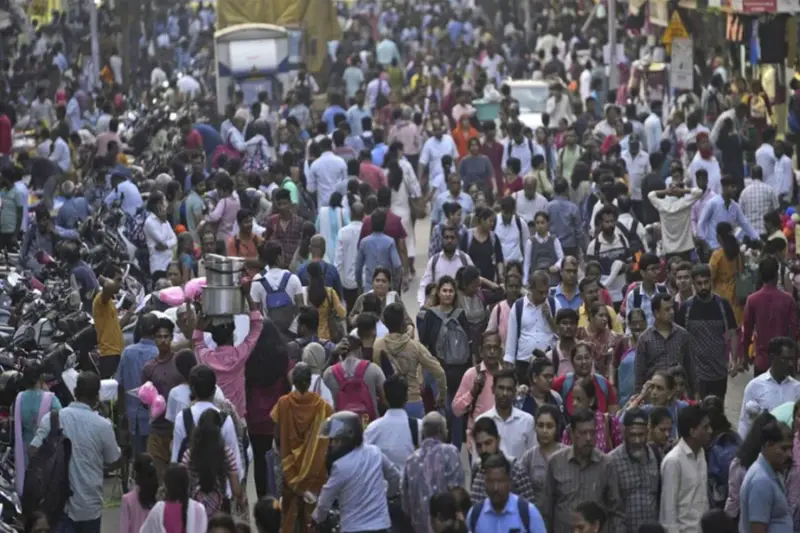

India will launch the world's largest census on Wednesday, deploying more than three million officials for a massive counting exercise that will span the next year.
The exercise, described as a "gigantic exercise of national importance," aims to support evidence-based policy for a nation of 1.4 billion people grappling with pressures from rapid growth, including water shortages and overcrowded slums.
The Registrar General and Census Commissioner, Mritunjay Kumar Narayan, confirmed that preparations are at an "advanced stage." The census returns after a long hiatus; India has not conducted a census since 2011, following delays caused by the Covid-19 pandemic.
The first phase: 33 questions and digital shifts
The first phase, known as the Houselisting and Housing Census (HLO), begins this Wednesday and will run through September 2026. During this period, officials will record details of housing conditions, amenities, and assets.
The government has notified 33 specific questions for this phase, ranging from the predominant materials used in floors, walls, and roofs to the type of fuel used for cooking and ownership of vehicles.
In a significant technological leap, this census introduces a digital system allowing citizens to self-enumerate. An app, supported by satellite imagery and available in 16 languages, will be used to link data. A 15-day window for self-enumeration will be available before the month-long fieldwork begins in each region.
To assist the public, the government's portal includes an FAQ section to clarify "tricky" scenarios:
- Live-in relationships: "If they consider their relationship as a stable union, they should be treated as a married couple."
- Flooring materials: If a house has multiple types of flooring, the material used "predominantly" should be recorded.
- Technology: If a mobile phone has FM, it counts as a radio; specifically, "On Mobile/Smartphone."
- Basic needs: Tap water kept in bottles is still considered "tap water," not bottled water.
Timeline, logistics, and privacy safeguards
The HLO phase is staggered across the country. Eleven states and union territories will begin in April, followed by nine in May, and the remainder through August. Buildings will be geo-tagged and assigned unique identification numbers. The Union Cabinet has approved a total outlay of Rs 11,718.24 crore for the operation.
Authorities have emphasised that data security is a priority. Narayan stated that data centres are designated as "Critical Information Infrastructure" with robust end-to-end security. Under Section 15 of the Census Act, personal information is strictly confidential. "It cannot be disclosed under the RTI Act, used as evidence in court, or shared with any other organisations," Narayan noted.
The Census Reference Day is set for 1 March 2027, providing a "snapshot" in time to ensure data consistency. However, for snow-bound regions such as Ladakh, Jammu and Kashmir, and Himachal Pradesh, the reference date is fixed earlier, on 1 October 2026.
The caste factor and population enumeration
The second phase, Population Enumeration (PE), will focus on individual data including age, occupation, literacy, and the politically sensitive issue of caste. Caste remains a powerful determinant of social status in India, yet comprehensive data has not been collected in a census since 1931.
While a caste survey was attempted in 2011, it was never published due to data inconsistencies. If a person's specific caste or tribe is not listed in the state-notified options provided on the portal, they are advised to select the "Other" option.
This census arrives as United Nations estimates suggest India has already surpassed China as the world's most populous country. With administrative boundaries frozen as of 1 January 2026 and 80,000 training batches for enumerators already formed, the machinery of the Indian state is now in motion for this historic count.