
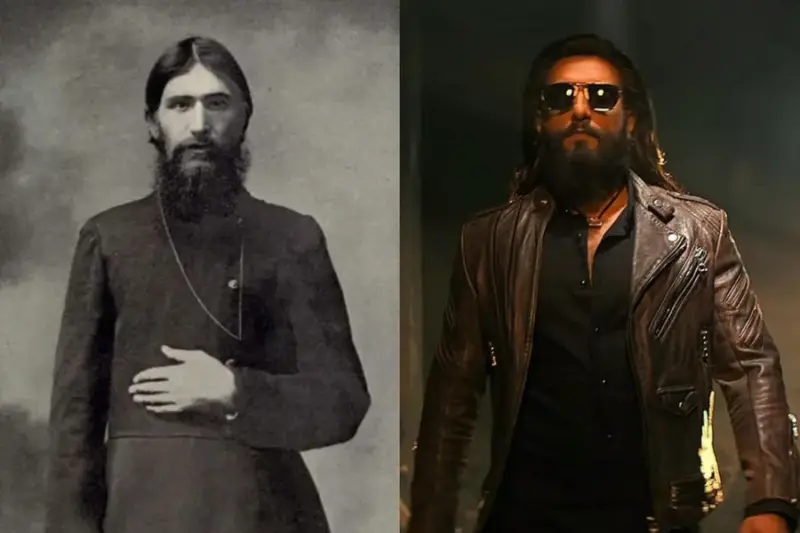

In 'Dhurandhar: The Revenge', director Aditya Dhar delivers not only a political thriller but a carefully engineered soundscape.
One musical cue in particular, 'Rasputin' by Boney M, has sparked widespread discussion. Heard during a pivotal confrontation between Indian and Pakistani intelligence forces, the song's placement is far more strategic than it appears.
Rather than an eccentric creative flourish, the track underpins the turning point in a climax centred on betrayal, exposure and collapsing power. To understand why 'Rasputin' plays exactly when it does, the film nudges the audience to look beyond the beat and towards the infamous historical figure who inspired it.
A power shift set to music
(INCLUDES SPOILERS)
The sequence unfolds after Hamza, played by Ranveer Singh, is taken into custody by SP Omar Haider following the killing of Major Iqbal. He is subjected to a punishing interrogation overseen by ISI chief Lt Gen Shamshad Hassan, portrayed by Raj Zutshi, a man who appears shielded by rank and impunity.
When IB chief Ajay Sanyal, played by R Madhavan, demands Hamza's release, Shamshad dismisses him with confidence. That posture collapses moments later when Sanyal reveals a damning video accusing the general of covertly passing Pakistan's military intelligence to Israeli officials.
It is at this precise moment, as Shamshad's authority disintegrates, that 'Rasputin' begins to play.
Who was Rasputin?
Grigori Rasputin, the Siberian mystic who insinuated himself into the court of Russia's last Tsar, held influence without office, a shadow power whose sway alarmed ministers, nobles and the military.
His notoriety grew amid allegations of corruption, manipulation and debauchery. Though not a formal statesman, he exerted enormous behind-the-scenes control, fuelling the perception that he was untouchable.
His assassination in 1916, sensationalised as a near-supernatural ordeal involving poison, bullets and drowning. According to accounts from his killers, including Prince Felix Yusupov, Rasputin was first served cakes and wine allegedly laced with cyanide. When he showed no reaction, he was shot. As the story goes, he then attempted to flee, prompting another round of gunfire before he was beaten and thrown into the frozen Neva River. Later autopsy findings, however, suggested a far more straightforward death from a close-range gunshot.
In 1978, the disco group Boney M. revived the Rasputin legend with their hit song 'Rasputin', reigniting global fascination with the mystic.
A modern cinematic Rasputin
In 'Dhurandhar 2', Shamshad is crafted as a contemporary echo of Rasputin, powerful, elusive and operating from the shadows. Like his historical counterpart, he thrives on the illusion of invincibility.
Sanyal's expose punctures that facade, stripping him of the very thing that sustains him: perceived untouchability. The upbeat, almost celebratory tone of Rasputin underscores the irony. A figure who believed himself beyond consequence is undone not through violence but through truth.
The music transforms the moment from a tactical victory into a symbolic unmasking.
Bollywood's previous encounters with the track
'Rasputin' is not entirely new to Hindi cinema. The 2012 spy thriller 'Agent Vinod', directed by Sriram Raghavan and starring Saif Ali Khan, featured a partial interpolation in the song 'I'll Do the Talking Tonight'. Composed by Pritam with licensed rights, the track sampled melodies rooted in Serbian and Ottoman folk traditions and appeared during a Moscow nightclub sequence integral to the plot.
However, 'Dhurandhar 2' marks the first time the original 'Rasputin' has been deployed to create thematic resonance rather than stylistic flair.
By pairing Shamshad's downfall with one of pop culture's most recognisable narratives of corrupted influence, the film adds a covert layer to an already tense geopolitical climax. The choice amplifies both the moment and the character, turning a song into subtext, and subtext into a message.
In 'Dhurandhar 2', 'Rasputin' is not merely background music. It is a commentary on power, corruption and the inevitable reckoning that follows.