




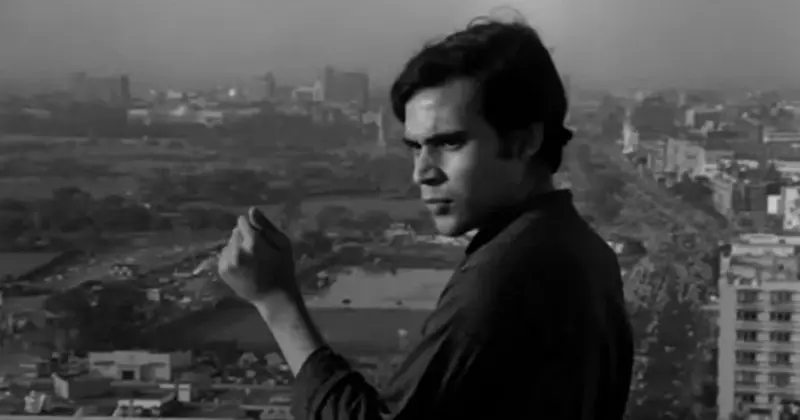

Pratidwandi (The Adversary) is said to be the first among the three city-centered films Satyajit Ray made. This celluloid journey began in 1970 to be followed by Seemabaddha (1971) and end with Jana Aranya (1973) to peel off, layer by layer, like the skins of an onion, the psyche of youth in an ever-changing Calcutta, yet to have a changed nomenclature.
This was a turbulent time in many parts of India in West Bengal in general and Calcutta in particular. Frustration arising from poverty, unemployment and social inequalities led young men like Siddhartha's brother to involve themselves in active and violent resistance, exploding at times into violence against all forms of authority. On the one hand, the state of West Bengal and its capital city was the epi-centre of much of this 'revolutionary thinking'. On the other, the public and private sector were building up a culture of bribes and corruption, with the older generation teaching the youngsters how to 'get ahead in life'.
With rising unemployment, the rise of the underground Naxalite movement that appropriated a slew of brilliant students of Calcutta and Jadavpur Universities within its fold, were committed to uproot capitalist and/or fascist rule through armed revolution. Alongside, there was an influx of hippies from the West, white-skinned youngsters from the US and European places living a Bohemian life, doing drugs, dancing away on the streets of Calcutta, enamoured of the poverty, the dirt and the debris. In one indoor scene, we find one hippie trying to hear the sound of a khanjani (a percussion instrument used mainly in religious songs) through a stethoscope! It is a fleeting scene but carries its own comment.
The protagonist in Pratidwandi, Siddhartha Choudhury, is forced to give up his medical education when his father dies suddenly and he has to join swarms of educated, middle-class young men looking for employment. Failing to get a job despite being competent and educated, he takes to walking the city's streets or wandering across to the digs of his two classmates from medical school and ruminating on how he can stop his younger brother from engaging in dangerous Naxalite activism or his sister from engaging in an affair with her boss.
Even his efforts on the personal front prove unsuccessful because his brother Tunu shrugs him off while his sister, Sutapa, a very attractive young girl, reminds him that after their father's death, she is the sole income earner in the family. Siddhartha suspects that she is being sexually pressurized by her boss but escapist that he is, he cannot do anything about it. The director suggests that the sister is preparing herself for a career in modelling.
Is Siddhartha a coward or is he an escapist? Or is he a misfit? He is really a microcosm of the city's youth who want to be upwardly mobile and yet are not ready to compromise on the moral values they have imbibed to fit into the fast-changing corporate world. His cowardice comes across when he suddenly, on an impulse, visits his sister's boss at his residence but walks away without 'shooting him down' though that was his original plan. His escapism comes across in many ways, specially when he refuses to work for a political party he does not believe in even for a salary. That he is a misfit we learn from his complete distancing from his family, especially his constantly weepy mother. He shows concern for his kin but is clearly not involved at all.
He dreams a lot but his dreams are more nightmares than dreams. He goes to watch a movie where the air-conditioned cool on a summer afternoon is ideal for an afternoon nap and not for the movie itself. We once see him go with a friend to watch a Swedish film at a film club which, the friend points out, has 'no cut.' But the film turns out to be a joke on what they were looking for-uncensored sex scenes in the film. In another nightmare, Siddhartha sees his sister in a bathing suit posing for photographs on a beach. The picture changes to Tunu being gunned down by a firing squad. A nurse comes to tend to him but when she looks up, it is his sister Sutapa whose face melts to become Keya's, (his brief girlfriend) face. All this happens on an empty beach with the tide ebbing and flowing in. Ray visualises this scene as if bringing it out of reality and placing it neatly within a surreal world from Siddhartha's point of view.
His younger brother Tunu takes pot-shots at him labelling him a conformist and a coward, pointing out that this same older brother had bought him a thick biography of Che Guevara; Siddhartha smiles wistfully to remind him that he had to sell of two thick medical books to buy this one for Tunu's birthday. If the medical books have lost their use for Siddhartha, Guevara's life too, now seems to have become an exercise in futility.
He accidentally gets into a brief relationship with Keya, a sweet young college girl who suffers from feelings of loneliness and a sense of rejection because her father is about to marry her aunt, who constantly tries to draw attention to herself. Though Siddhartha goes on a few dates with Keya, his body language, his silences, his brief conversations show that he is not taking the relationship seriously.
Siddhartha has no idea about what direction his life is taking which, perhaps, is a reflection of Calcutta itself, where hippies wander about aimlessly beside an unemployed young man, well-spoken nurse moonlights as a prostitute, a medical student from an affluent family has no issues pocketing the money someone has collected for charity. We get a glimpse when candidates for an interview have no proper place to sit, though they must wait the whole day for a meeting that lasts hardly five minutes. The walls of the hall where the candidates are waiting are filled with political graffiti and we learn that the office is shifting to another place.
The only evidence of Siddhartha's rootedness lies in his search for that unique birdcall he heard as a child. He goes in search at New Market but he does not know the name of the bird so the search is in vain. That birdcall keeps haunting him at odd times and we feel that this is his escape back to his boyhood days, a sweet memory trapped in his consciousness forever.
Siddhartha is fleshed out as an introvert, an 'outsider' who sees things through the lens of his medical lectures, in the negative. He finds it almost impossible to agree with his panel of interviewers who have decided that he has communist political leanings because he prioritises the Vietnam war over man's landing on the moon. He imagines the worst when his sister comes home very late, only to discover later that she is attending modelling classes. But he remains suspicious though he lacks the nerve to confront her.
The camera wanders across the city, sometimes casually, sometimes idly, sometimes rapidly following Siddhartha's tracks, scanning the public vehicles we see Siddhartha jostling in with the huge crowd, hanging from the slings, squeezing himself in and out of the overcrowded entrance without making an acquaintance.
The sights and sounds the camera and the sound design capture are often from Siddhartha's point of view while in other scenes, they make Siddhartha the subject of their focus and the audience enjoys both points of view, giving it a chance to draw its own conclusions when Siddhartha leaves Calcutta to go to a district to work as a medical salesman.
Towards the end, at a very crowded interview waiting room with just one functioning fan and seventy-five candidates waiting in the sweltering heat, we find Siddhartha angry for the first time in the entire film. He dashes into the room where the interviewers are seated and tried to explain the need of proper seating for the candidates waiting outside. He is asked to wait. When he comes out and joins the crowd, he suddenly visualises the waiting candidates reduced to skeletons of themselves, with a dry, authoritative voice-over narrating in English the significance of parts of a human skeleton. He emerges from his trance to find the candidates back in their human form. This is the only time we find Siddhartha, normally a very quiet young man, bursting out in anger. His anger is directed not so much on those suited-booted corporate honchos but at the entire socio-economic system that has effectively reduced one huge mass of humanity to waiting skeletons of themselves and another smaller group fighting to keep them trapped in the skeleton image.
Dulal Dutta's brilliant editing follows Siddhartha striding out of the hall with angry steps after crashing into the interviewing room, overturning the table, bashing up whoever tries to come in his way, walking out, the graffiti on the walls changing in its slogans as a metaphor of the passing time, speeding along with Siddhartha till suddenly we are looking out of a speeding train, at the raised hand of Siddhartha with a cigarette, moving away from Calcutta to take up the job of a medical salesman in Balurghat he had earlier decided against.
He gets into a seedy hotel and while penning a letter to Keya, he suddenly hears that bird-cry in the midst of the chanting of Bolo Hori Horiboli where in a long shot, a body is being carried to the crematorium. He walks up to the balcony and signs off the letter to Keya. The sound of the chant of pall-bearers mixing into the sweet, whistling cry of that bird Siddhartha had been searching, signs the full circle of life and death.
Who is the adversary here? Is it the city of Calcutta that is slowly moving towards a shift in values that seems to be working against the youth, be it Tunu who is drawn into an extremist movement that believes in the use of arms to quell the establishment? Or, is it Siddhartha's sister Sutapa who, as the single earner of the family, appears to be willing to compromise with conventional values of morality to go up in life and become a model? Perhaps, it is Siddhartha himself who finds himself a misfit in the corporate world? Is the bird-call an entreaty to return to an innocent childhood when he is getting ready to face the world? Ashe loses the birdcall along the way, healso loses his space in the world he ought to have fitted himself into. These questions keep you guessing long after the film is over.
This film, through the eyes of its protagonist, shows us the slow but sure socio-political changes happening in Kolkata where interviews are fixed, where hippy youngsters dance in merriment, where unemployment among the educated young keeps climbing everyday and yet, where a young man, defeated in the battle of life, seeks and finds succour in a simple birdsong lost in childhood.