
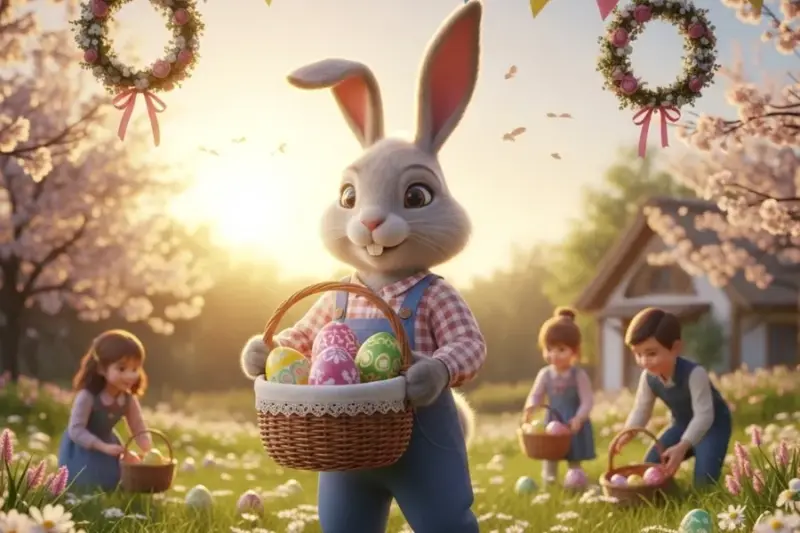

The Easter Bunny, one of the most recognisable symbols of Easter, blends folklore, religion and seasonal traditions.
While widely associated with egg hunts and chocolate treats today, its origins trace back to ancient fertility symbols, European myths and evolving cultural practices across the world.
What is the Easter Bunny tradition?
The Easter Bunny is a folkloric, anthropomorphic rabbit believed to deliver eggs, sweets and gifts to children on the eve of Easter. Much like the gift-giving role of Santa Claus, the Bunny is often portrayed as rewarding well-behaved children.
Traditionally, children prepare baskets or nests in anticipation, which are later filled with decorated eggs, chocolates and small toys. The Bunny is also linked to Easter egg hunts, where eggs are hidden for children to find - a custom that has become central to modern celebrations.
Ancient roots: fertility and spring symbolism
Long before its association with Easter, the rabbit or hare was a powerful symbol in ancient cultures. Known for rapid reproduction, hares represented fertility, renewal and the arrival of spring - themes that align closely with the seasonal timing of Easter.
Some historians link these symbols to festivals honouring spring deities such as Eostre, an Anglo-Saxon goddess associated with dawn and rebirth. Although evidence is limited, the idea of a hare connected to spring rituals likely contributed to later Easter traditions.
German folklore and the Osterhase
The modern Easter Bunny is widely believed to originate from 17th-century German folklore. The figure known as the Osterhase (Easter Hare) was said to lay coloured eggs for children who behaved well.
Children would create nests using hats or baskets, where the hare would leave its eggs. German immigrants later brought this tradition to America in the 18th century, particularly in Pennsylvania, where it gradually evolved. Over time, the hare transformed into the softer, more child-friendly "bunny", and nests became decorated Easter baskets.
Eggs and symbolism across cultures
Eggs themselves hold deep symbolic meaning across many cultures, often representing life, rebirth and renewal.
In Christian tradition, eggs are linked to the resurrection of Jesus Christ, symbolising new life emerging from the tomb.
In Eastern European countries, intricately decorated eggs such as pysanky reflect both religious and folk art traditions.
In Persian culture, eggs are part of Nowruz (New Year) celebrations, symbolising fertility and creation.
The combination of eggs and a fertility symbol like the rabbit naturally merged into a cohesive Easter narrative over time.
Variations of Easter traditions worldwide
While the Easter Bunny dominates in countries like the United States and parts of Europe, other cultures have different figures and customs:
In parts of Germany and Switzerland, the Easter hare remains closer to its original folkloric form.
In Australia, where rabbits are considered pests, the Easter Bilby - a native marsupial - has been promoted as an alternative symbol.
In France, church bells rather than a bunny are said to deliver eggs, returning from Rome on Easter morning.
These variations show how the core themes of renewal and celebration adapt to local cultures and beliefs.
Modern evolution: from myth to global icon
Today, the Easter Bunny has become a commercial and cultural icon, closely tied to confectionery traditions. Chocolate bunnies, marshmallow treats and large-scale egg hunts are now staples of Easter celebrations worldwide.
The first edible Easter bunnies appeared in 19th-century Germany, originally made from pastry and sugar before chocolate became the dominant medium. Over time, the Bunny transitioned from a regional folk figure into a global symbol recognised across both religious and secular contexts.
Myth or magic?
Biologically, rabbits do not lay eggs - a fact that highlights the purely mythical nature of the Easter Bunny. However, like many festive traditions, its significance lies not in realism but in storytelling, symbolism and shared cultural experience.
The enduring appeal of the Easter Bunny reflects a blend of ancient beliefs, religious symbolism and evolving folklore - a reminder of how traditions adapt while preserving their core message of renewal, hope and celebration.