




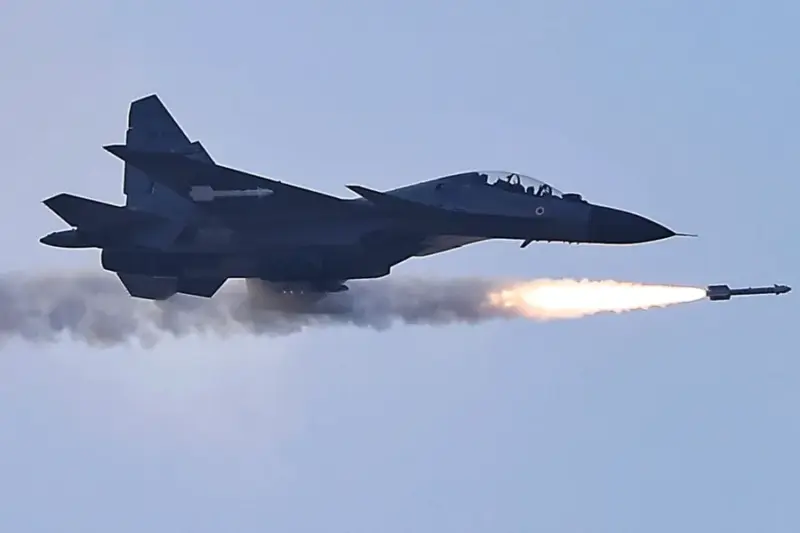

India's Defence Ministry has finally signed a major deal with Russia to buy 300 long-range R-37M air-to-air missiles, worth over $1.2 billion.
This is being reported by several Indian media houses, and it is going to make a huge difference to the strength of our Indian Air Force. These missiles will be fitted on the Su-30MKI fighter jets, which are the backbone of our air force. The Su-30MKI belongs to what experts call the '4+ generation' category, meaning it is highly advanced but not yet a fifth-generation stealth fighter.
To put it simply, an air-to-air missile is a weapon fired from one aircraft to destroy another aircraft in the sky. The R-37M is special because it can hit enemy planes from a very long distance, between 350 to 400 kilometres away. That means our pilots can attack enemy aircraft without even coming close to them. Only a few missiles in the world, like China's PL-17 and America's AIM-174, can match this kind of range. With these missiles, the attack range of our Su-30MKI fighters will almost become three times more powerful than before.
This big purchase comes along with another important decision. In late February, the Defence Ministry confirmed that 84 Su-30MKI aircraft will be upgraded with Russian help. The upgrade will include a new and stronger radar, electronic warfare pods to confuse enemy systems, and R-77M medium-range missiles. The R-37M was originally designed for the MiG-31BM, one of the heaviest fighter aircraft in the world. Since the Su-30MKI is also a heavy aircraft, it can comfortably carry this big missile without losing its flying ability.
India is not stopping here. In late March, the Defence Ministry also approved buying 10 battalions of the S-400 long-range air defence system, which can shoot down enemy planes and missiles from very far away. Then in January 2026, the Ministry confirmed that talks to buy the Su-57 stealth fighter jets from Russia have reached an advanced stage. Earlier in June 2025, Russia had made a rare offer to share the full source code of the Su-57, which means India can modify and control the aircraft's software as per its own needs. This kind of access is almost never given by any country.
The R-37M missile is truly a beast. It has a warhead of 61 kilograms, which is the explosive part, and travels at almost Mach 6, that is six times the speed of sound. However, the Su-30MKI's current radar is not as powerful as the MiG-31's, so it cannot use the missile's full range on its own. But once the radar is upgraded, and with help from S-400 systems on the ground and future Su-57 jets sharing data, these missiles will become far more deadly.
One important reason behind this purchase is what happened in March, when Russia's 40N6 missiles from the S-400 system, with around 400 km range, were used to disturb Pakistani support missions. It showed how useful it is to strike enemy aircraft deep inside their own area, especially high-value targets like AEW&C planes, which act like flying eyes for the enemy air force.
India has been buying more and more Russian defence equipment in recent times. One reason is that France has been finding it difficult to sell its Rafale jets to India, mainly because it has refused to fully share its technology with us. Russia, on the other hand, is openly sharing technology and even source codes.
Together, all these deals, missile purchases, fighter upgrades and air defence systems, are going to completely change the strength and reach of the Indian Air Force in the coming years.
(Girish Linganna is an award-winning science communicator and a defence, aerospace and geopolitical analyst. He is the managing director of ADD Engineering Components India Pvt. Ltd., a subsidiary of ADD Engineering GmbH, Germany.)