




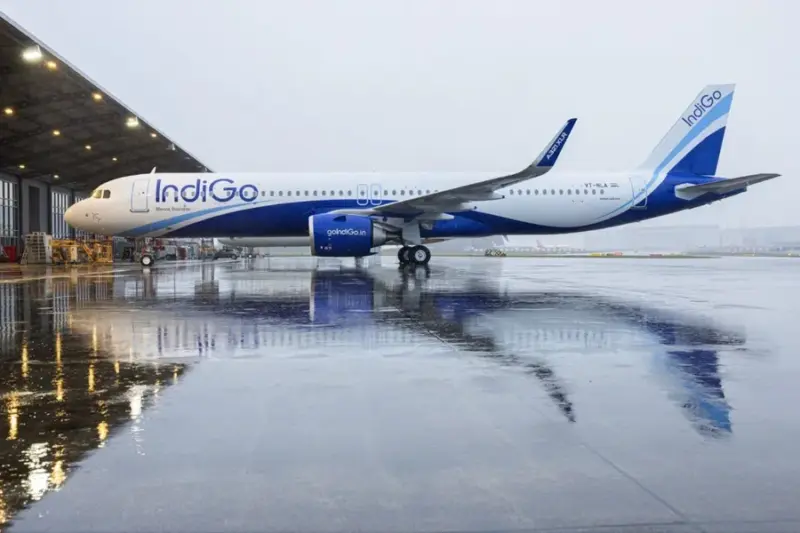

Bengaluru: Sarla Aviation has confirmed that IndiGo Ventures has made a minority investment in the company, even as it withdrew an earlier public communication and clarified that IndiGo has "no involvement" in its electric vertical take-off and landing (eVTOL) initiatives.
"Sarla Aviation confirms that IndiGo Ventures has made a minority investment in us. However, we are withdrawing our public communication, made earlier in this regard, and regret the confusion it has caused. We would also like to clarify that IndiGo has no involvement in Sarla Aviation's eVTOL initiatives," a company spokesperson said.
A strategic bet on urban air mobility
Despite the clarification, IndiGo's ₹10 crore investment signals a calculated entry into the emerging urban air mobility (UAM) space. The funding, routed through its venture arm, marks the airline's first direct stake in an eVTOL startup.
The move comes after IndiGo's earlier collaboration with Archer Aviation failed to materialise due to timeline delays, prompting the airline to explore domestic partnerships with better execution alignment.
Building a nationwide air taxi network
The partnership is aimed at developing a nationwide air taxi network focused on short-distance routes ranging from 0 to 300 km.
These include airport transfers, inter-city travel, and emergency mobility services, segments that remain inefficiently served by India's current transport ecosystem.
While India's mobility infrastructure is optimised for short intra-city commutes and long-haul travel, the mid-range connectivity gap has long persisted. Air taxis are being positioned as a solution to bridge this gap.
What are eVTOL aircraft?
Electric Vertical Take-Off and Landing (eVTOL) aircraft represent a new class of aviation platforms designed for urban environments. Unlike traditional aircraft, they can take off and land vertically, eliminating the need for long runways.
They are:
- Powered by electric or hybrid-electric propulsion
- Quieter and more environmentally friendly than helicopters
- Capable of operating from compact landing zones like helipads
This makes them particularly suited for dense cities where space constraints limit airport expansion.
'Shunya': Sarla's made-in-India air taxi
At the centre of Sarla Aviation's roadmap is its flagship eVTOL aircraft, Shunya. Designed for Indian conditions, the hybrid-electric aircraft is expected to carry up to six passengers and a pilot, with a payload capacity of around 680 kg.
Built for short-haul, high-frequency missions, Shunya aims to address one of the biggest challenges in electric aviation, battery limitations, through a hybrid propulsion architecture.
The company is also betting on existing infrastructure, such as helipads at hotels, hospitals, and corporate campuses, to fast-track deployment and reduce capital expenditure.
Can air taxis solve India's traffic crisis?
Urban congestion in cities like Bengaluru and Mumbai continues to strain existing infrastructure. eVTOL-based air taxis could offer a new dimension, literally, by shifting part of the traffic to the skies.
Potential advantages include:
- Travel time reduction during peak hours
- Airport transfers cut from 1-2 hours to 10-20 minutes
- Faster emergency and medical response
- Reduced load on heavily congested corridors
By introducing vertical mobility, eVTOLs could reshape how cities manage movement and connectivity.
Backed by top investors, eyeing 2028 launch
Founded in 2023 by Adrian Schmidt, Rakesh Gaonkar, and Shivam Chauhan, Sarla Aviation has raised over $13 million from investors including Binny Bansal, Nikhil Kamath, Sriharsha Majety, and Accel.
The company says it operates India's largest private eVTOL demonstrator and has onboarded talent from global players such as Lilium, Volocopter, and Joby Aviation.
With regulatory momentum building, led by the Directorate General of Civil Aviation working on certification pathways, Sarla is targeting a commercial launch in Bengaluru by 2028.
For IndiGo, the investment represents more than just a financial stake. It is a strategic foothold in what could become one of aviation's most transformative frontiers, urban air mobility.