
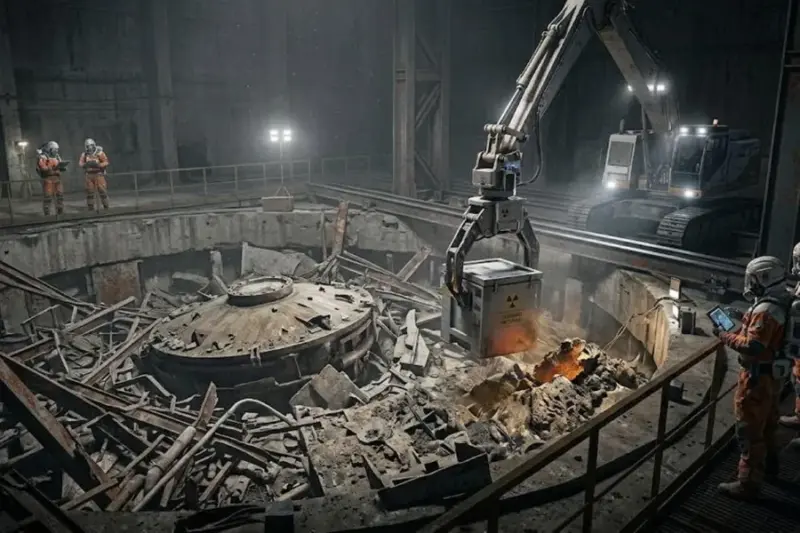

The world is watching closely as the United States tries to figure out how to safely remove Iran's highly enriched uranium. According to a detailed report by The Wall Street Journal, this is not a simple task at all.
America has handled such operations before in other countries, but experts and former officials say this one will be far tougher than anything attempted in the past.
The biggest problem is that Iran's nuclear sites were heavily bombed by American and Israeli forces earlier this year. Since then, no international inspector has been allowed to visit these damaged sites for the past 10 months.
So, before anything can be removed, teams will have to dig through rubble, collect the nuclear material, and also get a clear political agreement on where this uranium should finally be sent.
Andrew Weber, a senior expert and former Pentagon official, has called this one of the most difficult operations ever attempted. He said there are too many unknowns because of the recent US strikes in June, along with huge logistics problems, serious security risks, and rising political tensions between countries.
The future of this nuclear material has become the main topic in talks between the US and Iran. US President Donald Trump said fresh discussions will restart soon, though Iran has not confirmed it officially. Trump also claimed Iran had agreed to hand over its highly enriched uranium, but Iran rejected this statement within hours.
So why the rush? Iran currently holds enough 60% enriched uranium to possibly build around 11 nuclear weapons. This is just a few steps away from weapons-grade level. To prevent Iran from getting closer to making a bomb, the Trump administration is pushing hard for this material to be removed.
Reports say the US is even willing to release around $20 billion (about ₹1.86 lakh crore) of Iran's frozen money abroad if it hands over this stockpile.
According to the International Atomic Energy Agency, nearly half of Iran's enriched uranium is stored deep inside underground tunnels at the Isfahan nuclear site. Some is also kept at the Natanz facility. Both places were badly damaged in the June strikes. Iran had already strengthened the entrances earlier, and now the bombings have buried them even deeper, making access very difficult.
There is already a past example of such a deal. Under the 2015 nuclear agreement, Iran sent more than 11 tonnes of 20% enriched uranium to Russia, and in return, tough economic sanctions were lifted. That deal limited Iran to keeping less than 300 kilograms of low-enriched uranium for 15 years. But it fell apart after Trump pulled out of it in 2018.
Before the June attacks, Iran had around 441 kilograms of 60% uranium and 200 kilograms of 20% uranium. Experts say this can be pushed to weapons-grade 90% level within just a few weeks. Right now, Iran is not enriching uranium because the attacks have damaged its facilities.
During the talks, Iran offered to reduce its 60% uranium back to 20%, claiming it is only for peaceful civilian use. But experts say the 60% material must be fully removed from the country, and possibly the 20% too. Richard Nephew, who was a US nuclear negotiator under Obama and Biden, clearly said the uranium must leave Iran.
The US has done such work before. After the Soviet Union collapsed, America worked hard to stop nuclear materials from spreading. In a secret 1994 mission called Project Sapphire, the US quietly removed 600 kilograms of 90% highly enriched uranium from Kazakhstan, packing it into more than 440 special containers and flying it out in two giant C-5 transport planes.
Based on such past missions, the US built a "mobile packaging program." Under this, American experts along with X-ray machines, weighing scales, and glove boxes can be sent anywhere to safely collect nuclear material. If sent to Iran, IAEA specialists could also verify the amount and purity of the uranium once it is dug out.
Scott Roecker, a former US Energy Department official, said this would be a very demanding operation taking several weeks. He explained that Iran's uranium is stored as gas inside heavy cylinders.
Experts must first check if it can be transported in gas form, or if it should be converted into oxide powder before moving. If some buried cylinders are damaged, the job becomes even riskier. David Albright, a former weapons inspector, said advanced robots could be used to safely handle the material and check for damage.
Another big question is where this uranium will go. Iran has refused to give it to the US experts suggest it could go to Russia, or be diluted and sold for civilian use. Weber said it could also be flown to Kazakhstan, where the IAEA runs a low-enriched uranium bank. Even after such a deal, worries will remain.
Washington fears Iran may secretly keep some uranium. So any fresh deal must include strong inspection rights, including environmental sample testing, to confirm Iran's claims are true.
_The author is a Defence, Aerospace & Geopolitical Analyst_