
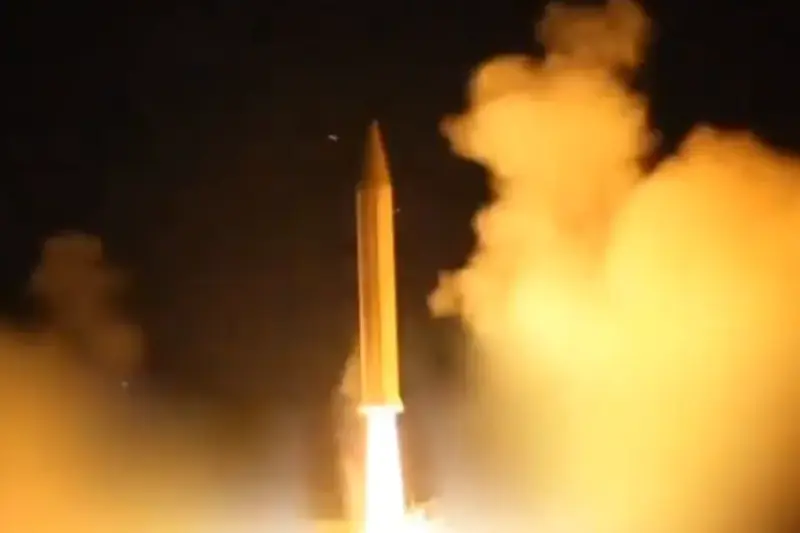

The world woke up to the sound of war again on Thursday morning. Iran fired missiles at Israel for the sixth straight day, and this time, it used one of its most powerful weapons - a missile called the Khorramshahr-4. If you have been hearing this name on the news and wondering what it actually means, here is everything explained simply, the way it should be.
So, what exactly happened?
Iran's Islamic Revolutionary Guard Corps, the IRGC, which is basically Iran's most powerful military force, often described as a state within a state, announced that it launched Khorramshahr-4 missiles toward central Tel Aviv, Ben Gurion Airport, and an Israeli Air Force base located near the airport. Drone strikes also hit a radar site in northern Israel. All of this came after the United States and Israel launched strikes on Iran on Saturday, and a US submarine sank an Iranian warship, raising the temperature dangerously higher.
Now, let us talk about this missile
Imagine a flying iron rod, 13 metres long, roughly the length of a double-decker bus. That is the Khorramshahr-4. It is a ballistic missile, which means it is launched upward into the atmosphere like a rocket, travels in a curved path through the sky, and then comes crashing down on its target with devastating force. Unlike a regular bomb dropped from a plane, you cannot easily predict or stop it once it is in motion.
Also read | US tests Minuteman III "Doomsday" missile amid Iran War
The Khorramshahr missile has been in Iran's arsenal since 2017, but the Khorramshahr-4 is the latest and most upgraded version, unveiled in May 2023. Think of it like a new model of a car, same name, but far more powerful and advanced.
What makes it so dangerous?
Three things make this missile particularly frightening. First, its range. It can travel up to 2,000 kilometres. To give you a sense of scale, the distance from Mumbai to Delhi is roughly 1,400 kilometres. So this missile can strike targets far, far away with ease.
Second, its warhead. A warhead is the part of the missile that carries the explosive material - essentially the "bomb" part. The Khorramshahr-4 carries a warhead weighing 1,500 kg. That is about the weight of a small car packed entirely with explosives. One tonne of explosive material landing on an airport or a military base causes catastrophic destruction.
Also read | Meet the B-52 Stratofortress: 1950s bomber behind US strikes on Iran
Third, and most worrying, it can potentially be fitted with a nuclear warhead. Experts say its size and design make it capable of carrying nuclear weapons, though Iran has not officially confirmed this. That single possibility is why this missile keeps the world's defence analysts awake at night.
What makes it hard to stop?
Older missiles depend on guidance systems at the final stage, like a GPS that kicks in as the missile approaches its target. But that guidance system can be jammed by electronic warfare - essentially, enemies can "hack" the signal and throw the missile off course. The Khorramshahr-4 has fixed that problem. It has a mid-phase navigation system, meaning it corrects its own path while still high up in the atmosphere, before any jamming can work. By the time it comes down, it is already locked in.
Also, it uses a special fuel called hypergolic fuel, which stays ready inside the tank for years without any preparation. This means Iran can launch this missile within just 12 minutes of deciding to fire it. There is almost no warning time.
Why does this matter to all of us?
Because what is happening between Iran, Israel, and the United States is not just a regional conflict anymore. Missiles with nuclear potential, sinking warships, strikes on airports - these are not small events. Every escalation brings the world closer to a situation that nobody wins.
The Khorramshahr-4 is not just a missile. It is a message - and the world is listening, whether it wants to or not.
The author is a Defence, Aerospace & Geopolitical Analyst