
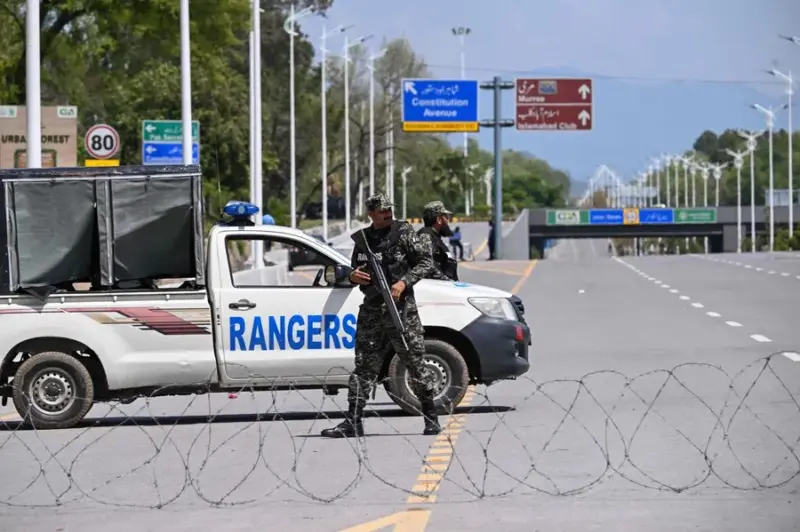

Islamabad: Islamabad has been placed under tight security lockdown as Pakistan prepares to host high-stakes US-Iran peace talks this weekend, with authorities enforcing unprecedented security measures across the capital ahead of visiting foreign delegations.
The move comes amid heightened West Asia tensions, following renewed warnings from Iran's leadership over Israeli airstrikes in Lebanon and fragile ceasefire conditions between regional powers.
Islamabad security lockdown: Red Zone sealed, traffic diverted
Security in the Pakistani capital was significantly intensified on Thursday, with key roads sealed, traffic diversions enforced, and the heavily guarded Red Zone in Islamabad completely cordoned off.
The Red Zone-home to key government buildings, foreign missions, and official residences-has been placed under multi-layered security deployment, with only official vehicles permitted entry.
According to Islamabad Police, movement restrictions have been imposed across sensitive zones. "The Red Zone and surrounding areas are closed to all types of traffic except official vehicles. Citizens are requested to avoid unnecessary travel," the police said in an advisory on X.
Pakistan assures 'foolproof security' for US-Iran delegations
Pakistan's Interior Minister Mohsin Naqvi assured full security arrangements for visiting delegations during a meeting with US Chargé d'Affaires Natalie Baker.
Calling the foreign delegates "special guests," Naqvi said a comprehensive security plan had been put in place to ensure "foolproof security" for all participants.
A 30-member advance team from the United States has reportedly already arrived in Islamabad to assess on-ground security arrangements ahead of US-Iran talks.
Also Read| 'Will take revenge for Supreme Leader's killing': Iran's Khamenei issues chilling warning
US-Iran talks in Islamabad after conditional ceasefire
The diplomatic engagement follows a reported two-week conditional ceasefire agreement between the United States and Iran, paving the way for direct negotiations in Islamabad aimed at converting the truce into a longer-term peace framework.
The US delegation is expected to be led by Vice President JD Vance, with special envoys Steve Witkoff and Jared Kushner also likely to participate, according to reports.
Iran has also confirmed participation, with its envoy initially describing the talks as "serious negotiations" based on proposals put forward by Tehran, though later remarks highlighted rising tensions after renewed Israeli strikes in Lebanon.
Islamabad and Rawalpindi are on high alert
Authorities have imposed a two-day local holiday in Islamabad to manage movement and security logistics. Strict traffic restrictions remain in place across the capital and adjoining Rawalpindi.
Key access routes, including highways leading to Nur Khan Airbase and Old Airport Road, have been blocked using containers and barbed wire. Several residential areas near the airport zone are also facing restrictions.
Emergency services, hospitals, and rescue departments have been placed on standby across the twin cities as part of the high-security protocol for international diplomatic talks in Pakistan.
Regional tensions shadow peace negotiations
The talks are taking place against a volatile backdrop, with Iran warning that ongoing Israeli strikes in Lebanon could undermine diplomatic efforts.
Iranian President Masoud Pezeshkian said recent military escalation risks derailing negotiations, stating that continued strikes could render peace talks "meaningless".
Despite the tensions, Pakistan has reiterated its role as a facilitator of dialogue. Prime Minister Shehbaz Sharif and Army Chief Field Marshal Asim Munir reviewed the mediation efforts and expressed support for continued de-escalation and regional peace initiatives.
Pakistan has urged all sides to maintain restraint and support a negotiated settlement aimed at stabilising West Asia security dynamics.