
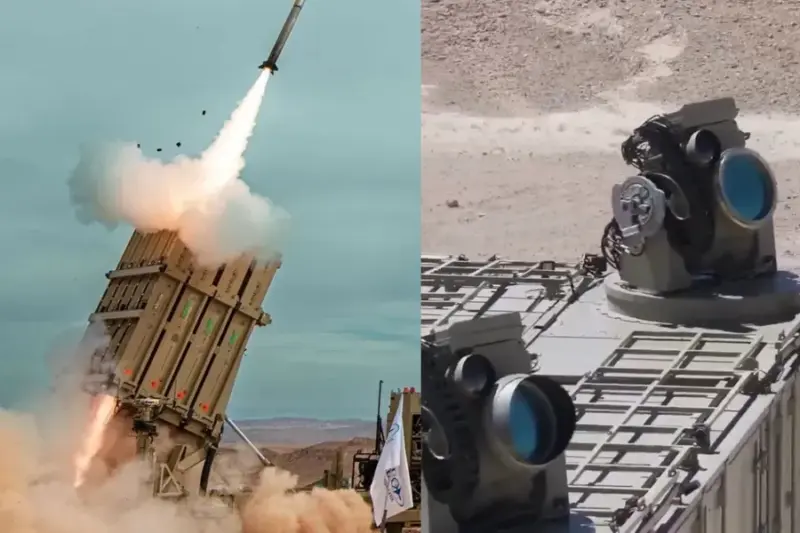

Jerusalem: Israel has reportedly deployed its advanced Iron Beam laser-based air defence system to the United Arab Emirates (UAE), signalling a significant shift in regional security cooperation amid rising tensions involving Iran.
Alongside this, a drone-detection system known as Spectro has also been supplied to strengthen early warning capabilities against aerial threats.
What is Iron Beam and how does it work
The Iron Beam is a ground-based, high-energy laser defence system developed by Rafael Advanced Defense Systems. It is designed to intercept short-range threats such as rockets, mortar shells, and unmanned aerial vehicles (UAVs), including drones.
Unlike traditional missile-based systems, Iron Beam uses a powerful directed-energy laser to destroy targets mid-air. Once a threat is identified, the system locks onto it and fires a concentrated laser beam that heats and disables the target within seconds. Reports indicate it can neutralise threats in roughly 4-5 seconds, operating effectively at the speed of light.
This makes it particularly useful against low-cost, high-volume attacks, such as drone swarms or repeated rocket launches.
How it fits into Israel's defence network
Iron Beam is designed to complement existing systems like the Iron Dome, which intercepts short- to medium-range rockets using interceptor missiles. While Iron Dome is highly effective, each interception comes at a significant cost.
Iron Beam, by contrast, offers a near-zero cost per shot since it relies on electricity rather than physical missiles. This allows it to handle frequent or large-scale attacks without rapidly depleting expensive interceptor stockpiles.
Together, these systems form part of Israel's multi-layered air defence strategy, with Iron Beam acting as the innermost, cost-efficient shield.
Why the UAE deployment is significant
The reported deployment to the UAE highlights growing defence cooperation between Israel and Gulf nations. It also reflects shared concerns over drone and missile threats linked to Iran and its regional allies.
By integrating Iron Beam and Spectro into its defence setup, the UAE could improve both detection and interception capabilities - identifying threats earlier and neutralising them faster.
This move also signals a broader trend: countries in the region are increasingly investing in advanced technologies, including directed-energy weapons, to counter evolving aerial threats.
Limitations and operational challenges
Despite its advantages, Iron Beam is not without constraints. Its effectiveness can be reduced by adverse weather conditions such as heavy clouds, rain, or dust, which can weaken or scatter the laser beam.
Additionally, the system is primarily suited for short-range threats and may not replace long-range missile defence systems entirely. Instead, it works best as part of a layered defence approach.
The reported use of Iron Beam outside Israel marks a notable moment in the evolution of modern warfare. As drone warfare and low-cost aerial attacks become more common, laser-based systems could play an increasingly important role in national defence strategies.
For the UAE, the deployment represents a technological upgrade in its air defence capabilities. For Israel, it underscores its position as a key exporter of advanced military technology - and a growing security partner in the region.