
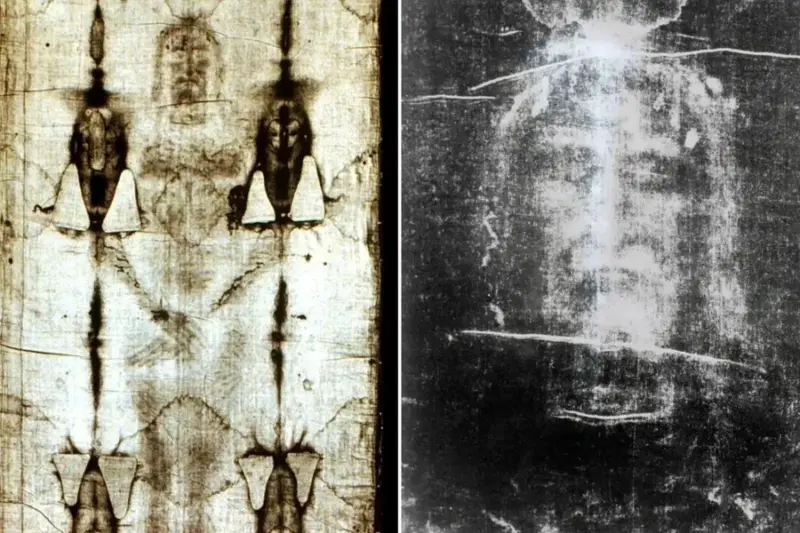

The Shroud of Turin, long at the centre of one of Christianity's most enduring controversies, has gained renewed attention after a recent study suggested surprising links between the ancient linen and the Indian subcontinent.
The 4.4-metre (approx. 14 foot) cloth, believed by many Christians to have wrapped the body of Jesus Christ after his crucifixion at Golgotha, carries a faint imprint of a man with wounds resembling crucifixion injuries. Now, new genetic findings have added complexity to the relic's already disputed past.
A genomic analysis of biological traces found on the shroud indicates the presence of DNA associated with people of Indian ancestry, along with material from plants, animals and multiple human handlers. The claims, published in the preprint journal bioRxiv, have stirred fresh debate about the cloth's origins, centuries-long journey and authenticity.
Study reopens an old mystery
The research team, led by Gianni Barcaccia of the University of Padova, examined biological particles collected from the cloth in 1978. Their aim was not to address religious questions but to catalogue the diverse DNA signatures preserved on the linen.
"The DNA traces found on the Shroud of Turin suggest the potentially extensive exposure of the cloth in the Mediterranean region and the possibility that the yarn was produced in India," the study notes.
Among the most attention-grabbing claims was that roughly 40% of the human genetic material appeared linked to Indian ancestry. This raises the possibility that the linen may have been produced in the Indus Valley region or came into contact with people from the Indian subcontinent during its travels.
Researchers detected a wide range of DNA - from humans, domestic animals, wildlife, insects and multiple plant species - indicating the cloth encountered varied environments over time.
Contested relic with a medieval paper trail
The Shroud of Turin's modern historical record begins not in ancient Judea but in medieval Europe. It was first documented in France in the mid-14th century, where it was displayed in Lirey around 1354. Even then, the cloth attracted both veneration and doubt, including scepticism from within the Church.
By the 16th century, it came into the hands of the House of Savoy and later moved to Turin, Italy. It remains there today, housed in the Cathedral of Saint John the Baptist.
While many Christians consider it a sacred burial cloth of Jesus, historians and scientists have long regarded it as a medieval artefact with unresolved questions.
Claims of an Indian link
The study's findings do not conclusively establish that the shroud was made in India, nor do they prove contact with India at a specific time. DNA can accumulate through handling, travel, contamination, trade or display.
However, the detection of Indian-linked human and plant DNA expands the debate beyond Europe and the Middle East. Scholars have largely centred past discussions on either a first-century Judean origin or a medieval European fabrication.
This new research suggests a broader geographical context, possibly tied to ancient trade networks between India, the Mediterranean and West Asia. The authors also emphasise that the study has not yet undergone peer review.
Scepticism within the scientific community
Predictably, experts have raised doubts. Some scholars argue the findings do little to alter the established view that the shroud most likely dates to the medieval period. One expert, cited in reports, noted that the new genetic material still falls short of overturning decades of historical evidence.
This resistance follows a familiar pattern: nearly every major scientific claim about the shroud has triggered counterarguments and renewed scrutiny.
Researchers also emphasised that the cloth contains DNA from numerous non-human sources - including cats, dogs, cattle, chickens, deer, rabbits, fish, insects and various plants - reflecting its long exposure to diverse conditions.
Genetic clues that challenge Western origins
A second study, published in 'Scientific Reports' under the Nature portfolio, used Next Generation Sequencing (NGS) technology to analyse dust collected from the shroud. This study also found mitochondrial DNA (mtDNA) from human and plant origins belonging to South Asian, Middle Eastern and Western European haplogroups.
Notably, scientists identified mtDNA haplogroup R0a, common in the Arabian Peninsula and Horn of Africa but with sequences linked to South Asia. Plant DNA associated with Indian agriculture, including species such as Vigna unguiculata (cowpea) and members of the Fabaceae family, reinforce the possibility of an Indian connection.
The presence of these species suggests the flax used to weave the linen may have been cultivated in India, or that the cloth travelled through Indian trade routes.
How a cloth could have travelled from India to medieval Europe
India was a major centre of textile production for millennia, supplying goods along the Silk Road and maritime trade networks connecting South Asia to the Middle East and Europe. The presence of diverse human and plant DNA from multiple regions on the shroud aligns with theories that the cloth travelled through these ancient routes long before arriving in medieval France.
Researchers argue that such extensive DNA diversity would require centuries of exposure, not just the timeframe proposed by medieval origins.
Radiocarbon dating puzzle
The 1988 radiocarbon test remains one of the most widely cited scientific assessments of the shroud. Three laboratories concluded the linen was produced between 1260 and 1390 CE, firmly placing it in the medieval period.
For many historians, this finding shaped the mainstream view of the shroud as a medieval artefact rather than a 1st-century relic.
However, defenders of the shroud have disputed the test, claiming the sample may have been taken from a repaired area or contaminated by fire, smoke or centuries of handling.
The new DNA claims do not overturn the radiocarbon results but do complicate the narrative, offering fresh insights into the cloth's exposure to multiple peoples and regions, potentially over a long period.