

A key responsibility of a healthy democracy is to remind people about things the powerful want them to forget. In today's digital world, these reminders can reach many more people, even as they compete with opinionated, half-true and misleading stories spread by those in power and their opponents.
This challenge is particularly visible now as the Kerala Assembly elections approach. Supporters of both the ruling and opposition parties have already started shaping digital narratives, using multiple platforms to influence public opinion and ensure their messages reach voters ahead of the polls.
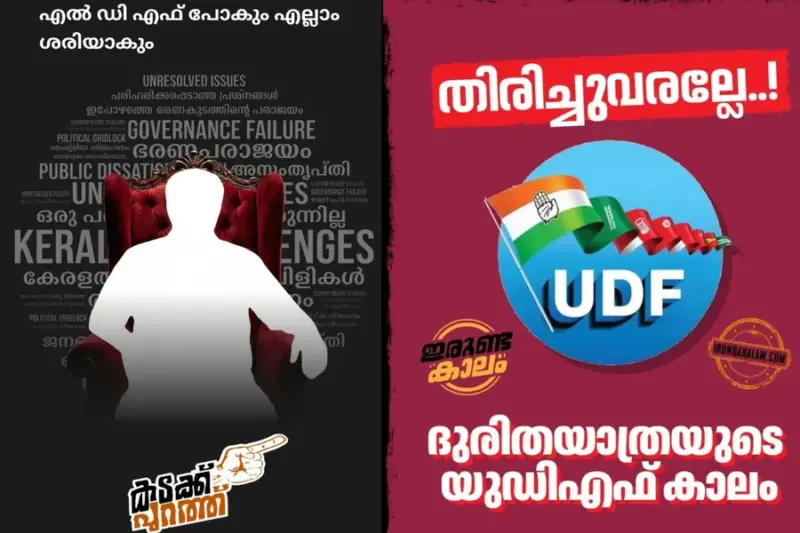
Loyalists of the ruling Communist Party of India-Marxist, which leads the Left Democratic Front, are targeting the Congress-led United Democratic Front through digital media campaigning that the "dark age should not return", implying the LDF's rule should continue for a third term and the UDF should not come to power. The interesting part is that they have found fresh ammunition in a website, 'Irunda Kalam' (dark age), and its social media campaign arm.
'Irunda Kalam' features videos highlighting alleged mismanagement, controversies and corruption during the UDF's 2011-16 rule, drawing from reports published in various media outlets. The videos cover the GAIL project, the bar bribery case, national highway development, then minister VS Sivakumar's alleged illegal wealth accumulation and power cuts.
The campaign appears to be a counter to the digital campaign 'Kadaku Purathu' that the UDF launched to attack the CPM government, its tallest leader and Chief Minister Pinarayi Vijayan. The name 'Kadaku Purathu' has special relevance as it is a dig at Pinarayi Vijayan's controversial remark in 2017, "Kadakku Purathu" -- meaning "get out" -- directed at journalists.
The 'Kadaku Purathu' website has a feature that allows users to symbolically ask Vijayan to "get out" of the seat by submitting their name and basic details. It also publishes a charge sheet listing alleged government failures in issues including temple gold theft, healthcare lapses, unemployment, agrarian distress, wildlife attacks, drug use and the state's financial crisis. It also provides a facility for people to record and submit their complaints against the government.
The digital attack also appears to have triggered a reporting war. Recently, a Facebook page, 'Satheesante Nunakal', emerged with the agenda of exposing lies allegedly peddled by the Leader of the Opposition and UDF chieftain VD Satheesan. However, this page was allegedly taken down, which CPM loyalists say was due to the efforts of poll strategist Sunil Kanugolu's team. Yet CPM loyalists are hopeful about a newly created Facebook page, 'Nunesante Nunakal', a wordplay spin-off of 'Satheesante Nunakal', with the same agenda.
It is expected that more digital campaigns attacking political rivals and opponents will emerge before Kerala heads to the polling booths.
Parallelly, top leaders including VD Satheesan and Pinarayi Vijayan are being interviewed not just by media persons but also by celebrities and social media influencers. The allegation in the air is that these are PR stunts ahead of the elections.
Experts weigh in on Kerala's digital battleground
According to political economist Dr D Dhanuraj, chairman of Centre for Public Policy Research (CPPR), the election campaign and outreach to voters in Kerala have undergone significant changes with urbanisation and increased penetration of digital space among voters.
"It can influence voters thinking and understanding. At the same time with high penetration, there are varied sources which could contest the veracity of the information in Kerala that include the YouTube channel videos and TV stories. So, the space is more democratic in nature in terms of airing and sharing of facts, figures and countering of them. So, it is not easy to assess how much impact they have on the final voting decision," he said.
He also raised concerns about the quality of discourse such digital campaigns put forth. "It looks like Kerala has struggled with the scientific rigour (on an average scale) as it was dominated by social science due to the poor quality of higher education for some years. This has had a high influence on societal thinking as a collective. Qualitative debates were dominated over the quantitative and data driven approach. It has a lot to do with the thriving political economy ideology of the state. Kerala may not be an exception looking at the dominance of such narratives around the world but it could be perceived as an aberration in the context of a state of high literacy and high living standards," he said.
Psephologist Dr Sajad Ibrahim noted that Kerala voters are comparatively resilient to purely digital media narratives. "Political loyalists and those with minimal education are more prone to fall for these narratives. Though there will be some influence, people here will not blindly believe everything. Social media also provides space for differing opinions and counter-narratives. The space is politically contested, and awareness levels are high," he said.
Ibrahim added that many citizens now view social media as a source to access information that traditional media might omit due to political affiliations. "Those disseminating such narratives are also cautious about potential legal consequences," he said.
A data window into legislative performance
Amid the surge of digitally driven narratives and efforts to scrutinise political leaders, initiatives are also emerging to provide voters with structured, data-based insights. A platform called 'MLA Track' was recently launched, seeking to introduce a more data-based approach to evaluating public representatives. The website, set up by Atyeti Research and Sahya Digital Conservation Foundation, has been pitched as the first-of-its-kind platform to track interventions made by MLAs of the Kerala Legislative Assembly. According to the mlatrack team, the platform helps users understand the interventions made by individual MLAs. It features brief profiles, attendance details, questions raised, private bills, debates attended and MLA fund projects.
Free Software and Wikimedia activist Manoj Karingamadathil, who is also part of the mlatrack team, said there is a lot of data available on the state government's Niyamasabha website, but it lacks data structure, codification and better visual analysis. "Our objective is to use our expertise in Open Data and Parliamentary Informatics to bridge this divide," he said.
The team also believes MLAs need a better platform to show their interventions. "Our MLAs are making proactive policy-level interventions in Niyamasabha (assembly). But it does not have public visibility. In my opinion, that's why MLAs are pressured to do visibility stunts in the form of attending inaugurals, social functions, and publicising even things like sanctioning of high mast lights with flexboards in streets. More than flex boards and inscriptions on streets, there should be visibility on what policy level interventions they are making," he added.
The team is also inviting suggestions and working on further updates and features so that citizens can make informed, data-based decisions.