
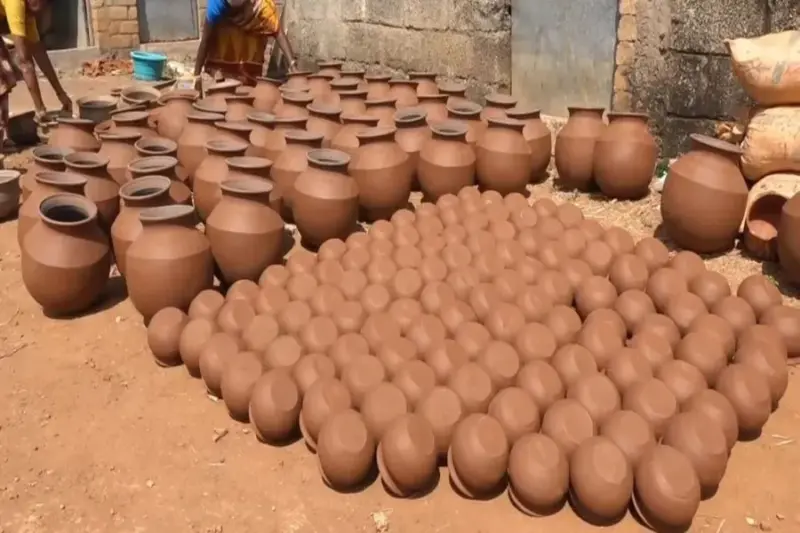

In Koyileri village near Mananthavady in Wayanad, the rhythmic spin of the potter's wheel still echoes, but it carries a story of struggle rather than sustenance.
For generations, the Kumbara community has lived by the craft of pottery, moulding clay into objects of both utility and tradition. Today, that legacy stands at risk. Escalating costs, dwindling access to raw materials, and a lack of meaningful support have left many artisans fighting to survive, even as Kerala heads toward Assembly elections.
Chankutty, a potter who started working at the age of ten, has dedicated his life to the craft. Decades later, he finds himself with little financial security to show for his efforts. He says that despite repeated assurances, real help rarely reaches those in need.
Chankutty, a potter, says, "The income is not sufficient. Even if we manage to earn something, it only covers our daily expenses, leaving no savings.
The government has taken some steps, but a few people are trying to withhold those benefits."
Artisans say the future of pottery looks uncertain, with younger members of the community turning away from the profession. Many no longer see dignity or financial stability in continuing the tradition.
Potter and President, Kerala Kumbara Samudaya Sabha, Kuttan, say, "The younger generation is not taking up this work. They view making clay pots as something shameful. We had plans to provide training for children, but only with support from the state government would we be able to take it forward. Our community, engaged in pottery, is among the most backward in society. Earlier, our social background was similar to that of Scheduled Caste communities."
One of the biggest challenges remains access to clay. Artisans allege that illegal extraction and a growing supply lobby have made it harder and more expensive to source the material essential to their work.
Meanwhile, Kuttan, a potter and president of the Kerala Kumbara Samudaya Sabha, says, "During the rains, we are unable to access clay. Taking advantage of the scarcity, some people have started illegally extracting clay from government land and selling it, forming a lobby. We have complained to the Geology and irrigation departments but have not received any response yet. If we are allowed to collect clay from government land with proper permits through the Geology Department, much of this crisis could be resolved. The cost of clay has surged drastically, we now have to pay exorbitant rates, with a single load costing up to Rs 50,000."
Women in the community are equally affected. With rising costs of firewood and transport, and limited access to raw materials, many say their work no longer guarantees even basic returns. Some have already shifted to daily wage labour to make ends meet.
"We do not get proper price for clay pots. Everyone who buys them says it's just clay, leaving us in a pathetic situation. The cost of firewood is high, and there is a shortage of clay. Even where clay is available, we are not allowed to extract it. We usually source it from fields, but transportation is also a challenge. As a result, our work suffers, and many are shifting to daily wage labour", says another potter Malu
Attempts to expand or sustain their work through financial assistance have also failed to yield results. Access to loans remains a distant possibility for many.
Potter Ponnu says, "Whenever we want to expand our work and approach banks for loans, they do not provide us with any."
Disillusionment runs deep, with some questioning whether their voices matter at all in the electoral process.
Potter Malu further added that "what is the point of voting if no one checks on us or asks about our problems... how we are living and sustaining this work?"
Nearly 500 Kumbara families across Wayanad continue to depend on pottery as their primary livelihood. Their demands are simple yet urgent - access to affordable clay and fair prices for their products.
As election campaigns gather pace, the potters of Koyileri are left waiting, not just for promises but for action that can keep their centuries-old craft alive.