
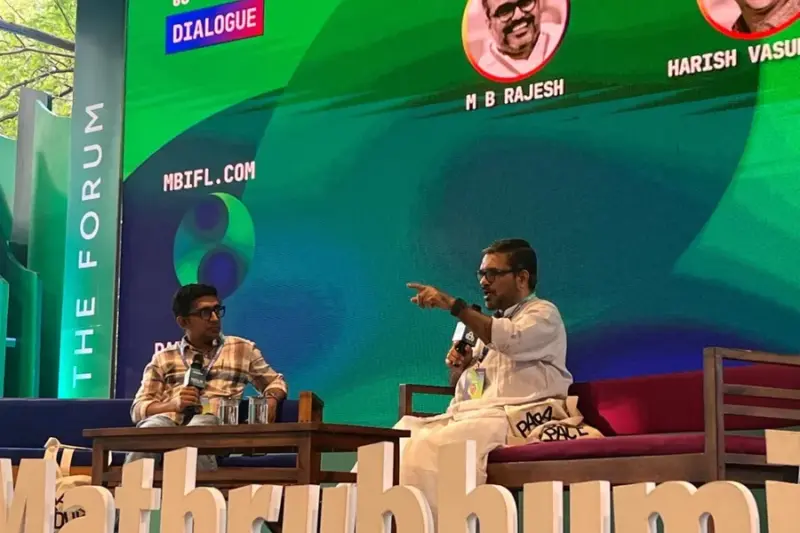

The discussion featured M. B. Rajesh, Kerala's minister for local self-government, and Harish Vasudevan, lawyer and environmental activist.
The speakers addressed multiple dimensions of waste management in Kerala, including government initiatives, community participation, systemic failures, and future priorities.
Brahmapuram fire as a turning point
The minister described the Brahmapuram waste plant fire of March 2023 as a critical moment that forced systemic introspection. The fire, which lasted nearly two weeks, exposed long-standing failures in centralised waste handling and caused severe air pollution across Kochi."The incident of Brahmapuram was a key change and the government took it as an opportunity for better waste management."
Brahmapuram continues to handle around 390 tonnes of waste daily, with nearly 64 per cent biodegradable content and about 8 lakh tonnes of legacy waste accumulated over years. Rajesh said the government treated the crisis as an opportunity to overhaul waste management rather than a one-off disaster.
Decentralisation and the Thumboormuzhi model
A key focus of the session was Kerala's shift towards decentralised waste management, especially the Thumboormuzhi aerobic composting model developed by Dr Francis Xavier.
This model uses ferro-cement bins to decompose organic waste within about 90 days, producing odour-free, high-quality compost. It relies on layered organic waste, dry leaves and inoculums, making it suitable for households and community-level implementation. The model is being promoted as an alternative to landfill-dependent systems.
Civic responsibility and local enforcement
The government's campaign 'Ente malinyam, ente utharavadhitham' (my waste, my responsibility) was highlighted as a behavioural shift strategy. Minister Rajesh said stricter waste management rules, fines, and local enforcement mechanisms are now backed by institutional systems.
Central to this effort is Haritha Karma Sena, a green workforce of over 35,000 women under Kudumbashree. The group manages door-to-door collection and segregation of non-biodegradable waste, including plastics and e-waste, and operates through user-fee-based sustainability models. The initiative has collected more than 50,000 tonnes of inorganic waste across the state.
Hazardous and industrial waste gaps
Harish Vasudevan questioned the state's preparedness in handling hazardous and industrial waste, where Kerala still lacks long-term infrastructure. The minister acknowledged the gap, stating that waste is currently being sent to cement plants in Tamil Nadu and Karnataka for co-processing.
"We are currently sending waste for recycle and other processing to neighbouring states like Tamil Nadu and Karnataka cement plants."
He added by saying this, "We understand it is not a long run solution. We need a long solution as soon as possible. And that is our focus now."
Rajesh admitted this is not a sustainable solution and said the government is working towards developing long-term, in-state facilities for hazardous waste treatment. "The EPR by companies is not effective and it is a charade now. We will improve that."
Medical waste: Strengths and recent failures
Kerala's biomedical waste management system was discussed as relatively advanced but under strain. The state relies heavily on the IMAGE facility in Palakkad, which processes waste from over 18,000 healthcare centres, handling nearly 56 tonnes daily, along with a secondary facility run by KEIL in Kochi.
Despite barcode tracking and regulated collection, illegal dumping incidents reported in 2024-2025, including waste found in Tamil Nadu, exposed enforcement gaps. The minister said the government is studying the issue in depth and reassessing capacity, compliance, and decentralisation options.
Electronic waste and producer responsibility
Rajesh flagged electronic waste as an emerging crisis. "The other important session we have to consider is electric waste. Our community is highly electric consumers and the ways to process this are not proper now."
He criticised the ineffective implementation of Extended Producer Responsibility (EPR) by companies, calling it largely symbolic. With Kerala being a high consumer of electronic goods, he said stronger accountability mechanisms and infrastructure are urgently needed.
Children and long-term behavioural change
The minister emphasised that lasting change depends on children and civic education. He noted growing instances where children correct adults for littering or improper disposal, calling this a crucial cultural shift. "I have heard people saying I don't throw water bottles even during travel now, my kids will scold me for it."
According to Rajesh, while adults often resist behavioural change, children adopt environmental responsibility without ego barriers, making them central to Kerala's long-term waste management vision. "Adults are a bit difficult to understand and correct, but kids will get this sense as they are not egoistic."
Why this matters
The MBIFL session made clear that while Kerala has moved decisively towards decentralised waste management after Brahmapuram, critical gaps remain in hazardous, medical and electronic waste. The state's next phase will depend on infrastructure expansion, stricter enforcement, and sustained civic education, especially among younger generations.