
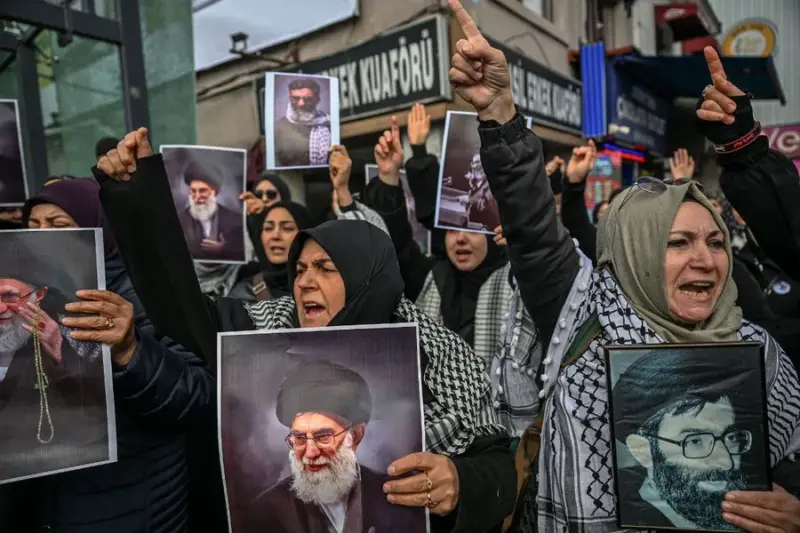

The killing of Iran's Supreme Leader Ayatollah Ali Khamenei is not a "development" in a live blog. It is a strategic event, the kind that reorders incentives far beyond the immediate battlefield.
That the United States and Israel chose to do it while Omani mediation was reporting significant progress in indirect nuclear talks is not just a diplomatic failure; it is a declaration that the era of bargains, inspections, and managed escalation has been deliberately set aside.
After the joint strikes began on February 28, 2026, hitting Iranian nuclear-linked sites, missile infrastructure, air defences, and leadership targets across multiple cities, under US 'Operation Epic Fury' and Israel's 'Roaring Lion', Iran's state media confirmed earlier today that Khamenei had been killed. Anyone expecting the Islamic Republic to fold because its figurehead is gone is confusing states with cults.
Yes, Iran is built around clerical legitimacy. But it is also built around institutions with guns, budgets, patronage networks, and very long memories. Decapitation does not end a war when the body still has reflexes, and it very often makes those reflexes violent.
Let us start with the diplomatic context, because that is where the moral of this story sits, and it stares at the world like an accusation. Oman's foreign minister, Badr Albusaidi, had publicly described the Geneva channel as having made 'significant progress', with technical discussions slated for Vienna and the IAEA in the loop. CBS quoted Albusaidi saying a deal was "within our reach", including commitments that Iran would not hold material for a bomb, with stockpiles down blended and converted into irreversible fuel.
Whether all of this would have survived Israeli politics or American election-season theatrics is another question. But the point is simpler; diplomacy did not die of natural causes; it was simply shot down.
Now look at what that choice does to Iran's internal argument. When 9/11 happened, Iran condemned it and provided crucial logistical assistance to the US campaign against Al Qaeda and the Taliban. George W Bush's State of the Union address on January 29, 2002, grouped Iran along with North Korea and Iraq under the label 'Axis of Evil'.
While North Korea went on to make a nuclear bomb, Iran chose to use ambiguity as leverage, diplomacy as cover, and a religious prohibition as reassurance. That fatwa, whatever its theological status, functioned as a political signal that Iran is not North Korea. And what did the world do with that signal other than teach Iran the exact opposite lesson it intended to teach? The JCPOA was not perfect, but it was a functioning instrument. Donald Trump tore it up in 2018. The message again was far from subtle: compliance is not protection, and restraint is not deterrence.
And now, with Khamenei killed in a coordinated US-Israeli assault, the lesson is being engraved into the Iranian state's bloodstream with explosives. In the international system as it exists, nuclear weapons are the ultimate insurance policy, and not a moral good or a sign of civilisation. It is a brutal, ugly fact of power. The bomb does not make you righteous, but it does make you costly to attack.
Iran is being bombed not because it built the bomb, but because it did not. And that is the sentence that will be repeated in Tehran, Qom, and in every secure IRGC compound from now on.
The early military exchanges since February 28 already hint at where this is headed. Iran retaliated by missiles and drones against Israel and against Gulf states hosting US assets, while oil markets brace for disruption. Iran has reportedly vowed long-term retaliation, and there is international alarm over an expanding conflict.
At the UN, Antonio Guterres called the bombing and retaliation a grave threat to international peace and security, and urged dialogue. Now the strategic anatomy. Iran is not a militia enclave. It is a large, militarily capable state with layered deterrence of ballistic missiles, drones, asymmetric naval warfare, regional partners, and an ability to escalate across multiple theatres.
This is exactly why any idea that you can "solve" Iran from the air is so seductive to politicians and so dangerous to everyone else. Airstrikes can crater runways, destroy radars, flatten above-ground facilities, and kill commanders. They can also generate what Tehran needs the most, a public story of survival through resistance and a private consensus that the nuclear threshold must be crossed quietly and quickly.
On damage and survivability, the open-source picture is already mixed, and that uncertainty itself is quite destabilising. CSIS's early assessment of 'Operation Epic Fury' emphasises that strikes may degrade, but not necessarily eliminate, Iran's nuclear capability, especially if stockpiles and key assets have been dispersed or concealed.
Separate reporting based on satellite imagery points to Iran's efforts to harden, repair, and fortify sensitive sites under threat. If Iran believes its leadership is now fair game and its diplomacy is now irrelevant, it will lean harder on the tools that can impose costs fast. That means three likely vectors, and none of them look tidy.
First, sustained pressure on US regional basing. Even if interceptions are high, repeated salvos create operational fatigue, political pressure, and the risk of a single catastrophic hit. Iran does not need to sink a carrier to change American politics. It only needs a handful of body bags and one burning base on a viral loop.
Second, escalation management through the Strait of Hormuz. This is not just about "closing" it in a theatrical sense. It's about mining threats, harassment, seizures, and insurance panic. Markets move on fear long before barrels stop moving. And that shock will not stay confined to West Asia but will affect every country's inflation figures, fuel prices, and election campaigns.
ALSO READ | These American bases in the Gulf are being targeted by Iran
Third, the proxy and partner network. Everyone talks about proxies as if they are obedient puppets. They are a portfolio; some assets you activate, some you hold back, some you allow plausible deniability. The more the centred the threat, the more attractive it becomes to ignite the periphery. Against this, Washington and Tel Aviv appear to be hinting at regime change, with Trump framing the operation in maximalist terms.
And that is precisely where the gamble becomes almost grotesque. Because regime change is not a strike package. It is a political project conducted under fire, against a state with coercive capacity, and in a region wired with sectarian, economic, and strategic tripwires. If you break Iran's centre, you don't get a neat liberal democracy as a "logical next step". You get a scramble of IRGC consolidation, clerical infighting, and opportunistic violence. You might also get something even worse: a successor regime that is less inhibited than Khamenei, precisely because it watched him die.
A note on the irony critics will not let Israel escape; its own nuclear arsenal remains outside the inspection regime, while pre-emption is justified as non-proliferation! That contrast will harden resentment across the region and complicate any coalition politics the US thinks it can build.
So, where does this leave the war? In the short term, escalation is the default. Tit-for-tat is not a failure of imagination here; it is the core mechanism of deterrence signalling. Each side has to show it can absorb pain and still strike. That loop continues until one side miscalculates or one side decides the economic costs are becoming politically suicidal.
Medium-term, Iran's likely outcome is not collapse but continuity; "Khamenei-ism without Khamenei," a harder, securitised state, with legitimacy manufactured through mourning and revenge, and dissent managed as treason in wartime. The international system will then have to confront a truly poisonous question; did killing the Supreme Leader make a bomb more likely? If the answer is yes, then the damage is not confined to Iran. The contagion will spread. Every mid-sized power watching will take notes. And for Donald Trump, as someone who marketed himself as the antidote to "forever wars", domestic politics would become the punchline and the warning for having chosen the most combustible target in the region at the exact moment a mediated off-ramp was being described as "within reach".
ALSO READ | Why was Oman spared - until now? Iran drone strike on Duqm Port explained
If this triggers an oil shock and a global slowdown, it won't be defused by bluster, or by the kind of hare-brained television quackery the world has already had to endure once. The bleakest part is that the world is about to relearn a lesson it already knows but refuses to admit; in this order, sermons are not shields and agreements are not armour. Deterrence is what survives.
And Iran, having watched its Supreme Leader die while diplomacy was still on the table, may very well decide that the only "deal within reach" is the one you can't rip up with a signature: a bomb you never announce, and never have to use.
(The author is a National Award winner for Best Narration and an independent political analyst. Views expressed are personal.)