

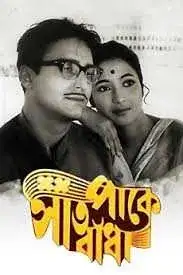
What can be so charismatic about a Black & White Bengali mainstream film Saat Paake Bandha (The Marriage Vows) made in 1963 that it remains archived in the history of Bengali cinema and also among the audience who may remember the film?
Not just that. It has inspired regional filmmakers in the South and also in Bollywood to make remakes over the years.
It is not just because it featured Suchitra Sen not with Uttam Kumar opposite her but with Soumitra Chatterjee. It remains one film in which her outstanding performance vested her with the Best Actress Award at the Moscow International Film Festival almost 60 years ago. No Indian actress has won this award before or after. But it remains archived also because its subject proved so attractive for the mainstream audience that it was made in other Indian languages like Tamil, Telugu, Malayalam and Hindi. Though it had a sad ending, it proved to be a commercial success in Bengal, directed by one of the most outstanding directors of the time, Ajoy Kar. It is perhaps one of the first films featuring the dissolution of a love marriage solely due to the needless interference of the girl's mother and the cowardice, escapism and arrogance of the husband. It is the beautiful, modern, educated wife who becomes the tragic victim of her own story. The original story was authored by a distinguished Bengali literatteur of the time - Asutosh Mukhopadhyay.
A resurrected print of the original film will be screened in Moscow at its Film Festival this year as a tribute to the original film. The Telugu remake, namely Vivaha Bandham was released the very next year starring none other than N.T. Rama Rao and Bhanumathi Ramakrishna in the lead. It was produced and directed by P.S. Ramakrishna Rao of Bharani Pictures. There were five songs in the film and Bhanumathi, known for her talents in music, assisted the music director and also lent her voice to four solos and one duet. The film turned out to be a big hit. This film was a remake of the Bengali original. Though N.T. Rama Rao received unstinted praise for his portrayal of the escapist and arrogant husband, that credit also goes to Bhanumathi known to help her heroes to achieve the best. So, she too, was just too good. The film was a thumping hit at the box office.
In 1976, Lalitha, a film in Tamil, written and directed by Valampuri Somanathan had a theatrical release. Though Sujatha played the title role of Lalitha, the other actors were none other than Gemini Ganesan, Kamal Haasan and Sumithra. Though the main story was inspired by the Bengali film, unlike Saat Paake Badha, Lalitha ended happily ever after for the estranged couple who renunite in the end. This was a super hit too and the masses loved the film with wonderful music by Ilaiyaraaja.
In 1981 came the Malayalam remake of the film titled Archana Teacher - The Malayalam version starred Venu Nagavally and Lakshmi. The film was produced by Madhu and written and directed by P.N. Menon, the film featured Madhu, Seema, Venu Nagavally and Ambika in the lead roles. The film featured a musical score by Shyam.
The Hindi remake Kora Kagaz, came in 1974 with Jaya Bhaduri and Vijay Anand portrayed the young couple directed by Anil Ganguly. It was rich with its wonderful musical score, low-key treatment but lost out on the weak performance of Vijay Anand as the husband.
Saat Pake Bandha was adapted from a novel by Asutosh Mukherjee. The script, the elaborate screenplay and the dialogue was penned by Nripendra Krishna Chatterjee who was a noted writer and was also known for his great screenplays. He was responsible for having authored the screenplays of several hit films starring Uttam Kumar and Suchitra Sen. Some noted names are - Shap Mochan (1955), Ekti Raat (1956), Harano Sur (1957), Indrani (1958), Chaoa Paoa (1959) and Uttar Phalguni (1963) which released after he passed away.
Saat Paake Bandha is a rare film of its time where most films ended on a happily-ever-after note and leaving a film with an open and sad climax was a big box office risk. Another unique feature of the film is that the entire story unfolds from Archana's perspective - the perspective of a woman. She is the storyteller, the voice-over, the anchor and the central character.
In real life, the institution of marriage has undergone a metamorphosis. The pressures are not totally new but they were comparatively invisible till recent times. The education of women, industrialisation, urbanisation and widespread dissemination of information about the evils of patriarchy and injustices towards women, has resulted in lesser tolerance among wives. After marriage, women are caught in a web of contradictions and ambiguities. They are expected to distance themselves from their natal kin at marriage, for ritual reasons and for reasons connected with the power to be wielded over them by their husbands. Yet, they are discouraged, by those same considerations of power and authority, from forging intimate bonds with their husbands. Thus, they often come to feel that they are "one's own" to no one at all.i
Sometimes, films have handled the theme of schisms in marriage with aesthetic sensitivity, technical finesse and, most importantly, strong social relevance. The aesthetics has sometimes been compromised for the sake of the social statement. Sometimes, the aesthetic stress may have tended to overshadow the social statement. But the fact remains that the portrayal of a problematic marriage offers greater scope to a filmmaker to play with the form, the content, the technique and the aesthetics of the film, not to talk of the background score, the histrionic credits, etc. Sometimes, a popular film on divorce or separation may have fallen flat on its face because the script shied away to carry the marital argument further after a particular point. Sometimes, the director may have been too immature to handle a subject like marital discord and could not carry it through. Often, the script turned out to be too weak to hold the cinematic narrative through. Then, there have been instances of gross miscasting.
Mainstream cinema's exploration of changes, subtle and visible, in the institution of marriage, has been more lip-service than a genuine movement to make a political statement on the man-woman relationship sanctioned by religion, or law, or both. A closer, insightful look at Saat Paake Bandha throws up the irony of the title that demonstrates that never mind if the marriage is an arrangement between families on either side or where the partners have made the decision to marry, many Indian marriages are still ruined due to men and women's minds still functioning under patriarchy.
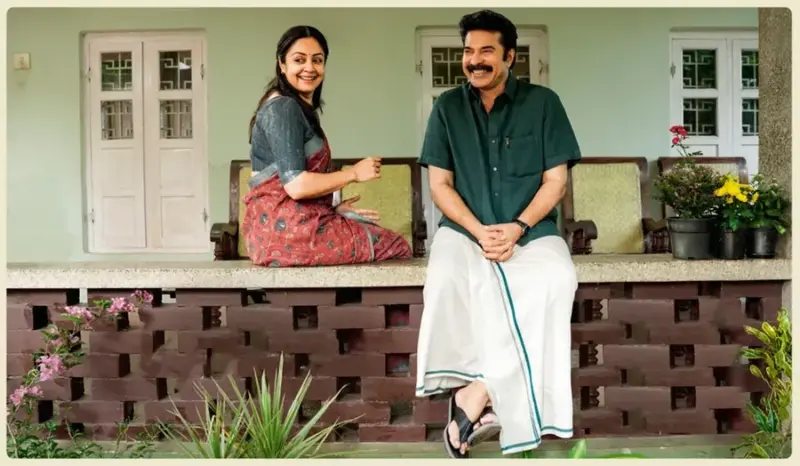
This brings us to one very unusual and contemporary Malayalam film called Kathal - The Core (1923) a very unusual and bold Malayalam film which unfolds as a courtroom drama. It portrays co-starring Jyothika as Mathew Devassy (Mamooty)'s wife, Omana. This film unspools the story of a wife who files for a divorce from her husband 20 years into their marriage when her husband has retired as a bank manager and aspires to run for the forthcoming elections.
Her complaint against him is that though he has been very dutiful as son, father and husband, he has not bothered about the conjugality of their married life because he is gay and had a secret male partner during their married life. They have had sex only four times over 20 years and the husband denies the allegation till his old father steps in and confesses that his son, indeed was gay and it is his fault to get him married to Omana. Omana says that she wanted a divorce to rescue them both from this meaningless family life; they both shed tears. The next day, as they sign the divorce papers, Mathew comes out as a gay man and proceeds to campaign for the elections. This is one of the most radically unusual films to come out of Malayalam cinema. Note that it was directed by Jeo Baby, written by Adarsh Sukumaran and Paulson Skaria and produced by Mammootty - all men.
These are contemporary films modern husbands and wives who might have or might not have married out of love. There is no dowry issue. There is no physical or sexual assault. There are no demanding and cruel in-laws to deal with. There is no direct attack to her person in any way. There is no alcoholic or womanising husband who tortures her. The violence is silent, invisible and therefore, is very strong. She is not out to make a career. She is content in mundane household chores like any middle-class housewife - handing the handkerchief to her husband before he steps out, making him his morning cup of tea, laying out his clothes, sharing the chores with her aunt-in-law are things she is happy doing. Yet the marriage, like a large sheet of fragile glass, disintegrates into fragments so small that one can no longer pick them up and put them together.