
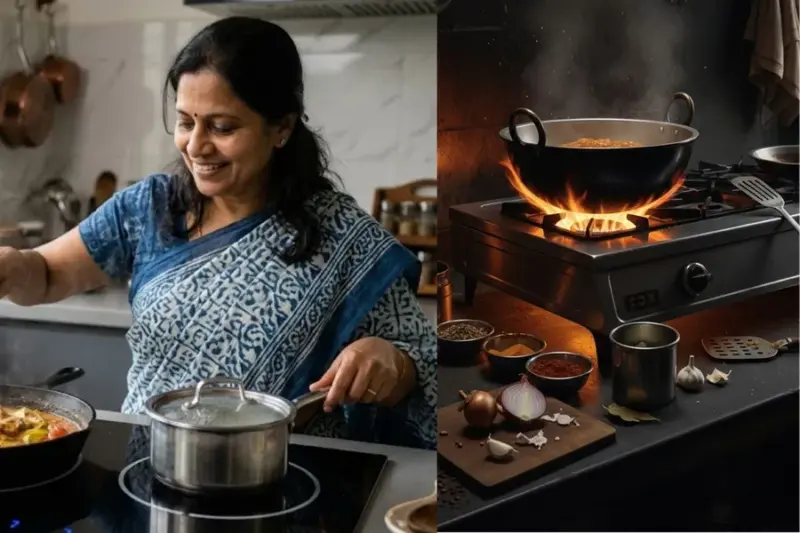

Rising LPG shortage and price volatility are forcing many urban households to rethink how they cook, with induction cooktops rapidly emerging as a serious challenger to traditional gas stoves in Indian kitchens.
Consumer surveys and industry data indicate a clear shift driven by concerns over efficiency, safety, and indoor air quality.
According to recent analyses by appliance manufacturers and energy experts, induction cooktops convert roughly 85 to 90 per cent of electrical energy into usable heat, while conventional gas stoves typically utilise only 40 to 50 per cent of the energy released from burning LPG. The rest is lost to the surrounding air, making gas-based cooking significantly less efficient. This efficiency gap is particularly relevant in dense urban areas, where households are sensitive to both monthly energy bills and rising ambient temperatures in small kitchens.
With LPG prices fluctuating in the wake of the war in the Middle East, the cost equation has begun to tilt in favour of induction, especially for smaller families and light to moderate cooking loads.
Speed and everyday cooking tasks
Comparative studies in the Indian context suggest that for everyday tasks such as boiling water, making tea, or preparing simple meals, induction cooktops can complete the job faster while consuming less overall energy value than their LPG counterparts.
Some analyses estimate that induction can boil a litre of water in noticeably less time than a standard gas burner, translating into meaningful savings over months of daily use.
Safety and accident risk
Safety remains one of the strongest arguments advanced in favour of induction technology. Unlike LPG stoves, which rely on an open flame and combustible gas, induction units heat only the base of compatible cookware through an electromagnetic field, leaving the surrounding surface relatively cool to the touch.
Most modern models also feature automatic shut-off functions if no vessel is detected or if a pot boils dry, reducing the risk of accidental fires. In contrast, LPG systems carry inherent dangers ranging from gas leaks and cylinder mishandling to kitchen fires and explosions, concerns that repeatedly surface in safety advisories and fire department reports.
Indoor air quality concerns
Another dimension gaining attention among health-conscious consumers is indoor air quality. Gas combustion releases carbon dioxide, water vapour, and trace pollutants into the kitchen, often in poorly ventilated spaces. Studies cited by appliance firms and energy consultancies note that prolonged use of gas stoves without adequate exhaust can worsen indoor air conditions, prompting experts to recommend chimneys or hoods as an essential companion to LPG-based setups.
Induction cooktops, by comparison, produce no direct combustion byproducts, limiting indoor emissions largely to fumes generated from the food itself.
Cleaning, maintenance and convenience
Ease of cleaning and maintenance has also emerged as a practical deciding factor for many households. Induction cooktops typically feature a single flat glass or ceramic surface, allowing users to wipe away spills and stains with minimal effort.
Traditional gas stoves, with their removable burners, trivets and crevices, tend to accumulate grease and food residue, requiring more time and effort to keep hygienic.
For working professionals and nuclear families with limited domestic help, this difference in upkeep can be a significant convenience.
Barriers to adoption
However, the transition to induction is not without challenges. One of the primary constraints is cookware compatibility: induction units require ferromagnetic vessels, meaning that not all existing aluminium or copper utensils will function unless they have an induction-friendly base.
For many middle-class households, replacing a full set of utensils can represent a substantial upfront cost. Additionally, induction cooktops depend entirely on a reliable electricity supply, making them less attractive in regions that still face frequent power cuts.
Rising interest in urban markets
Despite these limitations, manufacturers and retailers report steadily rising interest in induction models, particularly in metros and tier-1 cities. Marketing campaigns increasingly highlight not only the speed and precision of induction cooking - such as the ability to fine-tune heat instantly for tasks like tempering spices or simmering curries - but also the cooler kitchen environment they create by reducing ambient heat. For many apartment dwellers, the prospect of a kitchen that stays significantly cooler during peak summer is a compelling argument in favour of induction.
Energy transition and climate context
Industry observers note that the debate between LPG and induction is also playing out against the backdrop of broader energy and climate discussions. As India expands its renewable power capacity, the idea of shifting some household energy demand from fossil fuel-based LPG to grid electricity, potentially backed by solar and wind, has started to feature in policy and consumer conversations.
While LPG remains deeply entrenched, supported by a nationwide cylinder distribution network and long-standing cooking habits - experts suggest that induction adoption is likely to accelerate among younger, urban populations.
Hybrid kitchens point to the future
For now, kitchens across the country are experimenting with hybrid solutions, with many households using induction cooktops alongside LPG stoves rather than replacing them outright. This allows families to reserve gas for high-heat, large-volume cooking while relying on induction for quick, everyday tasks such as breakfast preparation, reheating, and beverages.
As costs continue to evolve and infrastructure improves, the humble cooktop is poised to remain at the centre of a larger shift in how Indian homes think about energy, safety, and comfort in the kitchen.