
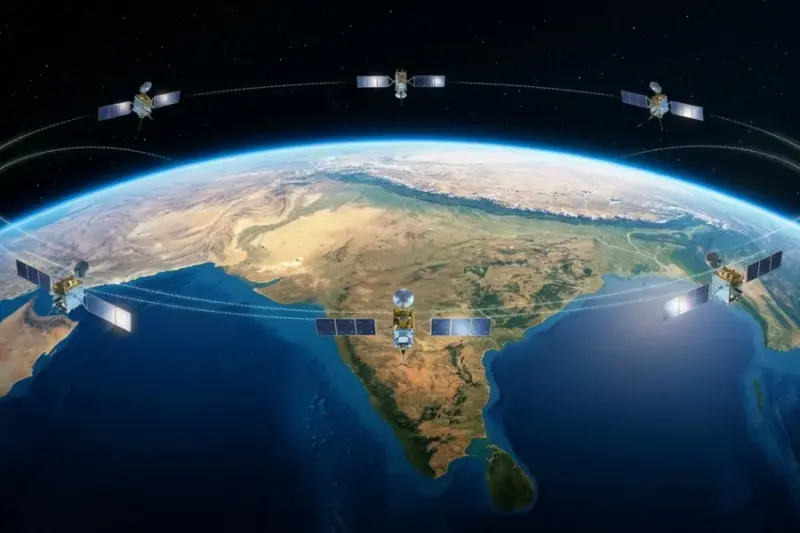

Bengaluru: India's domestic navigation system, NavIC, has officially ceased operations after the number of functional satellites in its constellation dropped below the critical threshold required for positioning services.
As of March 13, 2026, the network's active satellite count fell to three, one short of the minimum four-satellite requirement. The collapse of the system follows a turbulent history of technical setbacks, component failures, and recent launch complications.
Origins and Early Challenges
The impetus for NavIC, formerly known as the Indian Regional Navigation Satellite System (IRNSS), arose from the 1999 Indo-Pak war. After the United States restricted Indian military access to GPS data, New Delhi committed to developing an autonomous navigation capability.
The inaugural satellite, IRNSS-1A, launched in 2013, followed by eight additional first-generation units through 2018. The program faced an early hurdle when IRNSS-1H was lost due to a fairing separation failure on its PSLV-C39 launch vehicle.
The Clock Crisis
Precision navigation relies on highly accurate timekeeping. India's first-generation satellites utilised Rubidium atomic clocks imported from the Swiss firm SpectraTime. Beginning in 2016, these clocks, which also serviced the European Space Agency's Galileo system, began failing prematurely. The rapid loss of these components rendered five IRNSS satellites completely inoperable.
In response, the Indian Space Research Organisation (ISRO) developed a second generation of satellites featuring indigenously produced atomic clocks. The first of these, NVS-01, was successfully deployed in 2023.
A System on the Brink
By early 2024, the constellation was operating at its absolute limit with only four active satellites: IRNSS-1B, IRNSS-1F, IRNSS-1I, and NVS-01. The stability of the entire network hinged on IRNSS-1F, which was functioning on the last of its three atomic clocks.
Efforts to reinforce the network faltered in 2025 with the launch of NVS-02. Although the GSLV-F15 rocket reached its transfer orbit, a malfunction in a main thruster valve prevented the satellite from reaching its final geostationary position. ISRO investigators later determined the failure was caused by disconnected pins in every redundant connector on the valve.
The Final Failure
ISRO's attempts to launch a replacement, NVS-03, were further delayed by repeated failures of the PSLV rocket, which led to a three-month suspension of all launch activities.
The precarious balance finally tipped on March 13, 2026, when the final clock on IRNSS-1F failed. With the satellite unable to provide timing data, the constellation lost its functional capacity, leaving the nation without its independent navigation service.