
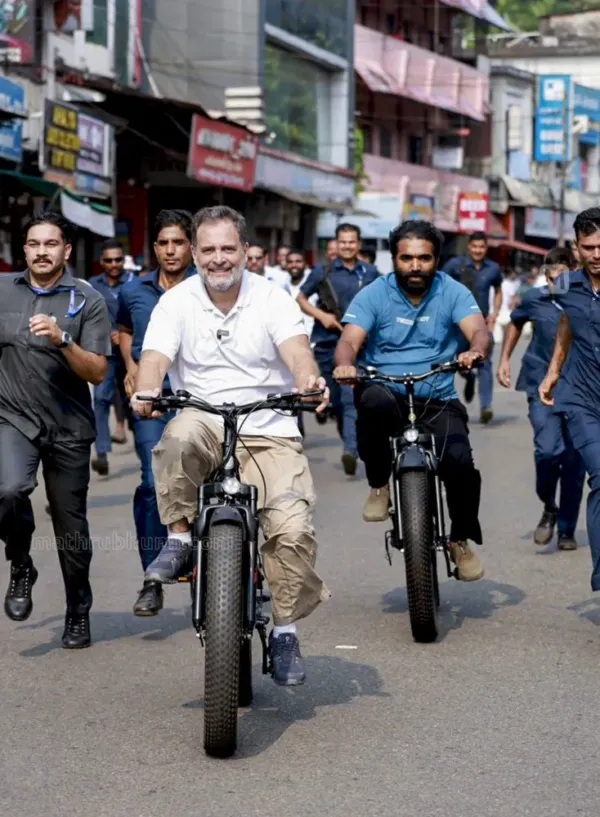

This appears to be among the rare instances in India's election campaigns where a candidate from a leading political party has chosen to do away with display-based campaign methods such as flex boards, wall paintings, posters and cut-outs, which continue to be among the most visible methods of election campaigning in the country.
Chandy Oommen, the Congress candidate from the Puthuppally constituency in Kottayam district of Kerala, has decided to face the Assembly elections scheduled to be held on April 9, 2026, without relying on flex boards, posters and cut-outs, and to conduct what he describes as a green campaign. Kerala's green election protocol permits the use of approved eco-friendly alternatives for campaign publicity. Chandy Oommen, however, appears to have gone a step further by reducing even those display-based campaign methods that could still have been used within that protocol. Chandy Oommen is the son of former Kerala Chief Minister Oommen Chandy, who represented the same constituency as its MLA from 1970 till his death in 2023.
This Legislative Assembly election in Kerala is crucial for both the ruling Left Democratic Front (LDF) led by the CPI(M) and the United Democratic Front (UDF) led by the Congress. The LDF has been in power for the last 10 years. And this election is an important opportunity for the UDF to return to power. In such a crucial election, doing away with some of the most visible campaign methods is a significant decision on the part of Chandy Oommen, and it calls for an analysis from the branding perspective to understand what may have prompted such a choice.
What makes this decision particularly noteworthy is that visual presence has traditionally been one of the most recognisable features of election campaigning in India. Posters, flex boards, banners, cut-outs, wall writings and public announcements have long served not only as campaign tools, but also as repeated visual reminders of the candidate in the minds of voters. In that sense, reducing or avoiding such methods in a crucial election is not merely an environmental or financial decision, but also a communication decision.
Election Campaign as a Communication Campaign
Election campaign is a clear example of a typical communications campaign. In an election campaign, one can see interventions through mass media, mid media and interpersonal communication methods. These are the three major media types in communications. A campaign will also have a social media strategy in place, along with media relations, public relations and advocacy. It also carries elements of social mobilisation, behaviour change communication and crisis communication. Moreover, the beauty of an election campaign lies in its specific timeline, which is a crucial element in any communications campaign.
Mass media interventions in a communications campaign include dissemination of messages through television, newspapers, radio and the internet. Mid media consists of methods such as posters, outbound voice calls, wall writings, banners, hoardings, wall paintings, mic announcements, cut-outs, folk programmes and group meetings. Interpersonal communication methods often refer to one-to-one communication, small group discussions, focused group meetings, house visits, leaflets, flipcharts and pocket charts. Chandy Oommen decided to avoid most of these mid media methods, which traditionally play a major role in creating repeated public visibility, visual recall, and reinforcement of the candidate during an election campaign.
Why Chandy Oommen Could Take This Risk?
What prompted Chandy Oommen to take such a decision? There are two probable reasons. The first is that he is confident about the brand value of "Oommen Chandy", his father and former Chief Minister of Kerala, who represented the same constituency as its MLA for decades, and whose name may still help him secure a comfortable win in this election. The second reason could be the increased penetration of internet-based platforms such as social media. Today, social media remains continuously active, and almost every campaign moment is quickly converted into digital content and circulated across platforms. This reduces, to an extent, the communication gap that conventional mid media methods were expected to fill, by ensuring repeated visibility, recall and reinforcement of the candidate's name and image in the minds of voters. Either way, Puthuppally also emerges as a case study for branding enthusiasts.
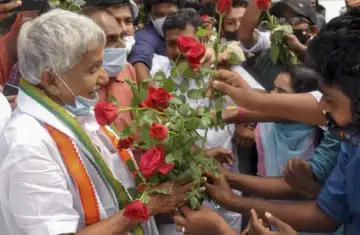
In an interview reported by a newspaper, Chandy Oommen said: "Since my dad (Oommen Chandy) worked so hard for the people, they are not able to forget him. When they refer to Puthuppally MLA, they refer to Oommen Chandy. I held a fest for four days, and twice or thrice the anchor of the fest called me Oommen Chandy. I was doing a campaign on cycle, and I met few children and even they called me Oommen Chandy. I was thinking how can a small kid remember him - he is not remembering me, he is remembering my father's name. So it is embedded in the mind of the people - his name, because of his work." His words show that the confidence to move away from these major mid media methods comes largely from the trust he has in the brand "Oommen Chandy".
The Brand Called Oommen Chandy
Oommen Chandy was not just a politician in Puthuppally. Over the years, he came to occupy a distinct place in the constituency's public memory through his constant presence, accessibility, credibility and his reputation for addressing people's problems. He represented Puthuppally without interruption from 1970 until his death in 2023, and that long association gave his name a meaning that went beyond electoral politics. His standing in the constituency was shaped less by overt publicity and more by sustained contact with people, attention to grievances, personal reach, and an emotional bond built over time. In branding terms, this gave the name "Oommen Chandy" considerable brand equity, with voters increasingly linking it to reassurance, familiarity, dependability and care. Over time, his identity and that of Puthuppally became closely linked, and this is what gives his son Chandy Oommen a significant advantage even today. The continued recall of Oommen Chandy's name across generations, and the ease with which people still emotionally connect the constituency with him, shows that his political clout in Puthuppally was not only electoral, but also psychological and symbolic. It is this inherited brand strength that appears to have given Chandy Oommen the confidence to reduce conventional visual campaign methods in a high-stakes election.
The impact
Removing flex, banners, cut-outs and hoardings has a direct impact on both the campaign budget and the environment. These materials involve substantial expenditure on design, printing, transport, installation and removal. At the same time, they generate large volumes of post-campaign waste, much of which is difficult to recycle or reuse.
The environmental burden is not merely assumed. In the context of Kerala's recent green election efforts, projections indicated that nearly 5,972 tonnes of non-biodegradable waste could be generated during an election season, including 2,150 tonnes of banners and hoardings and 980 tonnes of flags and festoons. Kerala has already recognised this challenge and brought in a green protocol framework to discourage plastic, PVC and other non-biodegradable campaign materials, while permitting approved recyclable and eco-friendly alternatives.
Flex materials in particular are largely plastic-based and non-biodegradable, and their disposal creates a serious waste-management burden for local bodies, which then have to deal with removal, segregation and post-poll processing. Once used, many of these materials have very limited reuse value, especially when they carry candidate-specific names, images and election messages. In that sense, reducing such materials is not only a campaign management decision, but also an environmentally significant one.
In a state like Kerala, where election management has already begun moving in a progressive direction through green protocol measures and eco-friendly campaign regulations, Chandy Oommen's decision acquires significance not only as a green gesture, but also as a strategic political communication choice enabled by the enduring brand value of Oommen Chandy in Puthuppally.
What Election Commission can do?
The Election Commission of India should undertake more studies on whether display-based campaign materials continue to be necessary in the same way as before, especially in an election environment where social media, internet-based platforms and digital circulation increasingly compensate for functions such as candidate visibility, recall and reinforcement. Such studies may be particularly useful in areas where internet access and smartphone penetration are reasonably adequate. Based on such evidence, the Commission can identify and notify categories of areas, such as urban, peri-urban and better-connected rural regions, where dependence on conventional display-based campaign methods can be meaningfully reduced without adversely affecting communication reach.
At the same time, the Commission should also examine the environmental burden created by the large-scale use of flex, banners, cut-outs, hoardings and similar materials during elections. Kerala's recent experience shows that this is not merely an environmental concern, but also an election-management issue. Learning from such examples, the Election Commission can promote greener campaign practices through clearer guidelines, stronger advisories, better enforcement, and policy measures that discourage environmentally damaging campaign materials while encouraging more sustainable alternatives and practices.
Chandy Oommen's campaign in Puthuppally is significant not merely because it adopts a greener approach, but because it suggests that, under certain conditions, a candidate may be able to reduce conventional display-based campaign methods without seriously weakening electoral communication. In this case, that possibility appears to rest substantially on the enduring brand value of Oommen Chandy in the constituency. What is being seen here is not simply a campaign style, but the political use of accumulated trust, recall, emotional association and constituency-level brand equity built over decades. In that sense, Puthuppally offers an important lesson for political communication: sustained public credibility, emotional recall and constituency-level brand equity can, at times, compensate for the reduced use of conventional visual campaign reinforcement. The case of Chandy Oommen shows that when such brand value has already been built over time, it can continue to shape campaign strategy even in a high-stakes election.
(The author is a New Delhi-based strategic communications and advocacy professional working in the development sector. He is also pursuing his PhD on social branding at IIT Delhi. He writes on communication strategy, social branding, behaviour change and public policy.)