
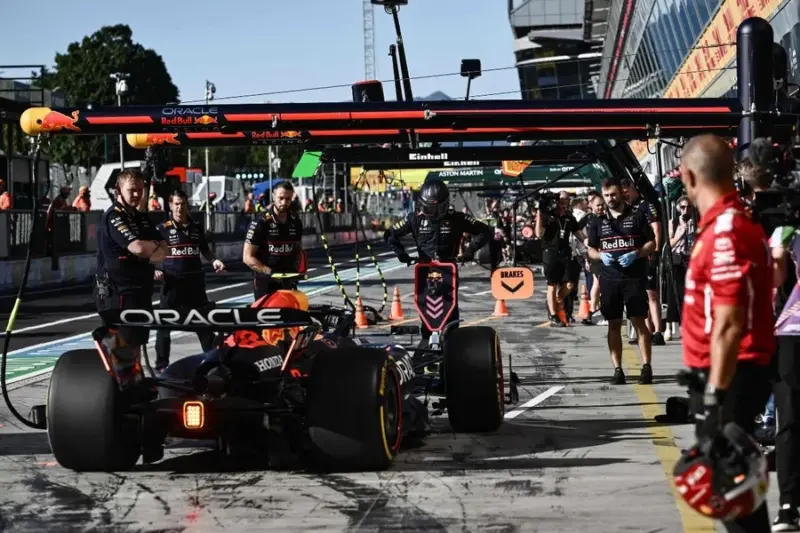

Monza: The Italian tax authority is intensifying its regulatory enforcement by attempting to retroactively collect taxes from Formula 1 drivers who have participated in Grands Prix within Italy over the last several years.
The Bologna-based publication Il Resto del Carlino reported recently that the local branch of the Guardia di Finanza, Italy's financial police, has initiated an investigation into both F1 organisations and their drivers. The probe focuses on whether income generated during Italian races was appropriately taxed, a move that legal experts suggest could create considerable complications for the sport's participants.
Italian tax statutes require foreign athletes competing in domestic sporting events to pay taxes on income earned on Italian soil. Historically, enforcement of this mandate has been irregular. However, Alessandro Mei, an Italian attorney identified by the newspaper, recently called for a comprehensive audit of tax compliance among foreign athletes.
F1 as the Primary Target
While the law technically applies to all foreign athletes, Formula 1 has emerged as the central target due to its immense public profile and the substantial salaries commanded by its drivers.
According to sources cited by RacingNews365, the Guardia di Finanza has recently broadened its scope to include all current and former F1 drivers, despite the fact that such payments had not been solicited from teams or athletes in the past. The tax authority has reportedly issued formal letters to drivers, instructing them to file tax returns for the 2025 fiscal year and to engage with authorities, either directly or via legal representation.
Furthermore, Italian officials reportedly intend to hold personnel accountable for unpaid taxes dating back several years, wherever such retroactive collection is legally permissible.
Deep Audits and Criminal Penalties
According to reports, the tax authority plans to conduct exhaustive audits. To precisely calculate earnings, investigators are reportedly seeking access to confidential driver agreements and lucrative sponsorship contracts.
For some athletes, the sudden shift in enforcement could result in severe penalties. Under Italian law, if unpaid tax obligations exceed €50,000 (approximately 55,02,700.00 INR), the matter is classified as a criminal offence. Individuals found in violation could face substantial fines in addition to the owed back taxes.
Regional Enforcement
In recent years, Formula 1 has held events at three Italian circuits:
- Monza: The traditional home of the Italian Grand Prix.
- Imola: Host of the Emilia-Romagna Grand Prix.
- Mugello: The site of the 2020 Tuscan Grand Prix.
The Court of Auditors has reportedly ordered investigations across all three provinces, triggering the current actions by the Guardia di Finanza. While the taxation of non-resident athletes was debated in the Italian parliament as recently as 2020, no significant enforcement followed at that time.
Italy's move mirrors similar tax structures used for non-resident athletes in nations such as Australia, the United Kingdom, and the United States.