




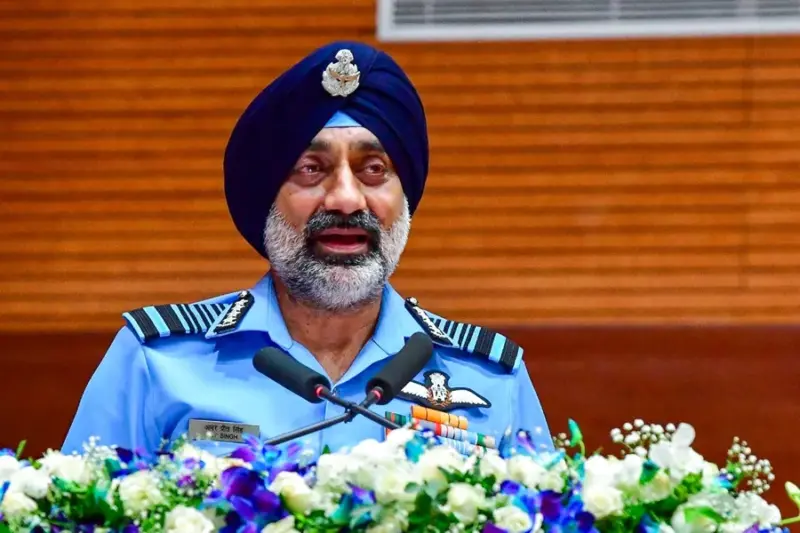

New Delhi: Air Chief Marshal A.P. Singh on Friday characterised unmanned aerial systems (UAS) as a transformative force in modern warfare, stating that drones have evolved from mere "eyes in the sky" to lethal "claws in the sky."
Delivering the keynote address at a defence seminar focused on UAS and counter-UAS technologies, the Chief of the Air Staff emphasised that total domain awareness is vital for addressing contemporary aerial threats. He called for "total coordination" among India's three military services as they increasingly share the same operational airspace.
The Air Chief referenced a recent tragedy during the West Asia conflict to underscore the dangers of inadequate situational awareness. On March 1, three U.S. F-15E Strike Eagles were lost over Kuwait in what U.S. Central Command described as a friendly fire incident.
"We have seen what happens... if you don't have domain awareness, you don't know where your people are and where others are. We've seen what happened to F-15s in Kuwait. The fratricide part. So we cannot afford to have things like that," the IAF chief said.
The Reality of Modern Warfare
The seminar, co-hosted by the Centre for Aerospace Power & Strategic Studies (CAPSS) and the Indian Military Review (IMR), highlighted that autonomous systems are a current tactical reality rather than a future concept. Singh noted that the battlefield has transitioned from concentrated air power toward decentralised and autonomous operations.
He asserted that all traditional principles of air power apply to UAS, which he described as an "extension of air power."
"They are no more eyes in the sky. They are like claws in the sky now. This, we've seen it in the recent conflicts that have taken place. And we also realised during Operation Sindoor, and this part cannot be forgotten," he added.
Addressing the defence against such systems, Singh described the struggle as a perpetual "cat and mouse game" where defensive technology must evolve at the same pace as offensive capabilities to prevent any side from achieving a total advantage.
Lessons from Operation Sindoor
The Air Chief highlighted the IAF's pivotal role during Operation Sindoor, the major military action conducted in May of last year. The operation was launched on May 7 in retaliation for a terror attack in Pahalgam, involving precision strikes on terror infrastructure in Pakistan and Pakistan-Occupied-Kashmir (PoK).
The ensuing 88-hour conflict saw India effectively neutralise waves of adversary drone swarms. Singh credited this success to the Integrated Air Command and Control System (IACCS), which functioned as the nerve centre for the defence.
"I think we've done reasonably well in Op Sindoor. And why that happened, because there was coordination," he said. "None of their UAS systems landed upon target, is because we were operating in a manner that is the way to go."
Addressing Cost Asymmetry
A significant portion of the address focused on the "cost asymmetry" of drone warfare-the practice of using expensive missiles to intercept inexpensive drones. While Singh agreed that India needs to scale up low-cost counter-UAS options, he argued that the true cost is measured by the value of the target being protected.
"The cost is not of the weapon system that is coming to hit. It is the cost of the system that it is going to hit. What is the target. And sometimes the target may be such that there is no thinking about cost that time," Singh explained.
The Future of Flight
Looking ahead, the Air Chief predicted that the next decade of warfare will be defined by "manned and unmanned teaming." He dismissed the idea that human pilots would be entirely removed from the loop in the near future, pointing out that global design houses continue to invest heavily in sixth-generation manned fighter programs.
He concluded by noting that the "battlefield survivability" of unmanned systems remains a primary concern for military planners. "We need to think about that part, how to make our UAS system survive in battle," he said.
With inputs from PTI