
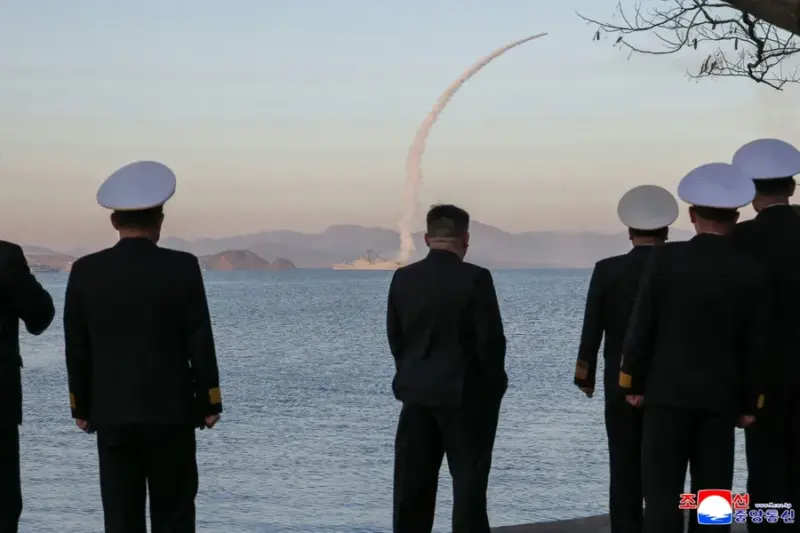

Seoul: North Korea launched multiple short-range ballistic missiles into the East Sea on Sunday, according to South Korean military officials, marking the latest escalation in a month defined by rapid-fire weapons testing.
The early morning launches occurred near the Sinpo area around 6:10 a.m. (2:40 AM IST on Sunday). South Korea's Joint Chiefs of Staff reported that the projectiles travelled approximately 140 kilometres (87 miles) before falling into the sea. Intelligence authorities from both Seoul and Washington are currently conducting a detailed technical analysis of the missiles' specifications.
Regional Defense and Response
In response to the provocation, South Korea's presidential office convened an emergency security meeting. The military emphasised that it is maintaining a "firm combined defence posture" with the United States to "respond overwhelmingly to any provocation." There are currently 28,000 U.S. troops stationed in South Korea to deter northern aggression.
Japanese Prime Minister Sanae Takaichi also confirmed the development, noting that the missiles appeared to have landed outside Japan's Exclusive Economic Zone (EEZ).
"The Hiyoshi Cabinet regards crisis management as the essence of national governance," Takaichi stated on social media, adding that her administration has instructed all relevant ministries to prioritise the safety of maritime and aerial traffic.
Heightened Diplomatic Standoff
Analysts suggest the timing of the tests is a calculated rejection of Seoul's recent diplomatic overtures. In January, South Korea expressed regret over civilian drone incursions into North Korea, a move initially labelled as "wise behaviour" by Kim Yo Jong, the influential sister of leader Kim Jong Un.
However, the tone has since soured. This month, senior North Korean officials revived the label of South Korea as the "enemy state most hostile," signalling a return to hardline rhetoric. International observers noted that this is North Korea's seventh ballistic missile launch of the year and the fourth in April alone.
Naval Modernisation and Russian Ties
The Sunday launches follow recent naval tests overseen by Kim Jong Un involving strategic cruise missiles fired from the Choe Hyon, one of two new 5,000-ton destroyers launched last year. Satellite imagery has indicated that Pyongyang is accelerating the construction of two additional destroyers of the same class at the Nampo shipyard.
South Korean lawmaker Yoo Yong-won recently suggested that this rapid naval expansion is being supported by military assistance from Russia. In exchange for North Korean ground troops and artillery shells used in the invasion of Ukraine, Moscow is believed to be providing advanced military technology to Pyongyang.
International Concern
The launches constitute a direct violation of United Nations Security Council resolutions. Nevertheless, Pyongyang has consistently defended its actions as a "sovereign right to self-defence."
The escalation comes as IAEA chief Rafael Grossi warned of "very serious" progress in North Korean nuclear capabilities, including the potential addition of a new uranium enrichment facility. The regional friction occurs just weeks before a high-profile summit in mid-May between U.S. President Donald Trump and Chinese President Xi Jinping, where North Korea's nuclear program is expected to be a primary agenda item.