




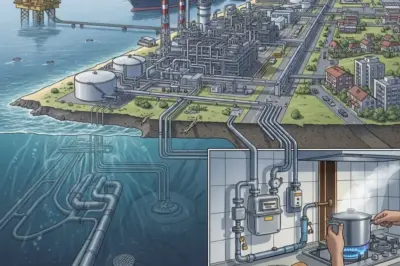

Piped Natural Gas, commonly called PNG, is mainly natural gas made up of methane. It is supplied directly to homes through underground pipelines.
This gas is extracted from natural reserves and is often brought into India as liquefied natural gas, known as LNG, before being converted back into gas and distributed.
Liquefied Petroleum Gas, or LPG, is quite different. It is produced in oil refineries during the processing of crude oil. LPG is a mix of propane and butane gases and is stored as a liquid under pressure inside cylinders.
One key difference lies in how they are delivered. PNG is supplied continuously through pipelines at a controlled low pressure, so households do not need to worry about refilling. LPG, on the other hand, depends on cylinder deliveries, which must be replaced once empty.
Where does PNG in India come from?
India sources PNG from both domestic production and imports.
Within the country, major gas reserves are located in regions such as the Krishna-Godavari basin, Assam, and Tripura. Among these, the deepwater Krishna-Godavari basin off the eastern coast is the largest contributor.
Three major fields in this basin, known as the R Cluster, Satellites Cluster, and MJ fields, produced nearly 25 percent of India's total gas output of 36 billion cubic metres in 2024. Over their full lifespan, these fields are expected to produce a combined 85 billion cubic metres of gas.
Onshore production also plays an important role. Gas fields in Assam and Tripura together account for about 47 percent of India's onshore production and contribute around 13 percent to the country's total gas supply.
In addition to domestic production, India imports LNG from several countries. While Qatar remains a major supplier, other nations such as the United States and Australia also export LNG to India.
How widespread are PNG and LPG connections in India?
At present, India has around 16.2 million domestic PNG connections. In contrast, LPG usage is far more widespread, with over 332 million consumers across the country.
The number of LPG users has grown significantly from 140 million in 2014. This includes about 105.6 million households that received subsidised connections under the Pradhan Mantri Ujjwala Yojana, aimed at supporting low income families.
Why is PNG less affected than LPG during global crises?
The government has been encouraging people to move from LPG to PNG, especially during the ongoing Middle East tensions linked to the conflict involving Iran, the United States, and Israel. A major concern is the Strait of Hormuz, a crucial waterway through which about one fifth of the world's fuel supplies pass.
LPG is heavily dependent on imports, particularly from the Middle East. Around 60 per cent of India's LPG consumption is imported, and nearly 90 per cent of these imports pass through the Strait of Hormuz. Recent incidents involving drones and missile attacks on tankers have disrupted movement in this region, leading to delays, shortages, and long waiting periods for LPG cylinders.
PNG, however, operates differently. It is distributed through a fixed network of pipelines and draws from both domestic production and imported LNG. Because it is part of a continuous supply system, it does not rely on individual deliveries like LPG cylinders. Even if global supply becomes tight, the effect on households is less immediate. In such situations, adjustments are often made at the industrial level rather than cutting off supply to homes.
That said, PNG is not entirely immune. Since a portion of natural gas is still imported, it can face slower and more gradual pressures during global disruptions.
How much of India's natural gas is imported?
India relies significantly on imports to meet its gas needs. Around half of the country's natural gas demand is fulfilled through imported LNG.
According to data from the Petroleum Planning and Analysis Cell, India imported roughly 25.5 million metric tonnes of LNG in 2025. This figure is expected to increase to around 28 to 29 million tonnes annually in the coming years.
Although Qatar contributed about 41 per cent of India's LNG imports in the financial year 2025, the United States accounted for 19 per cent, showing that India sources gas from multiple regions.
What steps has the government taken regarding PNG?
In response to rising pressure on LPG supplies, the government of India has issued a directive asking households in areas where PNG connections are available to switch from LPG within three months of receiving notice.
If households do not make the switch, LPG refill supplies may be discontinued. This move is intended to strengthen energy security, as PNG relies more on domestic production compared to LPG.
Sujata Sharma, Joint Secretary in the Ministry of Petroleum, explained that India produces about 50 per cent of the gas used in PNG domestically. She noted that the country's dependence on LPG imports is much higher, making the shift to PNG important in the national interest.
However, there is an exception. If it is technically not possible to provide a PNG connection to a household, the LPG distributor can issue a no objection certificate. In such cases, LPG supply will continue.
Why is understanding PNG important now?
With global energy routes under strain and rising geopolitical tensions, the way fuel reaches households has become more important than ever. PNG offers a more stable and continuous supply system, supported by both domestic production and diversified imports.
As India continues to balance energy security with rising demand, understanding where PNG comes from and how it differs from LPG helps explain why the government is encouraging this shift.